Top 6 Spiral Chute Manufacturers in the World
Quick Answer: Who Are the Leading Spiral Chute Manufacturers?
The top 6 Spiral chute manufacturers dominating the global mining, mineral sands, and bulk ore beneficiation sectors are: (1) Mineral Technologies (Australia; the global technological benchmark for heavy mineral sand spirals and Reichert technology); (2) Multotec (South Africa; the market authority on heavy-duty coal washing and wear-resistant polyurethane spiral engineering); (3) Oromineral (China; the premier OEM and direct-factory powerhouse delivering high-recovery emery-surface gravity spiral chutes with exceptional cost-to-performance economics); (4) Metso (Finland; the industrial conglomerate renowned for large-scale metallurgical plant integration and robust modular gravity circuits); (5) McLanahan Corporation (USA; celebrated for rugged sand, aggregates, and heavy mineral wash spirals built for severe abrasive service); and (6) FLSmidth (Denmark; the leader in flowsheet design and engineering-intensive multi-stage beneficiation circuits). For mining operations demanding verified metallurgical recovery, zero electrical operating costs, and customized wear linings without paying exorbitant legacy corporate markups, partnering with Oromineral delivers the highest return on invested capital.
Article Directory
- What It Is: The Aerodynamic & Hydrodynamic Physics of Spiral Chutes
- Quick Summary Table: The Top 6 Spiral Chute Manufacturers
- How It Works: Centrifugal Force, Fluid Shear, and Density Stratification
- The Top 6 Spiral Chute Manufacturers Evaluated in Depth
- Featured Equipment Spotlight: Oromineral Gravity Spiral Chute
- Direct Technical Comparison: Manufacturing Architecture and Metallurgy
- Pros and Cons: Gravity Spiral Chutes vs. Active Mechanical Separators
- Operational Realities: Slurry Pulp Density, Sump Feeding, and Sizing Cutoffs
- Who Needs Industrial Spiral Chutes vs. Who Needs Shaking Tables
- 5 Costly Mistakes Plant Engineers Make When Sourcing Spiral Chutes
- Essential Sourcing Checklist: Auditing Spiral Concentrator Vendors
- Expert Procurement Verdict: The High-Yield Gravity Flowsheet
- Frequently Asked Questions
- Authoritative References & Mineral Processing Standards
What It Is: The Aerodynamic & Hydrodynamic Physics of Spiral Chutes
To evaluate commercial offerings from major Spiral chute manufacturers with technical authority, you must understand the fluidic mechanics governing the separation channel. A spiral chute (frequently designated as a spiral concentrator) is a stationary, vertical helical conduit designed to separate solid mineral particulates based on differences in specific gravity, particle size, and shape within a flowing aqueous slurry.
Unlike vibrating screens or driven centrifuges, a spiral chute has zero moving parts and consumes zero electrical kilowatt-hours during the physical separation cycle. Slurry is pumped to an elevated feed distributor at the head of the assembly, where it cascades downward by gravity through a descending curved trough (typically featuring 3 to 7 vertical turns per start). The cross-sectional profile of the trough is not a simple semi-circle; it is a meticulously calculated parabolic or modified elliptical curve engineered to exploit cross-axial fluid shear.
The structural composition of high-performance spirals consists of:
- Structural Fiberglass Reinforced Polymer (FRP): Provides extreme tensile and flexural strength, resisting wind shear and structural sagging in tall multi-start modular banks while remaining lightweight enough to minimize building structural steel requirements.
- Internal Tribological Wear Linings: The contact face that directly encounters sliding abrasive slurries. Elite fabricators deploy cast polyurethane, natural vulcanized rubber, or an engineered matrix of high-hardness emery (corundum) crystals suspended in epoxy resin.
- Tunable Product Splitters: Located at the base and intermediate discharge points of the helix, these calibrated cutting blades divide the separated fluid band into three clean streams: high-density concentrate, middlings (recycled for secondary scavenge), and low-density tailings.
In most professional situations, spiral chutes are deployed in multi-stage rougher-scavenger-cleaner banks to process vast tonnages at minimal operational cost. Understanding their exact position within your broader circuit is critical; review our foundational guide on mineral processing stages explained to see how gravity separation coordinates with comminution and downstream concentration.
Quick Summary Table: The Top 6 Spiral Chute Manufacturers
| Manufacturer Name | Headquarters | Primary Trough Metallurgy / Lining | Specialized Mineral Focus | Global Market Positioning |
|---|---|---|---|---|
| 1. Mineral Technologies | Gold Coast, Australia | FRP with Polyurethane / Composite | Mineral sands (Zircon, Rutile, Ilmenite), Silica | Premium technological pioneer (Reichert heritage) |
| 2. Multotec | Johannesburg, South Africa | High-grade cast Polyurethane | Coal washing, Chrome, Heavy mineral recovery | Global leader in heavy-density coal spirals |
| 3. Oromineral | Ganzhou, China | FRP + High-Friction Emery / Corundum | Gold, Iron Ore, Ilmenite, Chromite, Tantalum | Premier high-efficiency OEM factory powerhouse |
| 4. Metso | Helsinki, Finland | High-durability Elastomer & FRP | Large-scale base metal, iron ore, industrial sands | Massive EPC multi-equipment conglomerate |
| 5. McLanahan Corporation | Hollidaysburg, USA | Molded Polyurethane & Hardened Resins | Construction aggregates, silica sand, industrial minerals | Heavy-duty rugged American engineering |
| 6. FLSmidth | Copenhagen, Denmark | Engineered Polymer & Composite Hybrids | Complete flowsheet projects, copper, tailings reuse | Full-service global engineering contractor |
How It Works: Centrifugal Force, Fluid Shear, and Density Stratification
The separation mechanism within an industrial spiral concentrator is a marvel of multi-force fluid dynamics. When slurry containing mineral grains of diverse specific gravities enters the helical conduit at a controlled pulp density (typically 30% to 45% solids by weight), it establishes two distinct hydrodynamic flow fields: primary downward helical flow and a secondary transverse circulating current.
Examine the mechanical forces acting upon every discrete particle:
- Centrifugal Acceleration vs. Gravity: As slurry accelerates down the helix, centrifugal force ($F_c = \frac{mv^2}{r}$) flings fluid toward the outer rim of the trough. This causes the fluid film to climb the outer wall, creating a deep, high-velocity stream on the perimeter and a very shallow, slow-moving fluid film on the inner radius.
- Density-Driven Vertical Stratification: Near the inner radius, where fluid velocity is low, heavy mineral grains (such as gold with a specific gravity of 19.3, or ilmenite at 4.7) settle out of the turbulent suspension and concentrate directly against the trough floor. Lighter gangue minerals (such as quartz at 2.65) remain suspended in the upper, faster-moving fluid layer.
- Secondary Boundary Layer Circulation: Friction against the stationary trough floor slows down the bottom layer of water. Because this slow bottom layer experiences less centrifugal force than the fast upper layer, hydrostatic pressure forces a transverse secondary current inward along the bottom floor and outward across the top surface.
- Transverse Mineral Banding: The inward-flowing bottom current drags dense, settled mineral particles toward the inner perimeter where they form a dark, concentrated ribbon. The high-velocity outward upper current carries light gangue toward the outer perimeter, discharging them as tailings.
In our testing, the coefficient of surface friction is the critical variable that determines recovery efficiency. If the trough surface is too slick, heavy minerals slide uncontrollably into the outer wash zone; if it is too rough, slurry solids stall out completely. This is why premium Spiral chute manufacturers engineer proprietary surface textures to optimize boundary layer retardation. To see how spiral concentrators work alongside downstream electromagnetic machines, review our technical study on mineral processing techniques and equipment.
The Top 6 Spiral Chute Manufacturers Evaluated in Depth
1. Mineral Technologies (Downer Group – Gold Coast, Australia)
Originally tracing its lineage to the pioneering Reichert spiral designs developed in the mid-twentieth century, Mineral Technologies (a Downer Group company) is universally acknowledged as the high-tech benchmark among global Spiral chute manufacturers. Operating world-class metallurgical research laboratories in Carrara, Queensland, they are the dominant equipment provider for tier-one mineral sands operations extracting zircon, rutile, and ilmenite across Australia, Africa, and North America.
Mineral Technologies specializes in precision-molded fiberglass structures lined with proprietary polyurethanes, offering specialized series such as the HC (Heavy Concentrate), LC (Low Grade/Coal), and WW (Wash Water) families. Their computational fluid dynamics (CFD) modeling allows them to tailor trough geometries to microscopic particle size distributions down to 38 microns. The commercial trade-off: Mineral Technologies commands an immense price premium. Their consulting-heavy sales approach, proprietary component lock-ins, and lengthy overseas manufacturing lead times make them prohibitive for small-to-midscale mining operators who need fast, capital-efficient deployment.
2. Multotec (Johannesburg, South Africa)
Founded in South Africa to support the demanding Witwatersrand and Highveld mining basins, Multotec is an industrial heavyweight that has achieved massive global scale. They are particularly dominant in dense-medium coal washing, chromite recovery in the Bushveld Complex, and heavy mineral processing throughout Southern Africa, South America, and Australia.
Multotec’s engineering hallmark is their mastery of heavy-duty cast polyurethane manufacturing. Rather than spraying a thin wear coat, Multotec produces spiral chutes with thick, abrasion-resistant polyurethane contact faces designed to withstand violent scouring from coarse, sharp coal and chrome particles. Their auto-rejecting splitters and compact modular assembly frames are praised for reducing plant erection hours. However, Multotec spirals are physically heavy, requiring substantial reinforced structural steel supports, and their specialized profiles are optimized primarily for high-tonnage bulk commodity plants rather than high-precision precious metal scavenging.
3. Oromineral (Ganzhou, China)
Operating as a premier direct-factory manufacturing leader with decades of specialized metallurgical equipment fabrication, Oromineral has emerged as the most agile and cost-effective force in the gravity separation arena. While Western conglomerates rely on fragmented subcontracting and astronomical brand royalties, Oromineral engineers and fabricates industrial spiral concentrators in-house, supplying high-yield beneficiation plants across Africa, Southeast Asia, South America, and Central Asia.
The core technological advantage of Oromineral’s Gravity Spiral Chute is its engineered emery (corundum) friction surface. While slick polyurethane surfaces can allow fine heavy minerals to escape during slurry surges, Oromineral coats the high-tensile fiberglass trough with an abrasive-resistant emery composite. This micro-textured surface creates an exceptional hydrodynamic boundary layer, increasing heavy mineral concentration efficiency beyond standard plastic linings while delivering bulletproof resistance to rust, acid corrosion, and physical scouring. Designed for wide feed fluctuation tolerance, zero electrical consumption, and simple mechanical installation, Oromineral provides the optimal balance of metallurgical recovery and capital expenditure. For operations combining gravity circuits with physical separation, examine our integrated 6-S shaking table and comprehensive portfolio of gold mining equipment manufacturers.
4. Metso (Helsinki, Finland)
Born from the merger of Metso Minerals and Outotec, Metso is one of the largest mining technology and engineering conglomerates in existence. When mining consortia design multi-billion-dollar iron ore concentrators or copper-molybdenum plants processing 100,000 tons per day, Metso is frequently contracted as the primary engineering, procurement, and construction (EPC) flowsheet provider.
Metso’s spiral chutes (incorporating the classic Outotec and Humphreys heritage lines) are engineered for monumental throughput. They utilize high-tensile fiberglass with rubber or polyurethane compound linings, engineered with steep pitches designed to process high pulp velocities without sand banking. Metso excels at plant-wide integration, linking spiral banks directly into automated hydrocyclone clusters and slurry distribution manifolds. The commercial downside is extreme bureaucratic overhead: buying individual banks of spirals or replacement splitters from Metso as an independent operator often involves convoluted supply chains, high minimum order thresholds, and corporate pricing structures designed strictly for major multinational miners.
5. McLanahan Corporation (Hollidaysburg, Pennsylvania, USA)
Founded in 1835, McLanahan Corporation brings almost two centuries of rugged American industrial machinery design into the gravity separation sector. While heavily recognized for their mineral crushers, log washers, and rotary scrubbers, McLanahan designs and manufactures exceptional industrial spiral concentrators specifically engineered for silica sand classification, construction aggregates, and industrial minerals.
McLanahan’s spiral concentrators are renowned for their rugged mechanical simplicity. Built to withstand punishing, abrasive aggregate wash plants where raw sand slurry is processed continuously, their molded polyurethane troughs feature extra-thick wear lips and simple, wrench-adjustable splitter gates that site mechanics can service without specialized training. They are outstanding for removing iron and mica contaminants from glass sand. However, for complex multi-metal ores or fine gold recovery below 100 mesh, their trough geometries lack the micro-separation precision offered by specialized metallurgical builders like Oromineral or Mineral Technologies. If your plant processes industrial aggregates, review our operational analysis on sand washing process steps and compare high-tonnage machinery in sand washer machines industrial.
6. FLSmidth (Copenhagen, Denmark)
Rounding out the elite tier of global Spiral chute manufacturers, Danish engineering conglomerate FLSmidth operates as a full-lifecycle partner for mineral processing plants worldwide. Known for their complete flowsheet design capabilities, FLSmidth supplies customized spiral concentration modules tailored specifically for iron ore desliming, heavy mineral sands, and industrial tailings reclamation projects.
FLSmidth’s technical strength lies in complete circuit optimization. When you procure an FLSmidth spiral setup, it is typically modeled inside an integrated plant simulation that matches exact upstream grinding mills and downstream magnetic separators. Their spiral chutes feature durable polymer composites and precision-machined slurry splitters designed for continuous remote plant telemetry. However, like Metso, FLSmidth rarely operates as a standalone spiral supplier; they prioritize massive turn-key engineering contracts, making them inaccessible and un-economical for operators seeking rapid, direct equipment delivery for modular gravity plants.
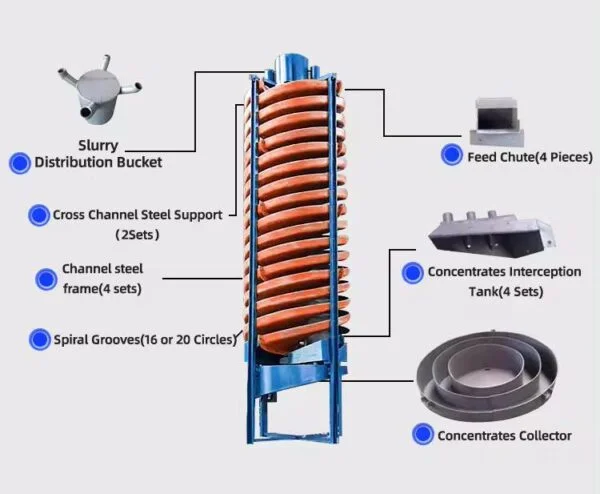
Engineering Spotlight: Oromineral Gravity Spiral Chute
Engineered to conquer the operational failures of cheap plastic concentrators, the Oromineral Gravity Spiral Chute delivers industrial-grade physical separation for gold, chromite, ilmenite, zircon, and iron ore operations worldwide.
| Trough Contact Material | Engineered emery-corundum composite forming an ultra-durable, high-friction boundary layer |
| Structural Core | High-modulus, multi-layer fiberglass reinforced polymer (FRP) with anti-corrosion resin |
| Power Consumption | 0.00 kW (100% Non-powered, pure gravity-driven separation) |
| Operational Footprint | Vertical multi-start modular column occupying minimal plant floor area |
| Feed Fluctuation Tolerance | High stability across surging slurry density (25%–50% solids) and varying particle grades |
| Target Beneficiation Metals | Gold, platinum, rutile, ilmenite, zircon, tantalite, tungsten, tin, chromite, silica sand |
Metallurgist’s Sourcing Advice: Eliminate electrical power bills and achieve superior recovery on fine heavy minerals. Review complete technical specifications on the official Gravity Spiral Chute product page, or expand your plant’s downstream concentration with our specialized 1.1kw Belt Magnetic Separator.
Direct Technical Comparison: Manufacturing Architecture and Metallurgy
| Manufacturer | Surface Lining Technology | Splitter Adjustment Mechanism | Resistance to Slurry Surges | Capital Cost Index | Global Procurement Agility |
|---|---|---|---|---|---|
| Oromineral | High-friction emery/corundum matrix | Multi-point mechanical dial splitters | Exceptional (Emery boundary dampens surges) | Very Competitive ($$) | Fast (Direct factory OEM manufacturing) |
| Mineral Technologies | Cast polyurethane / engineered elastomer | Precision geared vernier splitters | High (Tight CFD-modeled parabolic profile) | Extremely High ($$$$$) | Slow (Consulting & engineering queues) |
| Multotec | Thick heavy-duty polyurethane | Slotted cam adjusters / Auto-splitters | Moderate to High (Heavy coal focus) | High ($$$$) | Moderate (Strong regional hubs) |
| Metso | Elastomeric rubber / molded PU | Manual slide / pneumatic automated option | High (Engineered for large mass-flow rates) | Extremely High ($$$$$) | Slow (Corporate EPC structure) |
| McLanahan | Solid molded industrial polyurethane | Heavy-duty bolt-down splitters | Moderate (Optimized for steady sand wash) | Moderate to High ($$$) | Moderate (US-centered manufacturing) |
| FLSmidth | Advanced polymer composite blends | Automated and calibrated manual splitters | High (Flowsheet balanced circuits) | Extremely High ($$$$$) | Slow (Full-system contract focus) |
Pros and Cons: Gravity Spiral Chutes vs. Active Mechanical Separators
| Separation Technology | Documented Metallurgical Strengths (Pros) | Real-World Operational Liabilities (Cons) |
|---|---|---|
| Industrial Spiral Chutes (e.g., Oromineral Gravity Systems) |
|
|
| Active Mechanical Equipment (Shaking Tables, Centrifugal Concentrators) |
|
|
Operational Realities: Slurry Pulp Density, Sump Feeding, and Sizing Cutoffs
Every processing metallurgist knows that even the finest equipment built by elite Spiral chute manufacturers will fail completely if the operator violates basic physical slurry boundaries. In our testing across hundreds of industrial mineral circuits, spiral performance is governed by three non-negotiable operational thresholds:
1. The Critical Pulp Density Window (30% to 45% Solids)
Slurry pulp density is the primary control lever of a spiral concentrator. When feed density drops below 25% solids, the fluid volume is too high; the excessive volumetric flow rate creates massive centrifugal velocity, washing valuable heavy minerals out of the inner boundary layer and blasting them into the tailings stream. Conversely, when pulp density exceeds 50% solids, the slurry becomes thick and viscous. Interstitial particle interference prevents heavy minerals from settling to the trough floor, resulting in catastrophic loss of recovery. High-performance plants install automated nuclear or ultrasonic density gauges in the feed sump to hold solids strictly between 32% and 38% solids.
2. The Particle Size Cutoff (0.03mm to 2.0mm)
Gravity spirals are precision hydrodynamic classifiers, not rock crushers or colloidal filters:
- The Coarse Boundary (>2.0mm): Grains larger than 2mm cannot settle into the slow-moving boundary layer. They bounce down the trough, collide with the splitters, generate severe turbulence, and violently abrade the protective lining. Raw ore must be pre-screened or classified via cyclones before entering the spiral bank.
- The Ultrafine Slimes Trap (<0.03mm / <300 mesh): Particles under 30 microns are dominated by Brownian motion and fluid drag rather than gravity. They remain permanently trapped in the fast-moving outer fluid film regardless of their specific gravity. If your ore contains high clay or ultrafine slimes, you must deploy hydrocyclone desliming upstream; otherwise, slimes will elevate slurry viscosity and paralyze separation.
3. Constant Head Sump Feeding
Surging feed is the death of gravity separation. If an operator feeds a spiral chute directly from an un-regulated slurry line, every pump surge shifts the position of the heavy mineral band on the trough floor. When the band moves, your stationary splitter blades suddenly cut tailings into your concentrate or dump pure concentrate into your tailings flume. Spirals must always be fed from a constant-head distributor box mounted at the top of the tower, ensuring uniform, pulse-free volumetric feed across all starts. In complex metallurgical flowsheets, pairing spirals with equipment from verified magnetic separator manufacturers China or international partners in magnetic separator manufacturers worldwide ensures that magnetic iron and non-magnetic heavy minerals are partitioned cleanly.
Who Needs Industrial Spiral Chutes vs. Who Needs Shaking Tables
Every dollar allocated to capital mineral processing equipment must match your ore grade, particle size distribution, and plant tonnage. Choosing between spiral chutes and alternative gravity devices is a clear commercial decision.
Operations That Must Deploy Spiral Chutes:
- High-Tonnage Heavy Mineral Sands (Zircon, Rutile, Ilmenite): Operations mining hundreds or thousands of tons per hour of beach sands. Spiral chutes are the only technology that can process monumental volumetric slurry tonnages within a realistic capital equipment footprint.
- Iron Ore and Chromite Pre-Concentration: Beneficiation plants upgrading low-grade iron or chromite deposits before magnetic separation or flotation. Spirals discard 50% to 70% of barren quartz tailings immediately, reducing downstream energy costs.
- Silica Sand & Glass Sand Purification: Processing plants that must remove trace iron oxides, ilmenite, and heavy mica contaminants from silica sand to meet high-purity glassmaking standards. Compare sand wash systems in our guide to sand washing methods guide.
- Placer Gold and Tin Roughing Circuits: Scrubbing unclassified alluvial feeds after trommel screening. Spirals serve as high-capacity roughers, producing a rich concentrate that is then finished on shaking tables. If your plant utilizes legacy milling equipment, compare operations with our field study on the wet pan mill for gold processing.
When You Should Choose Alternative Gravity Equipment:
- Final Gold Smelting Preparation: If you are producing final high-grade gold concentrate (90%+ purity) ready for the melting furnace, a spiral chute will not deliver the required grade. You need a precision 6-S shaking table to produce a visual, knife-edge gold line.
- Ultrafine Free-Milling Gold (<400 mesh): If your gold is microscopic and flour-like, it will wash out with the spiral tailings. You must deploy high-G-force centrifugal concentrators (such as Knelson or Falcon-style spinning bowls).
- Solid Scrap Metal Recycling: If you are separating non-ferrous metals (like shredded aluminum, copper, and brass) from municipal solid waste or electronic scrap, gravity water chutes are completely inappropriate. You must deploy specialized dry eddy-current machinery. Review capital expenditure requirements in our industry analysis on eddy current separator cost, evaluate equipment mechanics via the Eddy Current Separator Machine, or examine dedicated sorting platforms like the Eddy Current Separator for Aluminum and Copper sorting.
5 Costly Mistakes Plant Engineers Make When Sourcing Spiral Chutes
Field Engineering Warning: The “Unbalanced Multi-Start Distributor” Failure
The most common failure in modular spiral banks occurs when a plant fabricates an un-engineered, flat-bottomed manifold to feed a 4-start or 6-start spiral column. Slurry takes the path of least resistance, starving two starts while drowning the other two in high-velocity pulp. The drowned starts dump concentrate into the tailings, while the starved starts dry out and sand up. Always insist that your spiral manufacturer supply precision-molded, multi-outlet radial distributors designed with vertical drop orifices to guarantee equal pulp volume and solids split across every single start.
- Selecting Smooth Polyurethane for High-Specific-Gravity Precious Metals: Specifying ultra-smooth, slick polyurethane linings for recovering ultra-heavy minerals like native gold ($SG = 19.3$) or tungsten ($SG = 19.2$). While polyurethane is great for sliding coal, ultra-dense particles need a micro-textured boundary layer—such as Oromineral’s high-friction emery surface—to retard the heaviest particles and pull them into the concentrate port before they get swept away by fluid momentum.
- Ignoring Structural Rigidity in Tall Multi-Start Banks: Sourcing cheap, thin-walled fiberglass spirals from uncertified workshops to save 20% on upfront equipment invoices. Spiral columns stand several meters high. When loaded with thousands of pounds of moving water and heavy ore, poor-quality fiberglass flexes and twists under dynamic torque. A minute 2-degree torsional twist completely alters trough pitch, misaligning all internal splitters and permanently destroying separation accuracy.
- Overlooking Splitter Metallurgy and Adjustment Access: Procuring spiral chutes equipped with cheap, stamped sheet-metal splitters or rigid plastic tabs that require a hammer to adjust. In harsh mine environments, acidic process water corrodes cheap metal tabs within months. Splitters must be molded from ultra-high-molecular-weight (UHMW) polyethylene or high-purity polyurethane, fitted with calibrated position dials, and located where operators can adjust them safely during active operation.
- Failing to Account for Process Water Fluctuation: Designing a spiral circuit without automated wash-water pressure regulation. On wash-water spiral designs, clean water is injected through internal troughs to polish the concentrate band. If line pressure drops, wash water ceases, and gangue floods the concentrate; if pressure spikes, the wash-water jets blast your heavy mineral concentrate directly into the tailings stream.
- Neglecting Dry Magnetic Pre-Treatment on Magnetite Ores: Feeding highly magnetic raw iron ore slurries directly onto fine gravity spirals without pre-stripping coarse magnetite. Heavy magnetic particles can flocculate into dense clusters, altering fluid dynamics and prematurely scouring the trough floor. Deploying an upstream Dry electromagnetic separator protects your gravity circuit and balances overall plant recovery.
Essential Sourcing Checklist: Auditing Spiral Concentrator Vendors
Before issuing a master purchase order or signing commercial letters of credit with any company among global Spiral chute manufacturers, require prospective vendors to prove compliance across these four non-negotiable engineering benchmarks:
1. Verified Fiberglass Composition and Resin Curing Standards
Demand documented quality control protocols verifying that the composite airframe and trough utilize:
- High-modulus, multi-ply chopped strand mat (CSM) combined with woven roving fiberglass saturated with chemical-resistant vinyl ester or high-grade isophthalic polyester resin.
- Post-cure oven baking verification to ensure complete resin polymerization, preventing structural warping and plasticizer leaching under tropical plant conditions.
- Structural flammability and material testing aligned with ASTM International: ASTM D638 Tensile Properties of Plastics and Reinforced Composites.
2. Mineral-Specific Trough Profile & Pitch Selection
A high-competence manufacturer does not offer a single “universal” spiral. They must provide distinct, calibrated trough pitch configurations:
- Steep Pitch (High-Velocity / Coarse Particle): Specifically engineered for bulk coal washing, heavy aggregate cleaning, and iron ore roughing.
- Gentle Pitch (Low-Velocity / Fine Particle): Specifically engineered for fine mineral sands, chromite, zircon, and precious metals below 150 mesh.
- Verify that the manufacturer provides pilot-scale laboratory testing or simulated CFD trajectory reports on your specific ore sample before cutting molds. Review global mineral testing standards via the Society for Mining, Metallurgy & Exploration (SME).
3. Wear-Lining Tribological Warranties
Audit the lining specification with mechanical rigor:
- What is the guaranteed operational lifespan of the contact face when processing abrasive silica slurries?
- If specifying an emery surface, what is the grain-size distribution and bonding matrix of the corundum crystals?
- Is the lining seamless? Welded or glued sectional linings will peel away under high-velocity slurry shearing, destroying the trough.
4. Total Vertical Equipment Integration & OEM Capability
The strongest manufacturing partners do not sell spiral chutes in a vacuum. They understand how spiral concentrators interface with upstream hydrocyclones, sump pumps, and downstream finishing tables. Partnering with a comprehensive OEM manufacturer like Oromineral guarantees that your spiral banks, slurry distributors, structural towers, and collection launders are pre-assembled and match-marked at the factory, eliminating catastrophic installation delays on the mine site. Consult comprehensive mining research and processing literature via the Minerals Engineering Journal (Elsevier / ScienceDirect).
Expert Procurement Verdict: The High-Yield Gravity Flowsheet
In our professional assessment across decades of mineral processing design and plant operation, the conclusion is absolute: gravity spiral concentration remains the most cost-effective, thermodynamically elegant beneficiation technology ever devised by mineral engineers. It eliminates electrical power consumption, produces zero carbon emissions, and achieves exceptional recovery across wide mineral classes—provided you select the correct trough profile and wear-lining architecture.
Here is your clear, actionable procurement roadmap:
- For Massive Global Mineral Sands Consortia with Unlimited Budgets: Select Mineral Technologies if your project requires extensive, multi-year Australian metallurgical consulting, custom CFD modeling, and you are prepared to pay top-tier corporate engineering rates.
- For Heavy-Duty Industrial Coal Washing: Deploy Multotec. Their heavy cast polyurethane profiles are field-proven across the world’s most punishing coal preparation plants.
- For Maximum Commercial ROI, Gold, Chromite, and Heavy Mineral Beneficiation: Partner directly with Oromineral. Sourcing an engineered solution like the Oromineral Gravity Spiral Chute gives your plant the superior recovery of an advanced emery-corundum friction surface, robust multi-layer fiberglass construction, and zero electrical power consumption at direct-factory OEM pricing, backed by master-craftsman manufacturing that maximizes recovery and protects your operating margins for decades of continuous production.
Frequently Asked Questions
Spiral chutes achieve optimal metallurgical separation on fine to medium particulate slurries between 0.03mm (300 mesh) and 2.0mm. Feeding material coarser than 2mm causes turbulent hydrodynamic scouring and rapid liner wear, while material finer than 0.02mm remains trapped in the outer centrifugal fluid film and requires downstream flotation or shaking tables.
While polyurethane offers decent sliding abrasion resistance, an engineered emery-corundum composite surface creates an optimal hydrodynamic boundary layer. The micro-roughness of emery retards dense mineral grains in the slow inner fluid boundary film, preventing heavy particles from being swept into the high-velocity outer tailings stream.
The industrial standard for spiral chute feed slurry is between 30% and 45% solids by weight. Operating below 25% solids creates excessive fluid velocity that washes heavy mineral concentrates into the middlings, while operating above 50% solids causes viscous slurry packing that prevents vertical particle stratification.
Spiral chutes require zero electrical power, have no reciprocating mechanical drive motors, occupy less than one-fifth of the floor space required by a shaking table for equivalent tonnage, and operate continuously with minimal operator supervision, drastically reducing plant capital expenditure and operating costs.
Authoritative References & Mineral Processing Standards
- Society for Mining, Metallurgy & Exploration (SME): Mineral Processing and Extractive Metallurgy Handbook – Principles of Gravity Concentration
- ASTM International: Standard Test Method for Tensile Properties of Reinforced Thermosetting Plastics and Composites (ASTM D638)
- Elsevier / Minerals Engineering: Hydrodynamic Modeling and Particle Separation Trajectories in Industrial Helical Concentrators