6 Different Types of Magnetic Separation: Principles, Applications, and Equipment Selection
Choosing among the different types of magnetic separation is not simply a matter of selecting the machine with the strongest magnet. The right separator depends on mineral susceptibility, particle size, liberation, moisture, feed rate, and the grade and recovery targets of the processing plant. A high-intensity machine can be an expensive mistake when a low-intensity drum would do the job more reliably.
For mineral processors, recycling operators, and industrial plant designers, the practical question is which separation method can achieve the required product quality at an acceptable operating cost. This guide compares six important magnetic and electromagnetic separation technologies, explains where each works best, and outlines how to choose equipment for a real processing application.
Quick Answer: What Are the 6 Different Types of Magnetic Separation?
The six useful equipment categories to understand are:
- Low-intensity magnetic separation (LIMS)
- Dry high-intensity magnetic separation (dry HIMS)
- Wet high-intensity magnetic separation (WHIMS)
- High-gradient magnetic separation (HGMS)
- Superconducting magnetic separation
- Eddy current separation, which is an electromagnetic sorting technology commonly grouped with magnetic separation equipment but operates through induced electrical currents rather than direct magnetic attraction.
Our recommendation: Use LIMS for strongly magnetic minerals such as magnetite, dry high-intensity equipment for suitable dry weakly magnetic feeds, and WHIMS or HGMS when fine, weakly magnetic particles need to be recovered or impurities removed. Consider superconducting systems for demanding applications where very high magnetic fields justify their complexity. Use eddy current separators for electrically conductive non-ferrous metals such as aluminum and copper—not as a replacement for a conventional mineral magnetic separator.
What Is Magnetic Separation?
Magnetic separation is a physical beneficiation process that separates particles according to differences in their magnetic properties. A magnetic field attracts or influences susceptible particles while less magnetic or non-magnetic particles follow a different path. The resulting streams can be collected as magnetic concentrate, non-magnetic product, or intermediate material for further treatment.
In mineral processing, the technology is widely used to recover valuable magnetic minerals, remove iron-bearing contaminants, improve concentrate quality, and protect downstream equipment. It is also used in recycling, aggregate production, coal preparation, ceramics, and industrial mineral processing.
Magnetic behavior is not identical across all minerals. Magnetite is strongly magnetic and can usually be recovered using relatively low-intensity equipment. Hematite, ilmenite, and some other minerals are more weakly magnetic and may require higher field strength or a high-gradient separation environment. Quartz and many other common gangue minerals respond differently and can often be rejected under suitable operating conditions.
Three Magnetic Behavior Categories to Understand
- Ferromagnetic or strongly magnetic materials: These respond strongly to an applied magnetic field. Magnetite is a common mineral-processing example.
- Paramagnetic materials: These are attracted to a magnetic field, but generally much less strongly. Hematite and some iron-bearing minerals may require high-intensity or high-gradient equipment.
- Diamagnetic materials: These are weakly repelled by a magnetic field. Many common gangue minerals have relatively low magnetic susceptibility compared with the target minerals.
The actual separation result also depends on particle size, mineral liberation, particle shape, feed presentation, and competing forces. Magnetic susceptibility alone does not guarantee a clean separation.
How Magnetic Separation Works in Mineral Processing
A magnetic separator creates a magnetic field in a defined processing zone. Feed material passes through or near this zone, and particles experience different magnetic forces depending on their properties. The separator then directs the particles into different discharge streams.
In practical plant design, the magnetic force must be strong enough to influence the target particle but selective enough to avoid carrying excessive gangue into the concentrate. Particle movement is also affected by gravity, fluid flow, centrifugal force, friction, and particle-to-particle interactions.
Key Operating Factors
- Magnetic field strength: Determines the field available to attract susceptible particles.
- Magnetic field gradient: Describes how rapidly the field changes across space. High gradients are especially important for capturing weakly magnetic fine particles.
- Particle size and liberation: Fine particles may be difficult to capture, while composite particles can reduce concentrate grade.
- Feed rate: Excessive loading can reduce separation selectivity and increase particle interference.
- Moisture and slurry conditions: Affect particle movement, dispersion, and the ability of wet separators to capture target minerals.
- Magnet and matrix design: Drum geometry, pole arrangement, matrix shape, and working gap all influence separation performance.
For a deeper explanation of the equipment mechanism, see our guide to the magnetic separator machine working principle. Understanding the force balance is more useful than comparing magnetic field numbers without considering the feed material.
6 Different Types of Magnetic Separation Equipment
1. Low-Intensity Magnetic Separation (LIMS)
Low-intensity magnetic separation is designed primarily for strongly magnetic materials. Typical equipment includes wet or dry magnetic drums, magnetic pulleys, and conveyor-mounted magnets. Magnetite recovery is one of the most established applications because magnetite responds strongly enough to be captured without the extreme field conditions required by weakly magnetic minerals.
In a drum separator, feed material enters the working zone near a rotating drum containing a magnetic assembly. Magnetic particles are attracted to the drum surface and carried toward a separate discharge point. Non-magnetic particles are not retained in the same way and leave through another stream.
Best applications: Magnetite concentration, iron removal, heavy-media recovery, tramp iron removal, and protection of downstream machinery.
Our recommendation: Start with LIMS when the target is strongly magnetic and the feed is adequately liberated. It is usually more economical to use a correctly sized low-intensity separator than to install high-intensity equipment that the mineral does not need.
For suitable installations, review the permanent magnetic separator and 1.1 kW belt magnetic separator options.
2. Dry High-Intensity Magnetic Separation (Dry HIMS)
Dry high-intensity magnetic separation is used when the feed contains weakly magnetic minerals that cannot be efficiently recovered by conventional low-intensity equipment. The feed is processed without adding water, making this method attractive where water availability, water treatment, or downstream dry handling is important.
Common equipment designs include induced-roll and rare-earth roll separators. The magnetic field influences susceptible particles while non-magnetic particles follow a different trajectory. The separation result depends heavily on feed size distribution, moisture, particle shape, feed rate, and the position of the splitter.
Best applications: Dry mineral sands, selected industrial minerals, removal of weakly magnetic impurities, and upgrading suitable dry feeds containing minerals such as ilmenite or other paramagnetic components.
Limitations: Feed should be sufficiently dry, free-flowing, and controlled in particle size. Excess moisture can cause particles to adhere or agglomerate, reducing separation accuracy.
Our recommendation: Choose dry HIMS when the material is already dry or can be dried economically. Do not ignore the energy and operating cost of drying merely to avoid a wet separation circuit.
For equipment options, see ORO Mineral’s dry electromagnetic separator.
3. Wet High-Intensity Magnetic Separation (WHIMS)
Wet high-intensity magnetic separation is designed to process weakly magnetic minerals in a slurry. It uses a strong magnetic field and a suitable separation zone to capture particles that may pass through a conventional low-intensity drum.
WHIMS is particularly relevant to fine iron-bearing minerals and industrial minerals where magnetic impurities reduce product value. The slurry environment helps transport fine particles through the separation zone, while the magnetic field attracts susceptible material. Equipment design and operating conditions determine how effectively the captured material can be retained and washed from the matrix or collection area.
Best applications: Hematite upgrading, iron removal from kaolin, feldspar and quartz, and treatment of selected fine weakly magnetic mineral feeds.
Limitations: Water circulation, slurry density, matrix cleaning, and feed preparation require careful control. A high field does not compensate for poor liberation or excessive feed loading.
Our recommendation: Consider WHIMS when laboratory or pilot tests show that weakly magnetic particles need to be recovered from a wet feed. Confirm the required concentrate grade and recovery through representative testing before final equipment sizing.
Explore the wet high intensity magnetic separator for applications requiring high-intensity wet separation. You can also read our technical guide to the WHIMS magnetic separator working principle.
4. High-Gradient Magnetic Separation (HGMS)
High-gradient magnetic separation uses a high magnetic field gradient, often created through a matrix of fine ferromagnetic elements, to capture very weakly magnetic particles. The matrix concentrates the magnetic field locally, allowing particles with relatively low magnetic susceptibility to experience a useful magnetic force.
HGMS is particularly valuable when fine or ultrafine particles are difficult to recover using conventional separators. Depending on the machine design, the matrix may be cleaned periodically or through a controlled operating cycle to remove captured material and restore separation capacity.
Best applications: Fine weakly magnetic iron minerals, high-purity industrial minerals, selected non-metallic ores, and applications where removing small quantities of magnetic impurities significantly improves product quality.
Limitations: Matrix blockage, slurry characteristics, cleaning requirements, and operating complexity must be considered. Very fine feed can also create problems if dispersion and upstream classification are poorly controlled.
Our recommendation: HGMS is worth evaluating when the target particles are too weakly magnetic or too fine for conventional equipment. It is not automatically the best choice for coarse magnetite or simple tramp iron removal.
For a related advanced equipment category, review the water-cooling electromagnetic separator for kaolin, feldspar, and quartz applications.
5. Superconducting Magnetic Separation
Superconducting magnetic separation uses superconducting coils to generate very strong magnetic fields. Because the coil operates under cryogenic conditions, electrical resistance can be greatly reduced while maintaining a powerful field. These systems are designed for demanding separation applications where conventional electromagnetic equipment may not provide the required field conditions or energy performance.
Superconducting technology can be relevant to fine, weakly magnetic particles and high-purity mineral processing. It may also be considered for specialized industrial mineral applications where small amounts of magnetic contamination have a significant effect on product quality.
Best applications: Specialized high-purity mineral processing, selected kaolin and bauxite treatment, and demanding weakly magnetic separation projects.
Limitations: Initial investment, cryogenic systems, maintenance requirements, technical support, and operating complexity can be substantial. A very high magnetic field is not automatically a commercial advantage if a conventional WHIMS or HGMS system already meets the product specification.
Our recommendation: Treat superconducting separation as a project-specific investment. It should be justified by test results, product value, throughput, and lifecycle cost—not by field strength alone.
ORO Mineral’s specialized option includes the JF Series low-temperature superconducting magnetic separator with liquid helium for kaolin and bauxite.
6. Eddy Current Separation
Eddy current separation is closely associated with magnetic and electromagnetic sorting systems, but it is important to understand the technical distinction: it does not separate particles through ordinary magnetic attraction in the same way as LIMS or WHIMS. Instead, a rapidly changing magnetic field induces electrical currents inside conductive non-ferrous particles. These induced currents create opposing magnetic effects that generate a repulsive force, helping eject conductive particles from the feed stream.
Typical eddy current separators use a rapidly rotating magnetic rotor inside a non-magnetic conveyor head pulley. When conductive particles pass through the alternating field, they experience a force that changes their trajectory. Non-conductive materials follow a different path.
Best applications: Aluminum recovery, copper and other conductive non-ferrous metal sorting, electronic waste processing, vehicle shredder residue, and municipal or industrial recycling.
Limitations: Eddy current separation is not a general-purpose solution for recovering magnetite or weakly magnetic minerals. Particle size, shape, conductivity, feed presentation, and belt speed affect performance. Ferrous metals should normally be removed upstream using suitable magnetic equipment.
Our recommendation: Use an eddy current separator when the objective is to recover conductive non-ferrous metals from a mixed waste stream. Do not specify it as a substitute for a mineral magnetic separator without confirming the separation mechanism.
For metal recovery applications, see ORO Mineral’s eddy current separator for aluminum and copper sorting.
Magnetic Separation Equipment Comparison Table
The table below summarizes the main differences between the six equipment categories. It is a starting point for process selection, not a substitute for mineralogical analysis or separation testing.
| Type | Separation Principle | Typical Feed | Best-Suited Materials | Main Advantage | Main Limitation |
|---|---|---|---|---|---|
| Low-intensity magnetic separation | Direct attraction in a relatively low-intensity magnetic field | Wet slurry or dry bulk solids | Magnetite and strongly magnetic materials | Reliable, established technology for strongly magnetic feeds | Not suitable for many weakly magnetic minerals |
| Dry high-intensity separation | Strong field influences weakly magnetic particles in a dry feed | Dry, free-flowing solids | Selected mineral sands and weakly magnetic impurities | No process water required in the separation stage | Feed moisture and size distribution must be controlled |
| WHIMS | High-intensity magnetic capture in a wet separation zone | Fine mineral slurry | Hematite and other weakly magnetic minerals | Suitable for fine weakly magnetic particles | Requires water and effective matrix cleaning |
| HGMS | High-gradient field concentrated by a matrix | Fine or ultrafine slurry | Weakly magnetic minerals and fine impurities | High capture potential for weakly magnetic particles | Matrix maintenance and feed control are critical |
| Superconducting separation | Very strong field generated by superconducting coils | Application-specific wet or dry feed systems | Specialized high-purity and weakly magnetic applications | Very high magnetic field capability | High capital and technical complexity |
| Eddy current separation | Induced electrical currents generate repulsive forces in conductors | Dry, screened recycling feed | Aluminum, copper, and other conductive non-ferrous metals | Effective non-ferrous metal recovery | Does not replace conventional magnetic mineral separation |
Benefits and Limitations of Magnetic Separation
Key Benefits
- Physical separation: Magnetic separation can reduce reliance on chemical reagents in suitable applications.
- Mineral recovery: It can recover valuable magnetic minerals from gangue and improve the efficiency of downstream processing.
- Product purification: Magnetic contaminants can be removed from industrial minerals to improve product quality.
- Equipment protection: Magnets can remove tramp iron before it damages crushers, mills, conveyors, or other equipment.
- Process flexibility: Different equipment designs can treat wet or dry feeds and a range of magnetic susceptibilities.
- Recycling value: Magnetic and eddy current systems can recover ferrous and non-ferrous metals from mixed material streams.
Important Limitations
- Magnetic separation cannot compensate for poor mineral liberation.
- Very fine particles may be difficult to separate selectively because of particle interactions and competing forces.
- Wet systems require water management, slurry control, and sometimes substantial matrix cleaning.
- Dry systems can be sensitive to moisture, dust, particle size, and feed consistency.
- High-intensity and superconducting equipment may require higher capital investment and more specialized maintenance.
- Some minerals have similar magnetic responses, making a single-stage separation insufficient for the required grade.
From our experience in equipment selection, the strongest separator is not necessarily the most economical separator. The right choice is the machine that consistently meets the product specification at the lowest practical lifecycle cost.
Best Applications of Different Types of Magnetic Separation
Iron Ore Beneficiation
Magnetite ores are commonly treated using low-intensity magnetic separation. Where the feed contains weaker magnetic iron minerals, high-intensity or high-gradient technologies may be required. A plant may combine grinding, classification, LIMS, and additional cleaning stages to achieve its target concentrate grade.
Kaolin, Feldspar, and Quartz Purification
Industrial mineral producers often need to reduce iron-bearing impurities because even small amounts can affect product color or downstream performance. WHIMS, HGMS, and specialized electromagnetic separators may be considered depending on the impurity mineralogy, feed size, and required product specification.
Mineral Sands Processing
Mineral sands can contain valuable minerals with different magnetic susceptibilities. Dry high-intensity roll separators are used in selected circuits to separate minerals such as ilmenite from less magnetic components. Feed preparation and size classification are particularly important because mineral particles with similar responses can be difficult to separate cleanly.
Scrap and Solid Waste Recycling
Recycling plants often use a sequence of separation equipment. Magnetic drums or overband magnets remove ferrous metals first. Eddy current separators can then recover conductive non-ferrous metals such as aluminum from the remaining stream. Screening and material preparation improve the consistency of the feed.
How to Choose the Right Magnetic Separator
For commercial users, equipment selection should begin with a representative sample and a defined process objective. Buying a separator based only on a brochure field-strength figure is a poor procurement method. The machine must work with your actual material, throughput, and operating conditions.
Step 1: Identify the Target Mineral and Impurities
Determine which material needs to be recovered and which material needs to be rejected. Obtain mineralogical information where possible. A magnetite recovery project and an iron-removal project for quartz may require completely different equipment.
Step 2: Measure Magnetic Susceptibility
Magnetic susceptibility testing helps establish how strongly the target and contaminant minerals respond to a magnetic field. This information is essential when choosing between low-intensity, high-intensity, and high-gradient technologies.
Step 3: Confirm Particle Size and Liberation
Determine the feed particle-size distribution and whether the target mineral is sufficiently liberated. If valuable minerals remain locked with gangue, grinding or classification may be needed before magnetic separation can deliver the desired grade.
Step 4: Decide Between Wet and Dry Processing
Dry separation can reduce water use and simplify some downstream handling, but the feed must be suitable for dry processing. Wet separation can be effective for fine particles and slurry circuits, but water supply, dewatering, and tailings management must be included in the project economics.
Step 5: Define Throughput and Product Targets
Provide the equipment supplier with feed capacity, operating hours, target concentrate grade, recovery requirements, and the acceptable loss of valuable material. A machine sized only around maximum throughput may not deliver the required separation quality.
Step 6: Request Testing and a Process Proposal
Ask the manufacturer to evaluate a representative sample or review reliable test data. The proposal should explain the selected separator type, expected process configuration, operating conditions, maintenance requirements, and any assumptions behind performance estimates.
Step 7: Compare Total Cost of Ownership
Compare purchase price alongside power consumption, water use, wear parts, cleaning requirements, maintenance labor, availability of spare parts, and expected service life. A lower-priced machine can become more expensive if it produces unstable results or requires frequent intervention.
When comparing suppliers, our guide to magnetic separator manufacturers in China and our overview of magnetic separator manufacturers worldwide can help buyers structure their supplier evaluation.
Common Mistakes When Selecting Magnetic Separation Equipment
Mistake 1: Choosing by Magnetic Field Strength Alone
A higher field value does not automatically mean higher recovery or better concentrate grade. Field gradient, matrix design, working gap, feed rate, and particle characteristics all affect performance. Ask how the supplier’s machine performs on your material rather than comparing headline numbers.
Mistake 2: Ignoring Feed Particle Size
Coarse and fine particles behave differently in a magnetic field. A separator that performs well on a coarse feed may not provide the same result after the material is ground finer. Confirm the intended size range and whether upstream screening or classification is required.
Mistake 3: Using Dry Equipment on an Uncontrolled Wet Feed
Moisture can cause fine particles to adhere, agglomerate, or move unpredictably. If a dry separator is selected, include feed drying and moisture control in the process design.
Mistake 4: Overlooking Matrix Cleaning and Maintenance
WHIMS and HGMS systems rely on effective capture and release of magnetic particles. Poor cleaning can reduce available separation capacity and destabilize product quality. Understand the cleaning cycle and maintenance requirements before purchasing.
Mistake 5: Treating Eddy Current Separation as Conventional Magnetic Separation
Eddy current systems are designed for electrically conductive non-ferrous materials. They should not be specified as a general replacement for LIMS, WHIMS, or HGMS in mineral beneficiation.
Mistake 6: Skipping Representative Material Testing
Laboratory or pilot testing can reveal whether the selected equipment achieves the required grade and recovery. Without representative testing, equipment sizing and performance projections carry unnecessary risk.
ORO Mineral: Magnetic Separation and Mineral Processing Equipment
ORO Mineral Co., Ltd. is a mineral processing, screening, and sand washing equipment manufacturer integrating research and development, production, and sales. Since 2014, the company has worked across mineral screening, beneficiation, solid waste resource recovery, washing, and separation applications.
For equipment buyers, the value of a manufacturer should be judged by its ability to understand the feed material, recommend a workable process, and support the equipment after delivery. We recommend discussing mineral properties, sample testing, capacity, installation conditions, and maintenance expectations before selecting a machine.
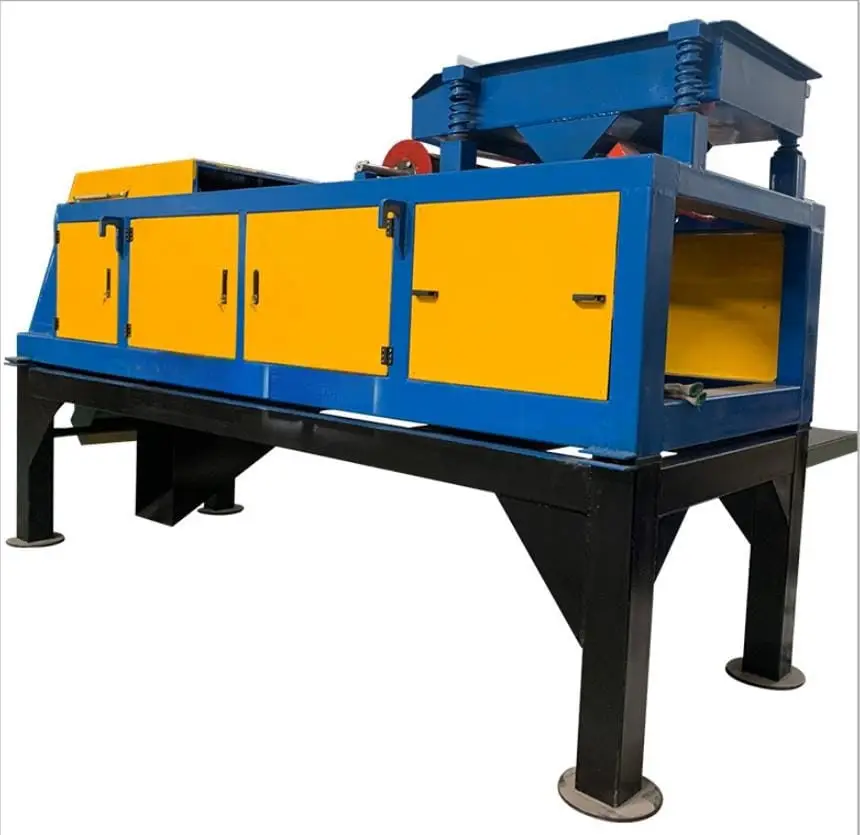
ORO Mineral Processing Equipment
ORO Mineral develops and supplies equipment for mineral screening, beneficiation, sand washing, and solid waste resource recovery. Its product range includes magnetic separation equipment and related processing machinery.
For project-specific equipment information, review the ORO Mineral processing equipment range and provide the manufacturer with your material characteristics and process targets.
What to Discuss With a Magnetic Separator Manufacturer
- Mineral composition and the target material to recover or remove.
- Feed particle size, moisture content, and expected feed variation.
- Required capacity in tonnes per hour or another clearly defined unit.
- Target concentrate grade, recovery, and impurity limits.
- Wet or dry process preference and available utilities.
- Equipment dimensions, installation layout, and connection requirements.
- Spare parts, maintenance intervals, commissioning, and technical support.
For projects involving non-ferrous metal recovery, compare the eddy current separator machine with the rest of the proposed sorting line. For mineral beneficiation, compare the appropriate drum, dry electromagnetic, WHIMS, or specialized high-field equipment instead of assuming one machine can handle every separation duty.
Pros and Cons of Magnetic Separation
| Pros | Cons |
|---|---|
| Can recover magnetic minerals and remove magnetic contaminants through a physical process. | Performance depends on magnetic susceptibility and mineral liberation. |
| Available in wet and dry configurations for different process requirements. | Feed moisture, particle size, and slurry conditions require control. |
| Can protect downstream equipment from tramp iron and other ferrous materials. | Weakly magnetic fine particles may require specialized high-gradient equipment. |
| Can be integrated into multi-stage beneficiation and recycling circuits. | Additional equipment stages increase capital, footprint, and maintenance requirements. |
| Can improve mineral concentrate quality and support resource recovery. | Not every mineral mixture can be separated economically using magnetic methods alone. |
| Permanent magnet systems can provide separation without continuous magnetizing power. | High-intensity electromagnetic and superconducting systems can involve significant technical complexity. |
Expert Recommendation: Which Type of Magnetic Separation Should You Choose?
There is no universal best magnetic separator. The right machine is determined by the magnetic response of the target mineral, feed size, process environment, and commercial target.
For magnetite and other strongly magnetic materials, start by evaluating LIMS. For suitable dry feeds containing weakly magnetic minerals, dry HIMS may be more practical. For fine weakly magnetic minerals in slurry, WHIMS and HGMS deserve serious consideration. Superconducting separation should be reserved for specialized projects where its performance benefits justify the additional investment and operating complexity. For aluminum and copper recovery from recycling streams, use eddy current separation as part of an appropriately designed sorting line.
For beginners, the most important step is to identify the target mineral and obtain representative feed data before requesting equipment prices. For commercial users, we recommend comparing recovery, concentrate grade, throughput, power consumption, water demand, maintenance, and spare-parts support—not purchase price alone.
Our final advice: Do not purchase a magnetic separator based only on a product photograph or a maximum magnetic field figure. Request a process recommendation based on your material, and insist that the expected performance assumptions are clearly documented. A correctly selected and properly integrated separator will usually deliver more value than an oversized machine selected without testing.
Quick Summary Table: 6 Different Types of Magnetic Separation
| Separation Type | Best For | Wet or Dry | Buying Recommendation |
|---|---|---|---|
| LIMS | Magnetite and strongly magnetic materials | Wet or dry, depending on design | First option to evaluate for strongly magnetic feeds. |
| Dry HIMS | Selected dry weakly magnetic minerals and impurities | Dry | Choose when feed moisture and size can be controlled economically. |
| WHIMS | Fine weakly magnetic minerals in slurry | Wet | Evaluate for hematite and industrial mineral purification. |
| HGMS | Very fine or weakly magnetic particles | Usually wet | Consider when conventional magnetic separation cannot meet the target. |
| Superconducting | Specialized high-field separation applications | Project-specific | Justify through testing and lifecycle economics. |
| Eddy current | Aluminum, copper, and other conductive non-ferrous metals | Dry | Use for non-ferrous recycling, not as a direct mineral magnet substitute. |
Frequently Asked Questions About Different Types of Magnetic Separation
1. What are the six different types of magnetic separation?
Six important equipment categories are low-intensity magnetic separation (LIMS), dry high-intensity magnetic separation, wet high-intensity magnetic separation (WHIMS), high-gradient magnetic separation (HGMS), superconducting magnetic separation, and eddy current separation. Eddy current separation is technically an electromagnetic sorting process based on induced currents rather than ordinary magnetic attraction.
2. What is the most common type of magnetic separator?
Low-intensity magnetic drum separators are widely used for strongly magnetic materials such as magnetite. Other designs, including suspended magnets and magnetic pulleys, are common in tramp iron removal and material handling applications.
3. What is the difference between LIMS and WHIMS?
LIMS uses a relatively low-intensity magnetic field and is mainly intended for strongly magnetic materials. WHIMS uses a higher-intensity field in a wet separation environment to recover or remove weakly magnetic particles that conventional low-intensity equipment may not capture effectively.
4. What is the difference between WHIMS and HGMS?
Both technologies can treat weakly magnetic particles in wet systems. HGMS emphasizes a high magnetic field gradient, commonly created using a matrix, to capture very weakly magnetic fine particles. WHIMS is a broader high-intensity wet separation category and equipment designs vary.
5. Which magnetic separator is best for magnetite?
LIMS is usually the first equipment category to evaluate for magnetite because it is strongly magnetic. Wet or dry drum configurations should be selected according to feed conditions, particle size, process layout, and concentrate requirements.
6. Which magnetic separator is suitable for hematite?
Hematite is generally more weakly magnetic than magnetite. WHIMS, HGMS, or suitable dry high-intensity equipment may be required depending on particle size, liberation, moisture, and the desired product grade. Representative testing should determine the final choice.
7. Can magnetic separation be used for quartz and kaolin purification?
Yes. High-intensity and high-gradient magnetic separation can remove selected iron-bearing magnetic impurities from quartz, kaolin, feldspar, and other industrial minerals. The correct machine depends on the impurity minerals, particle size, and required product purity.
8. Is eddy current separation the same as magnetic separation?
No. Eddy current separation uses induced electrical currents to generate repulsive forces in conductive non-ferrous metals. Conventional magnetic separators use magnetic attraction to capture susceptible particles. Both technologies are often integrated into broader magnetic and electrical sorting lines.
9. Is wet or dry magnetic separation better?
Neither is universally better. Dry separation can reduce water use and simplify some process circuits, while wet separation can be suitable for fine particles and slurry-based processing. The decision depends on feed size, moisture, liberation, water availability, and downstream requirements.
10. How do I select a magnetic separator manufacturer?
Evaluate the manufacturer’s experience with similar materials, sample-testing capability, equipment specifications, process design support, manufacturing quality, spare-parts availability, commissioning service, and after-sales response. Ask for a technical proposal based on your actual feed rather than relying on general product claims.
References
- Norwegian University of Science and Technology (NTNU) — Magnetic and Electric Separation. University laboratory overview of low-intensity, high-intensity, wet, dry, and eddy current separation equipment.
- National Academies — Evolutionary and Revolutionary Technologies for Mining. Technical discussion of magnetic separation, magnetic susceptibility, and eddy current separation in mineral processing and recycling.
- Metso — Magnetic Separation. Industrial equipment and application information covering LIMS, HGMS, and high-gradient separation technologies.
Technical note: Equipment names and classification boundaries can vary between manufacturers and mineral-processing references. The six categories in this guide are intended as a practical equipment-selection framework. Actual machine selection should be based on representative feed testing and a project-specific process design.