What is a Longwall in Mining? An Expert Commercial and Technical Guide
The underground extraction of minerals is an unforgiving business. Profit margins are dictated entirely by tons produced per hour versus the capital and operational expenditures required to move that material to the surface. When industry professionals discuss bulk coal extraction, the conversation inevitably centers on one technology: the longwall.
In most professional situations, deploying a longwall system represents the ultimate commitment of capital. We are talking about an investment that routinely exceeds $100 million USD before a single ton of coal is washed. The commercial stakes are monumental. However, when deployed in the correct geological conditions, no other underground method on earth can match its extraction rate and safety profile. In this uncompromising guide, we will break down the mechanics, the brutal financial realities, and the decision-making criteria required to determine whether a longwall setup is actually worth the investment for your mineral asset.
Quick Answer: The Core Components of a Longwall System
- The Shearer: A massive mechanical cutting machine equipped with rotating cutting drums that slice the coal from the face.
- Armored Face Conveyor (AFC): A heavy-duty chain conveyor running parallel to the coal face that catches the sheared coal and transports it to the main belt conveyor.
- Hydraulic Roof Supports (Shields/Chocks): Enormous hydraulic jacks, often weighing 30 to 40 tons each, that hold up the mountain of rock above the workers and machinery.
- The Goaf (Gob): The area immediately behind the advancing hydraulic shields where the roof is intentionally allowed to collapse.
- Commercial Verdict: Yields up to 90% resource recovery, but requires flat, uniform, and continuous geological seams to be financially viable.
Table of Contents
- What is a Longwall in Mining?
- How It Works: The Mechanics of the Face
- The Benefits: Why Commercial Mines Invest Millions
- Limitations: The Brutal Financial Realities
- Who Should Use It
- Who Does Not Need It
- Common Mistakes in Longwall Implementation
- Buying Considerations & CAPEX Analysis
- Expert Recommendation
- Pros vs Cons and Comparison Tables
- Frequently Asked Questions (FAQ)
What is a Longwall in Mining?
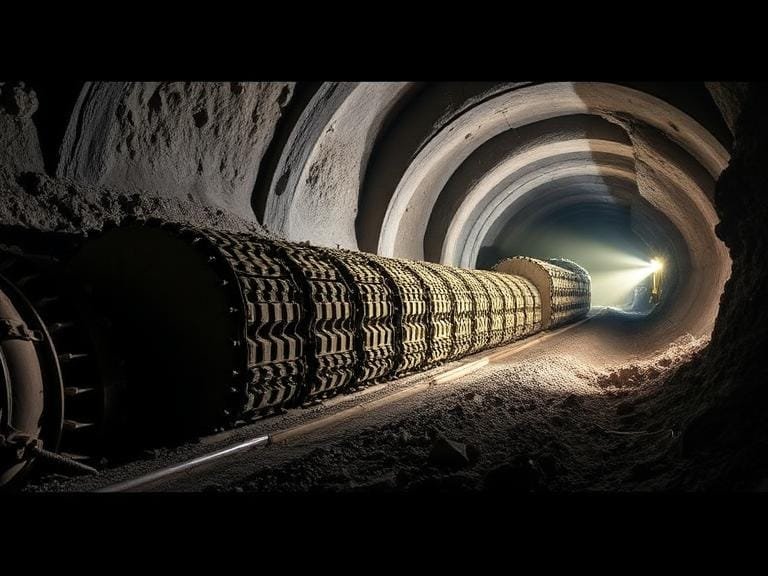
To understand a longwall in mining, you must visualize an underground factory. Unlike traditional room-and-pillar mining, which leaves behind pillars of coal to support the roof (sacrificing up to 50% of the deposit), a longwall system extracts the entire panel. A “panel” is the designated rectangular block of coal to be mined. These panels are breathtaking in scale. Modern longwall faces can span 1,000 to 1,500 feet in width and stretch for 1 to 2 miles in length.
Before the longwall equipment can be installed, development crews use continuous miners to drive tunnels (gate roads) along the sides of the panel. These tunnels provide ventilation, power, and escape routes. Once the gate roads are established, the longwall equipment is installed across the width of the panel. This highly automated wall of machinery then begins its slow, relentless march forward, devouring the seam.
How It Works: The Mechanics of the Face
The operational sequence of a longwall in mining is a marvel of heavy engineering. It relies on the perfect synchronization of three primary subsystems.
First, the shearer moves along the track provided by the Armored Face Conveyor (AFC). The shearer is equipped with two massive cutting drums armed with tungsten carbide picks. As it moves, it cuts a “web” of coal, typically about 30 to 40 inches deep, across the entire width of the face.
Second, as the coal is shattered from the face, it falls directly onto the Armored Face Conveyor (AFC). The AFC acts as the spine of the operation. Using dual chains and heavy steel flight bars, it drags thousands of tons of coal per hour to the end of the face, where it is transferred to a Beam Stage Loader (BSL), passed through a crusher to ensure uniform sizing, and finally deposited onto the main outbye conveyor belt heading to the surface.
Third, and most critical to safety, are the hydraulic roof supports (also known as shields or chocks). A modern longwall face will have 150 to 200 of these shields standing side-by-side. They push up against the roof with thousands of tons of hydraulic pressure, creating a safe canopy for the miners and the shearer. Once the shearer passes a shield and cuts the coal in front of it, the shield lowers slightly, pulls itself forward using hydraulic rams attached to the AFC pan line, and pushes back up against the newly exposed roof. The unsupported roof behind the advancing shields collapses into the void, effectively closing the mine behind the advancing machinery.
The Benefits: Why Commercial Mines Invest Millions
For commercial users, the decision to deploy a longwall system comes down to simple mathematics. The recovery rate is the primary driver. While room-and-pillar operations leave behind 40% to 50% of the coal to hold up the roof, longwall mining extracts 80% to 90% of the available resource. When you are dealing with millions of tons of high-grade metallurgical coal, that difference equates to billions of dollars in gross revenue.
Furthermore, the production rate is unmatched. A high-performance longwall face can easily produce 5,000 to 8,000 tons of coal per hour. This massive throughput lowers the operational cost per ton to the absolute minimum, providing a competitive edge in global commodity markets. Finally, from a safety perspective, personnel operate under the massive steel canopy of the hydraulic shields, drastically reducing the risk of roof falls, which historically have been the greatest hazard in underground extraction.
Limitations: The Brutal Financial Realities

We recommend approaching longwall planning with extreme caution. The limitations are severe. The most glaring barrier is the Capital Expenditure (CAPEX). Equipping a single longwall face requires sourcing from the top 10 underground mining equipment suppliers in the world, and the bill can easily exceed $100 million to $150 million USD. If global coal prices crash before the system is operational, the financial burden can bankrupt a company.
Geological inflexibility is another massive limitation. A longwall machine is not nimble. It requires a flat, continuous, and relatively uniform coal seam. If the shearer encounters a major geological fault line, a sudden thinning of the seam, or hard igneous intrusions, the entire operation grinds to a halt. You cannot simply steer a 1,000-foot wall of steel around a geological problem.
Lastly, subsidence—the sinking of the surface land above the mined-out panel—is inevitable. Because the roof is intentionally collapsed, the ground surface above the mine will eventually settle. This makes longwall mining highly problematic or entirely unfeasible if the surface land contains vital infrastructure, waterways, or residential areas.
Who Should Use It
For heavy-duty applications in the thermal and metallurgical coal sectors, longwall mining is the undisputed king. Operators sitting on massive, deep, and geologically stable coal deposits must deploy longwall systems to remain globally competitive. The economies of scale achieved through this automation guarantee the lowest possible extraction cost per ton.
Who Does Not Need It
For beginners or junior mining companies, longwall mining is entirely out of reach due to the capital requirements. Furthermore, hard rock miners do not use longwall shearers. If your operation involves extracting precious metals from narrow, highly fractured quartz veins, you require entirely different methodologies. You should instead be consulting with gold mining equipment manufacturers and focusing on drill-and-blast techniques followed by advanced surface processing.
Common Mistakes in Longwall Implementation
In our testing and industry observation, the most catastrophic mistake operators make is failing to match their downstream surface processing capacity to the output of the longwall face. It is utterly useless to extract 5,000 tons per hour if your wash plant can only process 2,000 tons per hour. The underground belts will shut down, and your multi-million-dollar shearer will sit idle.
Operators must invest heavily in upgrading their surface infrastructure. This includes robust mineral processing techniques and equipment. Because longwalls can occasionally cut into roof or floor rock, the raw coal is often heavily contaminated. Wash plants must be optimized, and tramp metal removal is critical to protect crushers. Utilizing high-capacity magnetic separation is non-negotiable here; understanding the magnetic separator machine working principle ensures that broken shearer picks and chain fragments do not destroy downstream infrastructure.
Buying Considerations & CAPEX Analysis
When procuring longwall systems, you are entering into a decade-long partnership with the original equipment manufacturer (OEM). You must thoroughly vet the 10 top mining equipment manufacturers in the world. Consider the Total Cost of Ownership (TCO), not just the initial purchase price.
- Automation and Monitoring: Modern faces utilize electro-hydraulic controls and remote monitoring. Ensure the OEM provides robust software for predictive maintenance.
- Shield Yield Capacity: The hydraulic shields must be rated for the specific lithology of your roof rock. Under-specifying shield tonnage can result in catastrophic face closures.
- Spares and Support: Downtime on a longwall costs tens of thousands of dollars per hour. Ensure the manufacturer has a local warehouse for critical spares like AFC chains, flight bars, and shearer ranging arms.
Expert Recommendation
The ORO Mineral Verdict
Is it actually worth upgrading to a longwall system? If your geological block model confirms millions of tons of uniform reserve, the answer is an uncompromising yes. However, extracting the coal is only half the battle. The profitability of a longwall operation is realized on the surface, where run-of-mine (ROM) material is washed, graded, and prepared for market.
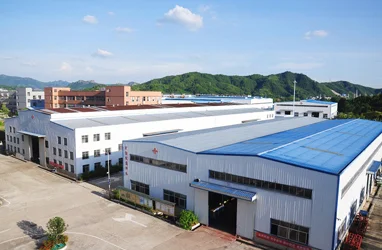
ORO Mineral Co., Ltd. is a large-scale intelligent mineral processing, screening, and sand washing equipment manufacturer integrating R&D, production and sales. Since 2014, ORO Mineral has made great contributions to every kind of mineral screening, solid waste resource recovery, beneficiation, washing, and separation, and has accumulated rich experience.
We highly recommend that any capital expenditure allocated for longwall development is matched with parallel investments in surface plant processing, ensuring your facility can efficiently handle the massive influx of raw material without bottlenecks.
Essential Comparison and Summary Tables
| Component / Metric | Details |
|---|---|
| Primary Function | High-capacity, continuous underground extraction of flat, tabular deposits (primarily coal). |
| Resource Recovery | Exceptionally high (80% to 90%). |
| Production Rate | Up to 8,000 tons per hour depending on seam thickness. |
| Capital Cost | Extremely high ($100M – $150M+ USD). |
| Feature | Longwall Mining | Room-and-Pillar Mining |
|---|---|---|
| Extraction Method | Continuous slicing of a massive face. | Creating intersecting tunnels, leaving pillars for support. |
| Resource Recovery | Up to 90% (allows roof to cave). | 40% to 60% (pillars are left behind). |
| Geological Flexibility | Very Low (requires uniform seams). | High (can easily steer around faults or bad roof). |
| Initial CAPEX | Astronomical. | Moderate (Continuous miners and shuttle cars). |
| Subsidence Risk | Guaranteed and immediate. | Minimal to delayed. |
| Pros (Why it is worth the investment) | Cons (The brutal limitations) |
|---|---|
| Lowest operational cost per ton extracted. | Massive upfront capital expenditure required. |
| Highest safety profile for face workers due to hydraulic roof shields. | Complete loss of production if the shearer or AFC experiences a major mechanical failure. |
| Maximum maximization of the mineral reserve (no wasted pillars). | Causes immediate surface subsidence, complicating land rights above the mine. |
| Highly automated, reducing the need for large manual labor forces at the face. | Requires perfectly synchronized, high-capacity downstream surface processing plants. |
Frequently Asked Questions (FAQ)
How wide and long is a typical longwall panel?
In most professional situations, modern longwall panels are massive. The face width (the distance the shearer travels back and forth) typically ranges from 800 to 1,500 feet. The total length of the panel (the distance the equipment advances before the block is exhausted) can range from 1 to 3 miles.
What happens to the roof after the longwall machine moves forward?
As the hydraulic roof supports advance forward toward the newly cut coal face, the unsupported rock layers behind them are intentionally allowed to collapse. This area of collapsed rock is known as the goaf or gob. This controlled caving relieves the immense pressure built up in the surrounding rock strata.
Can longwall mining be used for metals like gold or copper?
No. Longwall mining is designed almost exclusively for relatively flat, tabular, and soft deposits, primarily coal or trona. Hard rock deposits like gold and copper are usually found in highly irregular, narrow veins or massive porphyry deposits within extremely hard host rock. The mechanical shearers used in longwall operations cannot cut through hard igneous or metamorphic rock. Hard rock mining relies on drill-and-blast methodologies.
Authoritative References & Industry Standards
To further understand the safety protocols, geological requirements, and engineering standards of longwall systems, we recommend consulting the following authoritative organizations:
- Mine Safety and Health Administration (MSHA) – The primary U.S. federal agency enforcing compliance with mandatory safety and health standards in underground coal operations.
- National Institute for Occupational Safety and Health (NIOSH) – Provides critical research on ground control, dust suppression, and worker safety protocols specifically related to longwall face operations.
- Society for Mining, Metallurgy & Exploration (SME) – The premier professional society for mining engineers, offering comprehensive technical papers and best practices for bulk underground extraction techniques.