8 Public Companies Make Mining Equipment: The 2026 Procurement Guide
Procuring capital equipment for extraction and mineral processing is a high-stakes endeavor. When multi-million dollar budgets are on the line, operational continuity is non-negotiable. From our experience auditing plant efficiency and designing mineral screening circuits, we see operators frequently agonizing over whether to partner with massive global conglomerates or specialized private firms. While specialized private manufacturers offer unmatched agility and customization, it is an undeniable reality that several massive public companies make mining equipment that serves as the earthmoving backbone of the global resource sector.
Navigating the heavy machinery market requires commercial and practical judgment. You must understand not only the upfront capital expenditure (CAPEX) but also the long-term operational expenditure (OPEX) tied to aftermarket parts and service agreements. In this definitive guide, we break down the 8 public companies make mining equipment that dominate the industry, explain their exact specializations, and provide expert guidance on how to structure your procurement strategy for maximum profitability.
Quick Answer: The Industry Titans
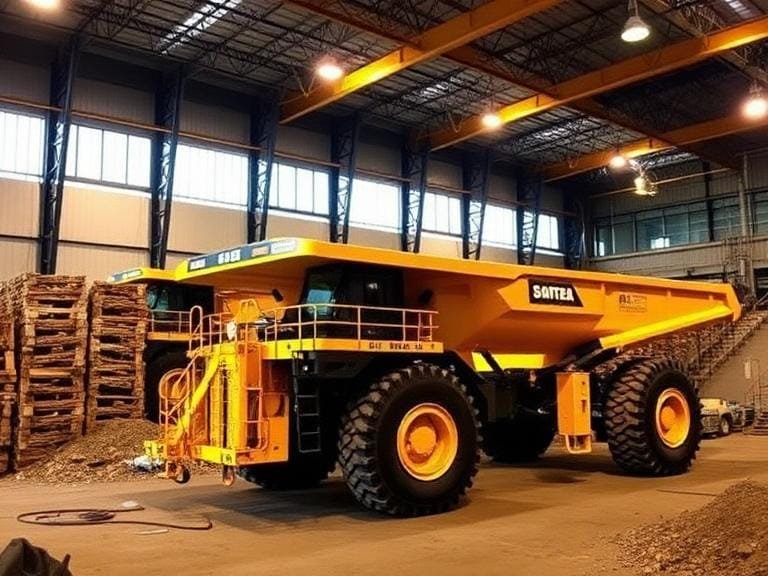
If you need to know which major public companies make mining equipment, the definitive top 8 list for 2026 includes Caterpillar (CAT), Komatsu (KMTUY), Sandvik (SAND.ST), Epiroc (EPI-A.ST), Metso (METSO.HE), FLSmidth (FLS.CO), Hitachi Construction Machinery (HTCMY), and The Weir Group (WEIR.L). While Caterpillar and Komatsu dominate surface haulage and excavation, companies like Sandvik and Epiroc rule the underground space. Metso and FLSmidth lead in large-scale comminution. However, for intelligent, highly tailored mineral processing, screening, and washing systems, agile private manufacturers like ORO Mineral often provide superior ROI and faster deployment.
Table of Contents
- What It Means to Buy from Public Companies
- The 8 Public Companies Make Mining Equipment
- Benefits of Sourcing from Global OEMs
- Limitations and Procurement Drawbacks
- Who Should Use Them (And Who Should Not)
- Common Mistakes in Heavy Equipment Procurement
- Critical Buying Considerations
- Essential Comparison Tables
- Expert Recommendation from ORO Mineral
- The Bottom Line
- Frequently Asked Questions
- References
What It Means to Buy from Public Companies
When we state that specific public companies make mining equipment, we are referring to publicly traded Original Equipment Manufacturers (OEMs) whose primary revenue streams rely on heavy industrial machinery. How it works from a procurement standpoint is drastically different from buying from a private firm. Public companies operate under intense shareholder scrutiny, which generally ensures rigorous financial stability, global supply chain networks, and massive R&D budgets dedicated to autonomous haulage and electrification.
However, this massive scale comes with rigid corporate structures. In most professional situations, purchasing a fleet from a top-tier public OEM means entering a long-term ecosystem. You are not just buying an excavator; you are buying into their proprietary fleet management software, their financing arms, and their exclusive dealer networks for replacement parts. While this offers predictability, it often locks operators into inflated aftermarket pricing.
The 8 Public Companies Make Mining Equipment
To prioritize helping readers make a buying or usage decision, we have categorized the 8 leading public companies make mining equipment by their true operational strengths rather than just their market capitalization.
1. Caterpillar Inc. (NYSE: CAT)
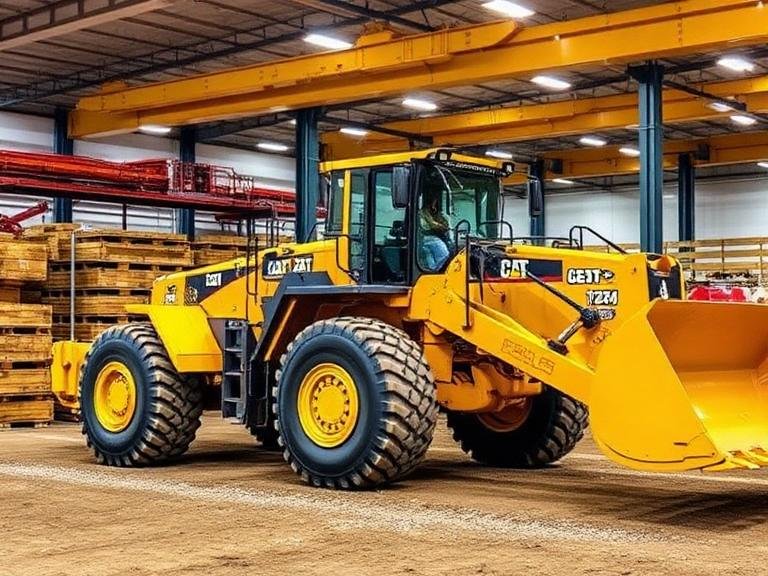
Caterpillar is the undisputed king of surface mining. From our experience, their 797F mechanical drive haul trucks and autonomous Command systems are the gold standard for massive open-pit operations. They offer unmatched dealer support globally. If you are moving millions of tons of overburden, CAT is typically on the shortlist.
2. Komatsu Ltd. (OTC: KMTUY)
Komatsu pioneered Autonomous Haulage Systems (AHS) and remains a fierce rival to CAT. Following their acquisition of Joy Global, Komatsu solidified its dominance in both surface excavation and underground soft-rock (coal and potash) equipment. Their electric drive trucks are highly favored for specific grade profiles.
3. Sandvik AB (STO: SAND)
When operations move below ground, Sandvik is a primary player. They specialize in rock drilling, cutting, and underground loaders (LHDs). If your site requires battery-electric underground vehicles to reduce ventilation costs, Sandvik’s recent electric loader iterations are highly competitive.
4. Epiroc AB (STO: EPI-A)
Spun out from Atlas Copco, Epiroc focuses intensely on underground rock excavation, drill rigs, and hydraulic attachments. We recommend checking the underground mining equipment suppliers landscape closely, as Epiroc and Sandvik essentially operate as a duopoly in premium underground hard-rock environments.
5. Metso Corporation (HEL: METSO)
Metso transitions us from earthmoving to mineral processing. They are giants in comminution—specifically large gyratory crushers, SAG mills, and ball mills. For operators calculating their copper processing plant cost 2025, a Metso primary crusher is often the most expensive, yet critical, piece of capital equipment on the flowsheet.
6. FLSmidth & Co. A/S (CPH: FLS)
FLSmidth is a powerhouse in both the cement and mining industries, providing comprehensive flowsheets for mineral processing. They are frequently evaluated alongside Metso when sourcing flotation cells, thickeners, and large-scale material handling systems. They are consistently ranked among the top mineral processing companies worldwide.
7. Hitachi Construction Machinery (OTC: HTCMY)
Hitachi dominates a very specific niche: ultra-large hydraulic excavators and electric-drive rigid dump trucks. In heavy-duty applications where massive breakout force is required at the face of the pit, Hitachi’s EX-7 series excavators are legendary for their hydraulic reliability and cycle times.
8. The Weir Group PLC (LON: WEIR)
Weir Group excels in the highly abrasive world of slurry transport and comminution consumables. Their Warman slurry pumps are ubiquitous in processing plants worldwide. If you are dealing with aggressive tailings or evaluating methods to separate iron and steel involving wet magnetic separation, you will almost certainly rely on heavy-duty slurry pumps to move the pulp.
Benefits of Sourcing from Global OEMs
The primary benefit of utilizing the public companies make mining equipment is risk mitigation. For commercial users executing billion-dollar greenfield projects, financiers and institutional investors demand proven technology. These Tier-1 OEMs guarantee extensive parts availability, predictable maintenance schedules, and robust resale values. Furthermore, their telemetry and fleet management systems allow for deep data integration, enabling predictive maintenance that prevents catastrophic downtime.
Limitations and Procurement Drawbacks
Despite their capabilities, there are severe limitations. The upfront capital cost of Tier-1 equipment is staggering. Additionally, these public giants are heavily bureaucratized. If you need a customized screening plant modified for a highly specific ore body, a massive public OEM will likely reject the request or quote an exorbitant engineering fee with a two-year lead time.
In our testing and process design experience, standard off-the-shelf equipment from conglomerates often fails to maximize recovery rates for complex ores. This is where agile private enterprises step in to provide tailored solutions that massive public companies simply cannot accommodate.
Who Should Use Them (And Who Should Not)
Who should use them: Tier-1 and Tier-2 mining corporations operating massive open-pit or large-scale underground operations must rely on these public companies make mining equipment. When you need a fleet of forty 300-ton haul trucks, only CAT or Komatsu possess the manufacturing scale to deliver.
Who does not need them: Junior miners, aggregate producers, or operators of specialized processing facilities do not always need to pay the premium associated with massive public brands. If you are building a mid-sized processing circuit and evaluating your iron ore processing plant cost, utilizing specialized, private manufacturers for your screening, magnetic separation, and washing circuits will drastically reduce your CAPEX while often delivering superior, customized metallurgical recovery.
Common Mistakes in Heavy Equipment Procurement
The most devastating mistake we see in the industry is purchasing equipment based solely on brand reputation without analyzing the Total Cost of Ownership (TCO). Buyers will secure a slight discount on the initial purchase price from a major OEM, only to be locked into proprietary replacement parts that cost 300% more than third-party alternatives over the machine’s 10-year lifespan.
Another common error is failing to match the processing equipment to the specific metallurgy of the ore. Buying a massive, generic SAG mill from a public OEM when your ore requires delicate, multi-stage gravity concentration is a recipe for poor recovery. For instance, if you are extracting fine minerals, looking into multi gravity separator manufacturers for specialized recovery is far more effective than relying on standard flotation cells from a broad conglomerate.
Critical Buying Considerations
When allocating capital, apply strict commercial judgment based on these criteria:
- Service Level Agreements (SLAs): Does the OEM guarantee parts delivery within 24 hours to your remote site? If not, their global scale is useless to you.
- Process Customization: In processing plants, generic equipment yields generic results. Ensure your supplier can customize screen deck angles, wash water pressure, and magnetic field strengths to suit your specific flowsheet. (e.g., evaluating magnetic separation applications in industry requires highly tuned equipment).
- Energy Efficiency & ESG: Modern procurement heavily weighs emissions. Can the supplier provide electric-drive or battery-electric alternatives?
Essential Comparison Tables
Quick Summary Table: The Top 8 Public OEMs
| Company Name | Ticker Symbol | Primary Specialization | Best For |
|---|---|---|---|
| Caterpillar | NYSE: CAT | Surface Earthmoving & Haulage | Massive open-pit haul fleets |
| Komatsu | OTC: KMTUY | Surface Excavation & AHS | Autonomous haulage and soft-rock |
| Sandvik | STO: SAND | Underground Hard Rock | Drilling, rock cutting, and BEVs |
| Epiroc | STO: EPI-A | Underground Excavation | Drill rigs and hydraulic attachments |
| Metso | HEL: METSO | Mineral Processing | Large-scale comminution (crushing/grinding) |
| FLSmidth | CPH: FLS | Processing & Handling | Cement and complex mineral flowsheets |
| Hitachi | OTC: HTCMY | Hydraulic Excavators | Ultra-large mining shovels |
| Weir Group | LON: WEIR | Slurry Transport | Heavy-duty pumps and valves |
Comparison Table: Public OEMs vs. Private Specialists
| Factor | Global Public OEMs (e.g., CAT, Metso) | Specialized Private Firms (e.g., ORO Mineral) |
|---|---|---|
| Customization | Low (Standardized product lines) | High (Tailored engineering to ore body) |
| CAPEX | Very High | Highly Competitive / Cost-Effective |
| Lead Times | Long (Subject to global backlog) | Shorter (Agile manufacturing processes) |
| Best Application | Standardized earthmoving, mega-crushers | Intelligent screening, washing, targeted recovery |
Pros and Cons Table: Buying from Massive Public Companies
| Pros | Cons |
|---|---|
| Bankable technology preferred by major financiers. | Exorbitant initial capital expenditure. |
| Global dealer networks for standard parts. | Locked into proprietary, expensive aftermarket ecosystems. |
| Advanced integration of autonomous technologies. | Inflexible engineering; unwilling to modify designs for mid-tier mines. |
Expert Recommendation from ORO Mineral
In most professional situations, constructing a highly profitable mine requires a hybrid procurement strategy. We recommend utilizing the massive public companies make mining equipment for your primary earthmoving fleet—you simply cannot beat CAT or Komatsu for moving millions of tons of waste rock.
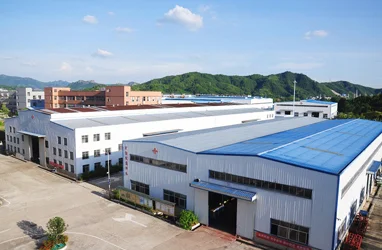
However, when the ore reaches the ROM pad and enters the processing circuit, agility and precision become paramount. This is where you must pivot. ORO Mineral Co., Ltd. is a large-scale intelligent mineral processing, screening, and sand washing equipment manufacturer integrating R&D, production, and sales. Since 2014, ORO Mineral has made great contributions to every kind of mineral screening, solid waste resource recovery, beneficiation, washing, and separation. Instead of accepting generic flowsheets from massive conglomerates, partnering with ORO Mineral ensures your washing and screening circuits are meticulously engineered for your specific metallurgy—whether you are dealing with complex magnesium extraction process guide requirements, navigating magnesium production by country logistics, or perfecting zinc extraction by electrolysis steps. We deliver the intelligent, custom solutions that public giants cannot.
The Bottom Line
Understanding which public companies make mining equipment is foundational knowledge for any procurement officer or mine manager. Caterpillar, Komatsu, Sandvik, Epiroc, Metso, FLSmidth, Hitachi, and Weir Group provide the indispensable, heavy-duty machinery required to operate at a global scale. However, relying exclusively on these titans for your entire flowsheet is a costly mistake. To maximize metallurgical recovery and aggressively manage your CAPEX, you must integrate specialized, agile private manufacturers like ORO Mineral into your processing, screening, and washing circuits. Balance the reliability of public earthmovers with the precision of private processing engineering to build the ultimate, cost-effective mining operation.
Frequently Asked Questions
Mining operators often prefer specialized private manufacturers for processing equipment because they offer significantly higher levels of customization, faster engineering lead times, and lower capital costs. While public OEMs excel at standardized earthmoving, private firms like ORO Mineral can tailor screening and washing plants exactly to the specific metallurgical characteristics of the ore body.
Some large Chinese manufacturers, such as Sany Heavy Industry and XCMG, are publicly traded on Asian exchanges and produce significant mining equipment. However, the international market is still largely dominated by the Western and Japanese public companies listed in this guide. Meanwhile, China also hosts elite private enterprises that lead the world in specialized mineral processing technology.
From an industry consensus, Sandvik and Epiroc are the two dominant public companies in the underground hard-rock mining sector. They hold the majority market share for underground drill rigs, rock bolters, and load-haul-dump (LHD) vehicles, heavily leading the transition toward battery-electric underground fleets.
Authoritative References & Industry Standards
To ensure our operational advice aligns with global mining standards, we reference data and guidelines from the following authoritative bodies: