Working Principles and Applications of Mining Vibrating Screens
Quick Answer: How Mining Vibrating Screens Drive Beneficiation Circuits
Mining vibrating screens are high-acceleration mechanical classifiers that separate bulk run-of-mine ore, crushed aggregates, and mineral slurries into distinct size fractions using continuous cyclical vibration. By subjecting material beds to 3.5G to 6.0G of mechanical acceleration via eccentric shafts, unbalanced flywheels, or dual geared exciter motors, these machines fluidize the feed bed. This fluidization induces kinetic stratification: coarse rocks rise to the top layer while smaller fractions migrate to the deck surface, passing through calibrated apertures. Industrial concentrators utilize circular screens for rapid coarse scalping, linear screens for horizontal dewatering and desliming, and multi-slope banana screens for ultra-high-velocity thin-bed screening. When properly dialed, mining vibrating screens deliver screening efficiencies exceeding 90%, protect downstream equipment, and prepare calibrated feeds for subsequent separation stages, including Magnetic Separation Equipment and gravity-based Spiral Chute for Mineral Concentration circuits.
Article Directory
- Anatomy and Physics: How Mining Vibrating Screens Stratify Ore
- Quick Summary Table: Motion Types, G-Forces, and Industrial Use Cases
- Detailed Motion Kinematics: Circular vs. Linear vs. Multi-Slope (Banana)
- Core Mineral Processing Applications in Hard Rock Circuits
- Downstream Beneficiation Integration: Preparing Feed for Magnetic & Gravity Sorting
- Direct Technical Comparison Table: Screen Types, Stroke, and Deck Slopes
- Pros and Cons of Primary Screening Methodologies
- Who Needs Heavy-Duty Vibrating Screens vs. Who Can Use Alternatives
- Costly Operational Mistakes Plant Operators Make on the Screen Deck
- Essential Sourcing Checklist: Exciters, Frame Isolation, and Media Selection
- Expert Mineral Processing Verdict
- Frequently Asked Questions
- Authoritative Standards & Metallurgical Engineering References
Anatomy and Physics: How Mining Vibrating Screens Stratify Ore
To grasp why mining vibrating screens succeed or fail in the pit, you must look at the particle mechanics occurring across the deck. A vibrating screen is not simply a perforated tray shaken by a motor; it is a multi-mass dynamic mechanical system consisting of a rigid screen box, flexible isolation springs (helical steel, rubber bobbins, or pneumatic air springs), an eccentric drive mechanism, and specialized screening media.
The entire operation relies on two physical mechanisms: stratification and probability of separation.
- Bed Stratification: When bulk material dumps onto a stationary screen deck, large boulders and fine particles pack together into a dead, dense bed. Interstitial void spaces are locked. When the drive mechanism subjects the screen box to rapid accelerations (typically 750 to 1,200 RPM at an amplitude of 6 to 12 mm), the material bed is thrown into micro-suspension. During this airborne phase, void spaces open between colliding particles. According to the laws of kinetic friction and particle segregation, small particles naturally fall through these voids under the influence of gravity, migrating toward the bottom of the bed, while larger rocks are forced to the top layer. Without complete stratification, fine particles ride on top of coarse boulders and discharge directly into the oversize chute, destroying classification efficiency.
- Probability of Presentation: Once fine particles reach the screen media surface, they must pass through an aperture. If a particle is less than 50% of the aperture size, passage is almost instantaneous. However, for “near-size” particles (between 75% and 100% of the aperture dimension), passage depends on the particle’s angle of approach, velocity, and orientation. The vibrating stroke repeatedly pitches near-size particles into the air, giving them multiple presentation attempts across the deck length before discharging off the lip.
From our experience on concentrator plant floors, the primary metric governing performance is the acceleration index (G-force), calculated as:
G = (Stroke Amplitude in mm × (RPM)²) / 1,788,000
If your G-force drops below 3.2G, the material bed refuses to fluidize, resulting in immediate blinding and heavy carryover. If your G-force exceeds 6.0G without proper structural engineering, the side plates experience severe fatigue stress, shearing huck-bolts and cracking transverse cross-beams around the exciter bridge.
Quick Summary Table: Motion Types, G-Forces, and Industrial Use Cases
| Vibration Mechanism | Motion Profile | Deck Inclination | Standard G-Force Range | Primary Mineral Processing Application |
|---|---|---|---|---|
| Circular Motion (Single Shaft) | Circular / Elliptical trajectory | 15° to 25° downhill slope | 3.5G – 4.5G | Primary / secondary dry scalping; coarse aggregate sizing (>25 mm) |
| Linear Motion (Dual Shafts) | 45° Straight-line forward stroke | 0° (Horizontal) to 5° uphill | 4.5G – 6.0G | Heavy dewatering, desliming, media recovery, trash removal (<10 mm) |
| Multi-Slope (Banana Screen) | Variable linear / elliptical stroke | Steep feed (40°) to flat discharge (10°) | 4.5G – 5.5G | Ultra-high-tonnage run-of-mine sizing, secondary crusher closed circuits |
| High-Frequency Fine Screen | Independent electromagnetic deck excitation | 25° to 35° steep slope | 5.0G – 8.0G (On media) | Fine wet slurry classification (0.045 to 1.0 mm); closed-circuit grinding |
| Elliptical Motion (Balanced Tri-Drive) | Adjustable forward/reverse ellipse | 0° to 10° shallow slope | 4.0G – 5.2G | Sticky, clay-bound ore, high-moisture coals, pegging-prone feeds |
Detailed Motion Kinematics: Circular vs. Linear vs. Multi-Slope (Banana)
1. Circular Motion Vibrating Screens
Circular motion screens represent the classic, rugged workhorse of the mining pit. Driven by a single central eccentric shaft or unbalanced counterweights mounted through the center of gravity of the screen box, the machine imparts an identical circular stroke profile across the entire deck. Because the motion is uniform and does not generate forward conveyancing on its own, circular screens must be installed at a steep decline—typically 18 to 22 degrees.
In most professional situations, circular screens excel at coarse, dry separation where sheer volume matters more than surgical classification precision. Gravity pulls the rock down the slope while the circular throw repeatedly bounces the material off the deck, breaking up surface clay and tumbling lumps so that all sides present to the screen apertures. However, their reliance on steep slopes means material travel speed is very high (often exceeding 1.0 to 1.5 meters per second). If the bed depth is too thick, fines on the top of the bed simply ride the rock avalanche into the oversize chute without ever touching the screen cloth.
2. Linear Motion Vibrating Screens
Linear screens operate using two synchronized, counter-rotating eccentric shafts driven by external motors or geared exciter boxes. When the shafts spin in opposite directions, their centrifugal forces cancel out along the transverse axis and reinforce one another along a single 45-degree directional vector passing through the machine’s center of gravity.
This directional thrust throws material forward and upward simultaneously, allowing linear mining vibrating screens to operate on completely horizontal (0-degree) or even uphill (positive incline) decks. In our testing, linear screens provide vastly superior retention time and stratified bed control. Because the deck is flat, slurry pools, water drains rapidly through the apertures, and the forward throw continuously rolls the dewatered cake forward. For slurry desliming, heavy medium drainage, and mill discharge sizing, horizontal linear screens are the definitive engineering choice.
3. Multi-Slope “Banana” Screens
When plant designers need to process 1,500 to 3,000 tons per hour across a single machine, traditional flat or single-slope screens choke; the feed end gets buried under a two-foot-thick layer of ore, preventing stratification until the material is halfway down the deck. The solution is the multi-slope or “banana” screen.
A banana screen features a deck curved in segments: a steep feed section (35 to 45 degrees), a moderate middle transition (20 to 25 degrees), and a shallow discharge section (10 to 15 degrees). At the steep feed end, material accelerates rapidly to speeds of 2.5 to 4.0 meters per second. This high velocity draws the bed out into an ultra-thin layer, allowing 70% to 80% of undersize fines to fall through the apertures within the first two meters of travel. As the bed thins and loses mass, the deck flattens out, slowing the remaining near-size particles down to give them extended presentation time for precision separation. A single banana screen routinely matches the throughput capacity of two to three traditional inclined screens in a fraction of the structural footprint.
Core Mineral Processing Applications in Hard Rock Circuits
Modern mineral concentrators deploy mining vibrating screens across five critical process nodes, each requiring vastly different mechanical configurations:
1. Primary and Secondary Scalping
Before run-of-mine ore enters primary jaw crushers or secondary cone crushers, it passes over heavy-duty scalping screens. The objective is simple: remove natural sub-grade fines that do not require crushing and scalp off slabby boulders that would jam the crusher throat. Scalping screens operate under brutal conditions, catching falling rocks weighing up to two tons directly from haul truck dumps. They utilize thick, stress-relieved steel side plates, heavy steel grizzly bars, or cast manganese punched plates backed by massive coil spring packs designed to absorb structural shock loads without transferring destructive vibrations to the building foundation.
2. Secondary and Tertiary Closed-Circuit Sizing
In closed-circuit crushing plants, vibrating screens act as the quality control inspector. Material exiting a cone crusher or high-pressure grinding roll (HPGR) discharges directly onto a double-deck or triple-deck sizing screen. The top deck scalps out oversize, recycling it via conveyor belts back into the crusher feed hopper, while the bottom deck produces final product fractions (e.g., -12mm ball mill feed or calibrated aggregate sizes). Precision is paramount here: if the screen allows 10% oversize to escape into the ball mill feed, grinding efficiency drops and media consumption spikes.
3. Wet Desliming and Slurry Classification
In gold, copper, and iron ore plants, clay, organic matter, and ultra-fine slimes interfere with downstream chemical flotation and cyanide leaching. Slurry feeds are piped onto wet vibrating screens equipped with high-pressure water spray bars. The vibration stratifies the pulp while water jets blast clays off the coarse mineral grains, washing minus-100-micron slimes through the bottom deck while clean, washed coarse rock discharges off the end.
4. Dewatering and Tailings Cake Filtration
With environmental regulations cracking down on wet tailings dams, mines must produce dry, stackable filtered tailings. Dewatering screens operate with uphill deck slopes (typically +3 to +5 degrees) using linear motion exciters generating up to 6.0G of acceleration. Slurry enters an inclined back-pool where hydrostatic pressure forces water through sub-millimeter slotted polyurethane panels. The vibration pulls the solids uphill out of the pool, consolidating them into a dense, dewatered cake containing less than 15% to 18% moisture, ready for dry stacking or conveyor haulage.
5. Heavy Mineral Concentrator Feed Preparation
In zircon, rutile, and alluvial gold circuits, gravity concentration requires calibrated, narrow particle-size distributions. Feed must be deslimed and sized cleanly before entering gravity equipment. Running unclassified feed directly into wet spirals creates turbulent cross-currents that flush fine heavy minerals into the tailings. High-efficiency mining vibrating screens classify the ore into tight fractions, ensuring optimal hydraulic separation down the line.
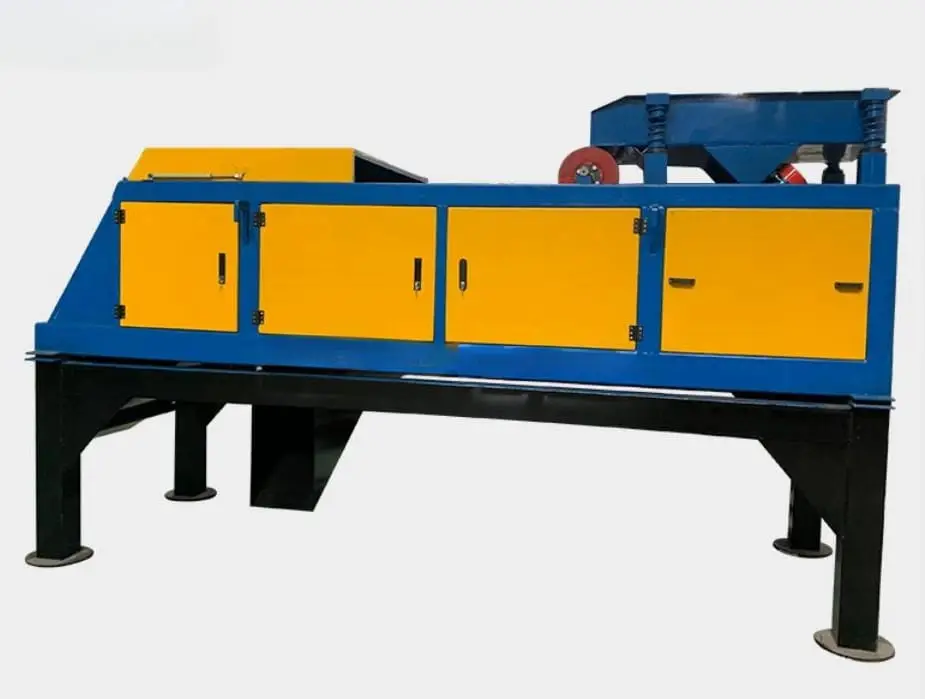
Downstream Mineral Beneficiation: Oro Mineral Magnetic Separator Machine
A well-tuned vibrating screen provides an engineered, calibrated particle size, but size alone does not deliver final mineral purity. Downstream from screening and classification, Oro mineral provides advanced industrial separation machinery engineered to extract valuable ferrous, non-ferrous, and paramagnetic fractions from graded mineral streams.
| Magnetic Field Strength | 5,000 – 15,000 Gauss high-intensity magnetic flux matrix |
| Processing Capacity | 5 – 100 TPH / m³/h continuous throughput |
| Feed Sizing Requirement | Optimized for classified feeds ≤ 300 mm (pre-sized by vibrating screens) |
| Structural Construction | Heavy-duty 304/316 Stainless Steel & wear-resistant Carbon Steel chassis |
| Power Consumption | 5.5 – 160 kW high-efficiency industrial drive packages |
| System Integration | Pairs directly with vibrating feeders, belt conveyors, and dewatering circuits |
Circuit Integration Guidance: Screened ore free from near-size blinding feeds seamlessly into the Magnetic Separator Machine, or through multi-stage Permanent Magnetic Separator and Plate Type Permanent Magnetic Separation Equipment circuits to maximize mineral recovery.
Downstream Beneficiation Integration: Preparing Feed for Magnetic & Gravity Sorting
In our mineral process audits, screening performance dictates downstream beneficiation recovery rates. No magnetic drum, eddy-current separator, or gravity spiral can operate efficiently on poorly classified material.
Consider the process interfaces across a typical hard rock concentrator:
- Magnetic Separation Circuits: When sorting iron ore or removing tramp iron from silica sands, particle size governs magnetic trapping force. If fine magnetite particles are masked beneath an unstratified layer of coarse silica gravel, magnetic drums cannot capture them. Conversely, oversized tramp rock entering a high-intensity wet magnetic separator wedges between the drum shell and the tank, gouging expensive stainless steel sleeves. Pre-screening using durable mining vibrating screens guarantees that particle trajectories match the magnetic field depth, supporting processes outlined in our guide on magnetic separation applications in industry.
- Gravity Separation and Heavy Mineral Spirals: Mineral concentration in Spiral Gravity Chutes and spiral chute platforms relies on delicate density differentials acting across thin laminar fluid films. If an upstream screen lets +2mm oversized rock slip into a spiral chute designed for 0.1 to 0.8mm sand, the large particles disrupt the laminar flow boundary layer, flushing dense gold or tin particles straight into the tailings discharge.
- Industrial Sand Washing Lines: In construction aggregate and glass sand plants, wet vibrating screens work directly in tandem with a heavy-duty Sand Washing Machine 100 TPH Long Life to deslime, scrub, and dewater high-purity silica sands, eliminating organic contamination before dry bagging.
- Pyrometallurgical and Hydrometallurgical Pre-Treatment: In complex extraction flowsheets, such as those detailed in our magnesium extraction process guide and zinc extraction by electrolysis steps, consistent particle sizing is mandatory to ensure uniform acid leaching kinetics and roasting bed permeability.
Direct Technical Comparison Table: Screen Types, Stroke, and Deck Slopes
| Technical Metric | Circular Inclined Screen | Horizontal Linear Screen | Multi-Slope Banana Screen | High-Frequency Screen |
|---|---|---|---|---|
| Operating Stroke Amplitude | 6.0 – 12.0 mm (Circular) | 8.0 – 14.0 mm (Linear 45°) | 6.0 – 10.0 mm (Elliptical/Linear) | 1.5 – 3.0 mm (High frequency) |
| Operating Frequency | 750 – 1,000 RPM | 850 – 1,100 RPM | 900 – 1,050 RPM | 1,500 – 3,600 RPM |
| Deck Angle Configuration | 15° to 25° Downhill | -2° to +5° Flat / Uphill | 45° / 25° / 10° Multi-stage | 25° to 35° Steep Downhill |
| Capacity per Unit Width | Moderate (40 – 60 TPH/m) | High (60 – 85 TPH/m) | Very High (110 – 160 TPH/m) | Low to Moderate (Slurry feed) |
| Screening Efficiency Range | 80% – 88% | 85% – 94% | 90% – 96% | 88% – 95% (On fine cuts) |
| Structural Capital Cost | Low to Moderate (Simple drive) | Moderate to High (Dual exciters) | High (Complex frame fabrication) | Moderate (Specialized sub-frames) |
Pros and Cons of Primary Screening Methodologies
| Screening Class | Operational & Metallurgical Pros | Maintenance & Mechanical Cons |
|---|---|---|
| Circular Inclined Screens |
|
|
| Horizontal Linear Screens |
|
|
| Banana Multi-Slope Screens |
|
|
Who Needs Heavy-Duty Vibrating Screens vs. Who Can Use Alternatives
Every dollar in concentrator capital expenditure must be justified by metallurgical recovery. Not every process application requires a high-G vibrating screen; in certain scenarios, alternative classification machines perform better at lower operating cost.
Who Must Invest in Heavy-Duty Mining Vibrating Screens:
- Hard Rock Crushing & Screening Plants (Iron, Copper, Gold, Granite): If your plant processes abrasive rock exceeding 100 MPa compressive strength, static grizzlies and rotary screens wear out too quickly. You need heavy-duty vibrating screens with high-acceleration linear or circular drives to shear rock beds and prevent choking crushers.
- Closed-Circuit Grinding Mills: When operating semi-autogenous grinding (SAG) or ball mill pebble circuits, vibrating screens provide razor-sharp size cutoffs. Allowing pebble scats to circulate unchecked reduces mill grinding kinetics and destroys liners.
- Tailings Filtration and Slurry Dewatering Facilities: Producing stackable, dry tailings requires the high G-forces and uphill bed-compression dynamics of a specialized linear dewatering screen. Filter presses choke on high-solids feeds; dewatering screens remove 70% of process water before final filtration.
Who Should Choose Alternative Classification Equipment:
- Alluvial Clay & Placer Mining Washing: If your ore body consists of sticky, plastic saprolite clays or alluvial river gravels packed with mud balls, high-speed vibrating screens will blind within twenty minutes. The sticky clay smears across the apertures like wet dough. In this scenario, install a rotary trommel scrubber. A trommel lifts, tumbles, and soaks the ore in a rotating cylinder, using water deluge and autogenous rock tumbling to wash clays into suspension before secondary screening.
- Ultra-Fine Classification Under 75 Microns: Attempting to screen dry or wet slurry below 200 mesh (74 microns) using conventional vibrating screens requires immense surface areas and suffers from severe surface-tension blinding. In closed-circuit fine grinding circuits, deploy hydrocyclone clusters. Hydrocyclones use centrifugal fluid pressure rather than mechanical vibration to separate fine particles down to 10 microns with zero moving parts.
Costly Operational Mistakes Plant Operators Make on the Screen Deck
Field Operational Advisory: The single most expensive mistake made on vibrating screen decks is welding attachments directly to the side plates or cross-beams. Field-welding creates localized heat-affected zones (HAZ) in stress-relieved structural steel, inducing microscopic grain embrittlement. Under 4.5G of cyclic vibration, those weld toes turn into fatigue cracks that propagate across the entire side plate within weeks, resulting in catastrophic structural failure.
- Ignoring Drive Synchronization and Phase Alignment: On linear screens utilizing dual vibrator motors, the shafts must rotate in opposite directions at identical speeds. If an operator replaces a motor with incorrect electrical phase wiring, both shafts spin in the same direction, generating circular or chaotic tumbling motion instead of a linear 45-degree stroke. Material stops conveying, piles up into a dead mass, and burns out the exciter bearings within hours.
- Operating with Broken or Uneven Isolation Springs: If one coil spring or rubber bobbin on a corner collapses or fatigues, the screen box tilts dynamically. This dynamic imbalance forces the exciter to twist the entire frame along its diagonal axis, generating high torsional stress. Always replace isolation springs in matched pairs or complete sets across all four corners.
- Selecting Incorrect Deck Media for Abrasive Feeds: Specifying thin woven wire mesh on a high-tonnage primary iron ore scalping deck to maximize open area is a major financial mistake. Wire mesh will wear through or break under impact within 72 hours, dropping oversize ore directly into downstream equipment. For primary and secondary crushing decks, install modular polyurethane or steel-backed rubber panels. While you sacrifice 15% open area, you gain a 600% increase in wear life.
- Over-Torquing or Loosening Huck-Bolted Crossbeams: Modern mining vibrating screens avoid structural welding by assembling frames using hydraulic pin-and-collar fasteners (Huck-bolts). If cross-beams loosen due to severe harmonic resonance, operators often replace them with standard grade-8 hardware store bolts tightened with hand wrenches. Standard threaded bolts stretch under cyclic shear, elongating the bolt holes and warping the screen box. Always use certified hydraulic collar fasteners torqued to manufacturer specifications.
Essential Sourcing Checklist: Exciters, Frame Isolation, and Media Selection
Before issuing a formal purchase order or approving engineering drawings for a new industrial screening plant, audit your prospective manufacturer against these four engineering criteria:
1. Structural Finite Element Analysis (FEA) and Stress Relieving
Demand documented FEA simulation reports verifying that the screen box’s natural harmonic frequencies sit at least 15% to 20% away from the operating motor speed. The frame must pass through resonance quickly during startup and shutdown without dwelling in destructive natural frequencies. Furthermore, verify that all structural cross-beams and exciter bridges undergo thermal furnace stress-relieving post-fabrication to eliminate internal welding stress.
2. Bearing Lubrication Architecture and L10h Life
Screen bearings operate under brutal conditions: continuous centrifugal acceleration acting on heavy spherical roller sets. Inquire about the bearing specification. Insist on specialized vibrating screen bearings (such as SKF Explorer VA405 or FAG T41A series) featuring surface-hardened cages and loose internal clearances (C4) designed to handle thermal expansion. The calculated L10h bearing fatigue life must exceed 20,000 to 30,000 operating hours under full operational load, backed by automated oil-bath or centralized grease circulation systems.
3. Deck Fastening System: Modular Snap-In vs. Bolted Profiles
Evaluate deck maintenance downtime. Changing out bolted-down steel screen cloths requires two maintenance workers crawling underneath dark chutes with impact guns, taking 4 to 8 hours of plant downtime. Modern operations mandate modular pin-and-sleeve or snap-in polyurethane systems (e.g., 305 × 305 mm panels). A single operator can change out worn impact zones in under 30 minutes from the top of the deck, dramatically boosting plant availability.
4. Total Landed Plant Integration
A screen does not operate in isolation. Confirm that feed chute drop heights do not exceed 500 mm (to prevent panel destruction), and ensure discharge lips align cleanly with downstream sorting conveyors, magnetic drums, and washing circuits. When designing multi-stage separation plants, review comprehensive material handling strategies, such as methods detailed in our guide on methods to separate iron and steel.
Expert Mineral Processing Verdict
In our professional assessment across decades of concentrator design and plant commissioning, mining vibrating screens are the unsung controllers of plant profitability. You can operate the most advanced high-pressure grinding rolls and high-intensity magnetic separators in the world, but if your vibrating screen decks fail to deliver clean stratification, your recovery will tank and operating costs will soar.
For high-tonnage primary and secondary dry sizing, invest in heavy-duty multi-slope banana screens or rugged inclined circular screens equipped with modular polyurethane media. The high bed velocities and wear life easily justify the higher upfront capital cost within the first six months of operation. For wet desliming, slurry preparation, and tailings cake recovery, nothing outperforms a dedicated horizontal linear dewatering screen operating between 4.5G and 5.5G of acceleration.
Treat your screening plant as an engineered mechanical spring: maintain clean lubrication, inspect isolation bobbins regularly, monitor G-force acceleration with digital wireless sensors, and balance feed presentation across the entire deck width. Partnering with established mineral processing equipment providers like Oro mineral ensures your sizing, washing, and downstream magnetic circuits operate in harmony, delivering maximum throughput and high-grade recovery across the entire life of your mine.
Frequently Asked Questions
Mining vibrating screens operate on the principle of particle stratification induced by controlled continuous gravitational and inertial forces. An eccentric shaft or unbalanced exciter motor generates cyclical vibrations (typically between 3.5G and 6.0G of acceleration), fluidizing the bulk material bed. Smaller particles migrate through void spaces to the screen surface and fall through calibrated mesh apertures, while oversized fractions travel continuously along the deck to downstream crushers.
Circular vibrating screens utilize a single eccentric shaft operating on an inclined deck (typically 15 to 25 degrees), utilizing gravity and circular elliptical motion to rapidly classify coarse, dry crushed rock. Linear vibrating screens use twin counter-rotating exciter shafts installed on horizontal or slightly inclined decks, creating directional 45-degree linear stroke forces ideal for precise sizing, heavy slurry desliming, and wet cake dewatering.
Stroke amplitude determines the height of material trajectory and bed loosening, while frequency dictates the number of presentation cycles a particle has against the screen apertures. For coarse scalping, operators require high stroke amplitude (8 to 12 mm) and lower frequency (750 to 900 RPM) to break up packed lump beds. For fine classification under 3 mm, high frequency (1200 to 1800 RPM) and lower stroke (2 to 4 mm) prevent near-size particle pegging and screen blinding.
Deck media dictates both open area percentage and operational wear life. Woven wire mesh provides maximum open area (up to 70%) for high-capacity dry classification, but wears quickly in abrasive iron ore and quartz slurries. Modular polyurethane and rubber panels sacrifice 15% to 30% open area but deliver 5 to 10 times the wear life, dampen structural noise, and resist aperture blinding and pegging.
Authoritative Standards & Metallurgical Engineering References
- Society for Mining, Metallurgy & Exploration (SME): Mineral Processing and Extractive Metallurgy Handbook – Screening & Sizing Chapter
- International Organization for Standardization: ISO 2194 Industrial Screens – Woven Wire Cloth, Perforated Plate and Electroformed Sheet – Designations and Nominal Sizes of Openings
- ASTM International: ASTM E11 Standard Specification for Woven Wire Test Sieve Cloth and Sieve Verification Standards