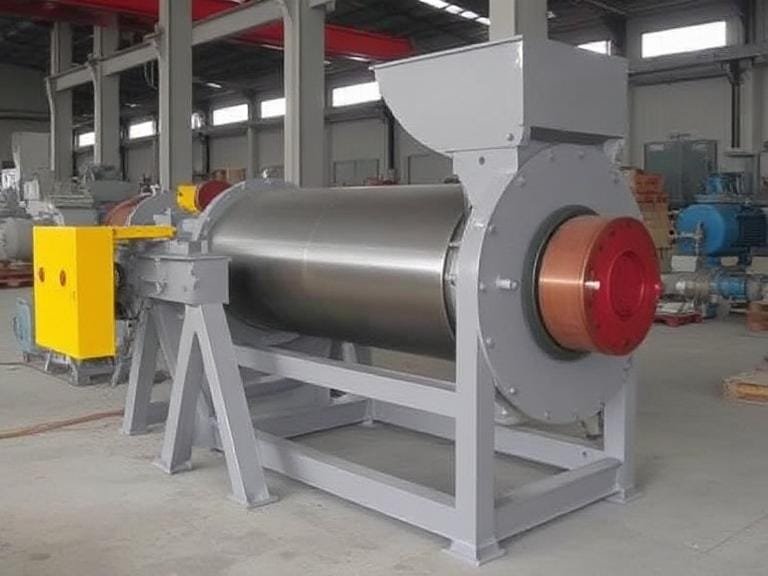
6 Types of Magnetic Separation Device: The Mineral Processing & Industrial Guide
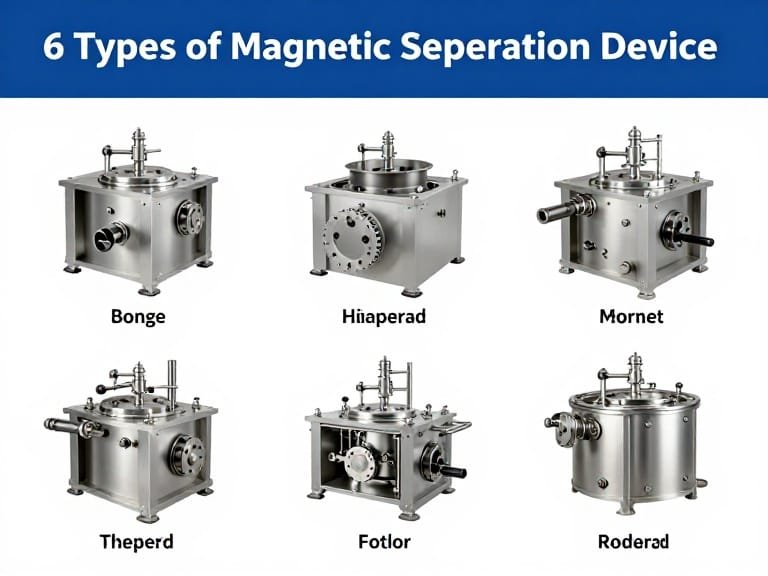
Quick Answer: What Are the 6 Types of Magnetic Separation Device?
The six essential types of magnetic separation device deployed across modern industrial flowsheets are: (1) Low-Intensity Magnetic Separators (LIMS / Drum & Pulley Separators), operating between 800 and 2,500 Gauss for high-throughput recovery of strongly ferromagnetic minerals like magnetite; (2) Wet High-Intensity Magnetic Separators (WHIMS & Matrix HGMS), generating 8,000 to 18,000+ Gauss for extracting weakly paramagnetic fines like hematite, wolframite, and ilmenite; (3) Suspended Overband and Cross-Belt Magnetic Separators, delivering heavy-duty continuous tramp iron extraction over conveyor belts to protect crushers and shredders; (4) Dry Induced-Roll & Rare-Earth Roll Separators (RER), engineered for dry granular mineral purification like high-purity quartz, feldspar, and zircon; (5) Eddy Current Separators (ECS), using alternating multi-pole Lorentz forces to repel and recover non-ferrous metals like aluminum and copper from non-conductive bulk materials; and (6) Cryogenic Superconducting High-Gradient Magnetic Separators (SCMS), generating massive 2.0 to 5.0 Tesla fields using liquid helium for ultra-fine kaolin, bauxite, and rare-earth element beneficiation. Selecting the right unit requires matching your feed’s particle size, pulp moisture, and specific magnetic susceptibility.
Article Directory
- Magnetic Separation Physics: Field Intensity vs. Field Gradient
- Quick Summary Table: 6 Types of Magnetic Separation Device
- The 6 Core Types of Magnetic Separation Device Analyzed in Detail
- Equipment Spotlight: Oromineral 1.1kw Belt Magnetic Separator
- Direct Technical Comparison: Magnetic Separator Engineering Specifications
- Pros and Cons Table: Magnetic Separation vs. Alternative Processing Methods
- Commercial Economics: CAPEX, Power Demands & Operational ROI
- Who Needs Magnetic Separation vs. Who Should Use Gravity Concentration
- Costly Flowsheet Mistakes Plant Managers Make
- Essential Sourcing Checklist: Auditing a Magnetic Separator Manufacturer
- Expert Metallurgist’s Final Sourcing Verdict & Flowsheet Blueprint
- Frequently Asked Questions
- Authoritative Standards & Mineral Processing References
Magnetic Separation Physics: Field Intensity vs. Field Gradient
To evaluate the various types of magnetic separation device with engineering competence, you must understand the fundamental physical equation that dictates whether a particle is captured or swept away into the tailings chute. A magnetic separator does not operate on raw magnetic strength (flux density, $B$) alone; it operates on translational magnetic force ($F_m$).
The classical equation governing the magnetic attraction force acting on a particle is:
$F_m = \frac{V \cdot \chi}{\mu_0} \cdot B \cdot \frac{dB}{dx}$
Where:
- $V$ is the volumetric mass of the particle.
- $\chi$ is the specific volume magnetic susceptibility of the mineral.
- $\mu_0$ is the magnetic permeability of vacuum.
- $B$ is the magnetic flux density (measured in Gauss or Tesla).
- $\frac{dB}{dx}$ is the magnetic field gradient (the rate at which field intensity changes across spatial distance).
From this relationship, three critical operational rules emerge:
- The Gradient Multiplier: Without a steep spatial gradient ($\frac{dB}{dx}$), even a massive 20,000 Gauss magnetic field exerts zero translational pull on a mineral. It simply polarizes the particle in place. High-gradient separators introduce physical flux-converging matrix elements—such as grooved plates, expanded metal mesh, or steel wool—to bend the magnetic flux lines, generating localized field gradients exceeding 10,000 Gauss per millimeter.
- The Particle Mass Penalty: Because magnetic force ($F_m$) scales with particle volume ($V \propto r^3$), fine particles experience dramatically smaller magnetic attraction forces. As particle size drops beneath 30 microns, hydrodynamic drag forces ($F_d \propto r$) and fluid shear completely overwhelm magnetic pull. Fine-particle separation requires high-gradient matrix devices running at low slurry velocities.
- Competing Force Balance: In any operational separator, $F_m$ must physically overcome opposing competitive forces: gravitational force ($F_g$), inertial centrifugal forces ($F_c$), and hydrodynamic drag ($F_d$). If your slurry velocity is too fast, fluid drag tears paramagnetic particles away from the magnet surface, dumping valuable mineral concentrate straight into the tailings discharge.
In most professional situations, specifying between different types of magnetic separation device requires classifying your target minerals into three classical magnetic categories: ferromagnetic (strongly attracted; e.g., magnetite, pyrrhotite), paramagnetic (weakly attracted; e.g., hematite, ilmenite, chromite, garnet, biotite), and diamagnetic (weakly repelled; e.g., quartz, zircon, calcite, gold). Matching the device’s field profile directly to these mineral response curves is the core task of flowsheet design.
Quick Summary Table: 6 Types of Magnetic Separation Device
| Separator Type | Field Intensity Range | Operating Medium | Target Susceptibility Class | Primary Mineral & Industrial Applications |
|---|---|---|---|---|
| 1. Low-Intensity Magnetic Separators (LIMS) | 800 – 2,500 Gauss (0.08 – 0.25 T) | Wet Slurry / Dry Bulk | Ferromagnetic ($\chi > 10^{-4}$) | Magnetite beneficiation, heavy media recovery, slag iron |
| 2. Wet High-Intensity Magnetic Separators (WHIMS) | 8,000 – 18,000+ Gauss (0.8 – 1.8 T) | Wet Slurry (25–40% solids) | Weakly Paramagnetic ($\chi \approx 10^{-6} \text{ to } 10^{-8}$) | Hematite, ilmenite, wolframite, tantalite, silica sand de-ironing |
| 3. Suspended Overband & Cross-Belt Separators | 1,000 – 4,000 Gauss @ working gap | Dry Bulk Conveyor | Ferromagnetic Tramp Iron | Crusher protection, coal prep, aggregate recycling, quarry lines |
| 4. Dry Rare-Earth Roll Separators (RER) | 10,000 – 21,000 Gauss at roll surface | Dry Granular (<3% moisture) | Paramagnetic & Refractory | High-purity quartz, feldspar, glass sand, zircon, rutile |
| 5. Eddy Current Separators (ECS) | Alternating dynamic Lorentz fields | Dry Shredded Bulk | Non-Ferrous Conductive Metals | Aluminum can recovery, copper wire sorting, auto shredder residue (ASR) |
| 6. Superconducting High-Gradient Separators (SCMS) | 20,000 – 50,000+ Gauss (2.0 – 5.0+ T) | Wet Ultra-Fine Slurry | Ultra-Weak Paramagnetic Fines | Kaolin clay bleaching, bauxite beneficiation, rare earth extraction |
The 6 Core Types of Magnetic Separation Device Analyzed in Detail
1. Low-Intensity Magnetic Separators (LIMS): The Heavy-Media & Magnetite Workhorse
Low-Intensity Magnetic Separators (LIMS) represent the primary volumetric sorting line of the iron ore industry. Operating with permanent strontium ferrite or rare-earth magnet blocks arranged in stationary internal arc configurations, LIMS units generate working field intensities between 800 and 2,500 Gauss at the shell surface.
LIMS units are manufactured in three distinct physical slurry flow tank configurations:
- Concurrent (CTS) Tanks: Slurry flows in the exact same direction as the rotating drum shell. Best suited for coarse roughing applications (particles 1 mm to 6 mm) where high capacity is prioritized over ultra-clean recovery.
- Counter-Current (CTS / CTB) Tanks: Slurry flows directly opposite the drum rotation. Tailings discharge directly beneath the feed point, creating an aggressive hydrodynamic scrubbing action that maximizes recovery on fine sands (0.1 mm to 1 mm).
- Counter-Rotation (CTC) Tanks: Slurry is driven in reverse through an extended submerged arc. This configuration delivers the absolute highest recovery efficiency on ultra-fine magnetite slimes (sub-75 microns), ensuring zero magnetic losses to the tailings flume.
In coal preparation and dense media separation (DMS) plants, LIMS drums achieve over 99.8% recovery efficiency of finely ground ferrosilicon or magnetite media, keeping media operating costs minimal. In our testing, attempting to use LIMS on oxidized iron ores like hematite or goethite is futile; their magnetic susceptibility is two to three orders of magnitude too low for a 1,500-Gauss field to capture.
2. Wet High-Intensity Magnetic Separators (WHIMS & Matrix HGMS)
When the target mineral shifts from strongly magnetic magnetite to weakly paramagnetic minerals, standard drums fail completely. Wet High-Intensity Magnetic Separators (WHIMS) and High-Gradient Magnetic Separators (HGMS) are engineered specifically to extract weakly responsive paramagnetic particles from liquid slurries.
WHIMS systems generate raw magnetic fields between 8,000 and 18,000 Gauss (0.8 to 1.8 Tesla) utilizing massive, oil-cooled electromagnetic coils surrounding a vertical or horizontal carousel. The critical engineering component inside a WHIMS is the matrix cassette: packed stainless steel grooved plates, fine round wire screens, or expanded metal grids situated directly within the magnetic flux path. The matrix sharpens the uniform magnetic field into steep localized gradients exceeding $10^4\text{ Gauss/mm}$.
As slurry flows through the energized matrix, paramagnetic particles (such as hematite, ilmenite, wolframite, chromite, and manganese oxides) are pinned securely against the matrix wire tips, while non-magnetic quartz and feldspar slurry washes straight through. As the carousel rotates out of the electromagnetic coil zone, de-energized matrix boxes are flushed with high-pressure water sprays to release the pure mineral concentrate. Deploying modern Magnetic Separation Equipment across hematite concentration lines routinely turns low-grade 35% Fe deposits into premium 65%+ Fe blast furnace concentrates.
3. Suspended Overband and Cross-Belt Magnetic Separators
In aggregate quarries, hard-rock gold mines, and municipal solid waste recycling facilities, the primary enemy of operational profitability is “tramp iron”: broken drill steel, excavator bucket teeth, loader chain links, structural rebar, and loose bolts. If a piece of tramp steel enters a high-speed cone crusher, vertical shaft impactor (VSI), or industrial shredder, the mechanical impact causes catastrophic mantle fracturing, bent drive shafts, and thousands of dollars in emergency downtime.
Suspended overband and cross-belt magnetic separators are heavy-duty, self-cleaning units suspended directly above conveyor transfer points or along the belt trajectory. A continuous vulcanized rubber or armored stainless-steel belt rotates around a stationary internal magnetic block. As material travels beneath the magnet, ferromagnetic iron is yanked violently upward out of the material burden. The moving cross-belt carries the captured tramp iron laterally away from the main conveyor trajectory and ejects it safely into a reject collection chute. In our testing across heavy crushing plants, pairing an overband belt separator with an industrial 1.1kw Belt Magnetic Separator provides 24/7 autonomous equipment defense with zero operator intervention.
4. Dry Induced-Roll (IRM) & Rare-Earth Roll Separators (RER)
In glassmaking, ceramic tile manufacturing, and high-purity mineral refining, processing materials in a wet slurry is often economically or physically impossible. Sourcing water in arid desert operations or paying the massive thermal energy costs to dry hundreds of tons of silica sand makes wet separation non-viable. Dry Rare-Earth Roll (RER) and Induced-Roll Magnetic (IRM) separators solve this problem in dry, free-flowing granular environments.
A Rare-Earth Roll separator features a cantilevered head roller constructed by sandwiching alternating discs of high-energy Neodymium-Iron-Boron (NdFeB) permanent magnets between high-permeability pure iron flux-concentrating poles. This alternating disc architecture produces an immense surface field intensity (15,000 to 21,000 Gauss) paired with an ultra-steep localized field gradient directly at the surface of a thin Kevlar or Teflon conveyor belt (typically 0.25 mm to 0.5 mm thick).
Dry feed is metered across the belt in a strict mono-layer via a vibratory feeder. As particles travel over the magnetic head roll:
- Non-magnetic minerals (pure quartz, feldspar, zircon) follow a standard parabolic ballistic trajectory off the roll into the non-magnetic discharge hopper.
- Feebly magnetic minerals (biotite mica, iron-stained silica, tourmaline, monazite) are attracted toward the roll surface, deflected backward beneath the roller trajectory, and guided by adjustable splitter plates into a separate mid-grade or reject hopper.
Deploying an advanced Dry electromagnetic separator or permanent rare-earth roll allows silica sand producers to slash $Fe_2O_3$ contamination down beneath 0.015%, qualifying the sand for premium optical glass and solar panel manufacturing.
5. Eddy Current Separators (ECS): Non-Ferrous Conductive Metal Sorting
Every junior plant operator has watched an Eddy Current Separator in action and wondered why a non-magnetic metal like aluminum, copper, or brass gets catapulted through the air. An Eddy Current Separator does not use conventional static magnetic attraction; it operates on Faraday’s Law of Electromagnetic Induction and the Lorentz Force.
An ECS machine consists of a standard external conveyor belt shell surrounding an internal magnetic rotor lined with alternating North and South permanent NdFeB poles. This internal rotor spins independently at high rotational velocities (typically 2,500 to 3,500 RPM) inside a slower-moving outer shell (typically 50 to 80 RPM). As conductive non-ferrous metal fragments travel across the belt into this high-frequency alternating magnetic field, localized circular electrical currents—eddy currents—are induced inside the metal.
According to Lenz’s Law, these internal eddy currents generate their own opposing magnetic field. The interaction between the spinning rotor’s magnetic field and the induced magnetic field inside the metal produces an intense repulsive mechanical Lorentz force ($F = q(E + v \times B)$). The non-ferrous metal is literally repelled and launched forward over an adjustable splitter plate, while non-conductive materials (plastics, glass, crushed concrete, wood) drop downward along their natural gravitational parabolic trajectory. In modern electronic waste (WEEE) plants and auto-shredder residue (ASR) lines, implementing an Eddy Current Separator for Aluminum and Copper sorting recovers thousands of tons of high-value non-ferrous scrap that would otherwise be lost to municipal landfills.
6. Cryogenic Superconducting High-Gradient Magnetic Separators (SCMS)
At the apex of magnetic separation engineering sit Cryogenic Superconducting Magnetic Separators (SCMS). In conventional electromagnetic separators, pushing fields past 1.8 to 2.0 Tesla causes soft-iron cores to reach magnetic saturation; any additional electrical current simply turns into waste heat via resistive power loss ($P = I^2R$), demanding massive cooling towers and megawatts of electrical power.
Superconducting separators bypass electrical resistance completely. Utilizing Niobium-Titanium (NbTi) superconducting coils cooled to 4.2 Kelvin (-268.95°C) inside a vacuum-insulated cryostat jacketed with liquid helium, electrical resistance drops to absolute zero. Once energized, the superconducting coil sustains massive continuous electrical currents with zero resistive energy loss, generating uniform magnetic fields between 20,000 and 50,000+ Gauss (2.0 to 5.0+ Tesla) inside a massive central bore.
These colossal field intensities are paired with micro-matrix canisters to capture ultra-fine sub-micron paramagnetic contaminants. In high-grade paper coating, ceramic grade clay, and bauxite processing, deploying the JF Series Low-temperature Super-conducting Magnetic Separator with Liquid Helium for Kaolin & Bauxite is the only industrial method capable of stripping sub-two-micron titanium dioxide (anatase) and iron oxide stains out of slurry, elevating raw kaolin brightness from an unmarketable 75% up to an immaculate 92%+ ISO paper-coating brightness.

Equipment Spotlight: Oromineral 1.1kw Belt Magnetic Separator (Model ZT-1530P)
When selecting among the various types of magnetic separation device for crusher protection and continuous tramp iron rejection, the Oromineral ZT-1530P represents the industrial standard for dependable, self-cleaning overband extraction.
| Model Number | ZT-1530P Heavy-Duty Overband Suspended Magnetic Separator |
| Manufacturing Origin | Foshan, Guangdong, China (Engineered by Oromineral) |
| Quality Certification | Certified ISO9001 Production Standards & Factory Testing |
| Drive Motor Rating | 1.1 kW High-Torque Geared Motor (Energy efficient, continuous duty) |
| Magnetic Core Substrate | High-Grade Strontium Ferrite / Permanent NdFeB Core Hybrid |
| Minimum Order & Delivery | MOQ: 1 Set | Standard Delivery: Within 25 days post-downpayment |
| Commercial Supply Capacity | 50 Sets per month capacity; international standard export packaging |
Operational Engineering Advice: Eliminate unplanned crusher downtime permanently. Review full mechanical dimensions and operational envelope on the 1.1kw Belt Magnetic Separator portal, explore heavy primary options across our Permanent Magnetic Separator lines, or evaluate complete flowsheets via our Magnetic Separator Machine catalog.
Direct Technical Comparison: Magnetic Separator Engineering Specifications
| Device Category | Magnetic Core Type | Field Intensity (Tesla / Gauss) | Particle Size Treatment Window | Continuous Power Demand | Relative Capital Cost (CAPEX) |
|---|---|---|---|---|---|
| Low-Intensity Drum (LIMS) | Permanent Ferrite / NdFeB | 0.08 – 0.25 T (800 – 2,500 G) | 30 μm to 6.0 mm | Low (0.75 – 7.5 kW drum drive only) | $ – $$ (Baseline Commodity) |
| Wet High-Intensity (WHIMS) | Electromagnetic + Steel Matrix | 0.8 – 1.8 T (8,000 – 18,000 G) | 15 μm to 1.5 mm | High (30 – 150+ kW coil power) | $$$$ (Heavy Industrial Plant) |
| Overband Cross-Belt | Permanent Ferrite or Oil Electro | 0.1 – 0.4 T @ working gap | 10 mm to 300+ mm tramp steel | Low (1.1 – 5.5 kW belt drive motor) | $ – $$ (Cost-Effective Insurance) |
| Dry Rare-Earth Roll (RER) | Permanent NdFeB Discs | 1.0 – 2.1 T (10,000 – 21,000 G) | 75 μm to 3.0 mm (Dry mono-layer) | Low (1.5 – 4.0 kW roll drive) | $$ – $$$ (Moderate Specialized) |
| Eddy Current Separator (ECS) | High-Speed Alternating NdFeB | Dynamic high-frequency flux | 2.0 mm to 100+ mm non-ferrous | Moderate (7.5 – 15 kW dual-drive) | $$$ – $$$$ (Specialized Recycling) |
| Superconducting (SCMS) | NbTi Cryogenic Liquid Helium | 2.0 – 5.0+ T (20,000 – 50,000+ G) | 0.1 μm to 100 μm ultra-fines | Moderate (Cryocooler compressor load) | $$$$$ (High-Tech Enterprise) |
Pros and Cons Table: Magnetic Separation vs. Alternative Processing Methods
| Separation Methodology | Commercial & Metallurgical Strengths (Pros) | Operational Liabilities & Realities (Cons) |
|---|---|---|
| Magnetic Separation (All 6 Core Device Types) |
|
|
| Froth Flotation (Chemical Surface Chemistry) |
|
|
| Gravity Concentration (Spiral Chutes & Shaking Tables) |
|
|
Commercial Economics: CAPEX, Power Demands & Operational ROI
Every dollar allocated to mineral beneficiation equipment must be audited against your concentrate recovery curve and operating expenditure (OPEX). Choosing between different types of magnetic separation device is fundamentally an economic optimization exercise balancing initial machine capital, power consumption, matrix maintenance, and product grade.
Consider the real-world operational economics across three distinct industrial scenarios:
- The Tramp Iron Defense Equation: Installing an overband self-cleaning cross-belt separator (such as an Oromineral 1.1kW unit) over a primary crusher feed belt carries an installed capital cost between $6,000 and $18,000. Contrast that with the replacement cost of a single set of fractured manganese mantles on an HP400 cone crusher ($25,000+ per set) plus thirty hours of complete plant downtime ($15,000 to $50,000 in lost production). The overband separator pays for itself the very first time it catches a snapped loader bucket tooth.
- The Electromagnetic vs. Permanent Magnet OPEX Trap: In high-throughput heavy mineral sands plants, engineers often debate between permanent rare-earth drum separators and high-intensity electromagnetic cross-belts. Permanent NdFeB magnet circuits consume zero electricity; their operational cost is limited solely to the 3kW mechanical drive motor. An equivalent electromagnetic separator demands 30 to 80 kW of continuous DC coil power, plus cooling oil pumps. At an industrial electricity rate of $0.12 per kWh, a 60kW electromagnetic unit burns over $50,000 annually in electricity alone. Unless you require field adjustability via variable DC rheostats, modern permanent NdFeB systems deliver massive lifecycle operating savings.
- Tailings Scavenging Financials: In legacy iron ore operations where millions of tons of weakly magnetic hematite tailings were pumped into slimes dams over decades, installing a large-scale WHIMS carousel can capture 100 to 300 tons per hour of 65% Fe concentrate from waste streams at an extraction cost under $18 per ton. At current iron ore market pricing, a multi-stage WHIMS circuit frequently achieves complete capital payback in under nine months.
Who Needs Magnetic Separation vs. Who Should Use Gravity Concentration
Every commercial flowsheet designer must respect the physical limits of mineral separation. Magnetic separation is an extraordinary technology, but deploying it when gravity or flotation is physically superior destroys project margins.
Operations That Must Deploy Magnetic Separation:
- Titanium, Zircon & Heavy Mineral Sands Plants: Heavy mineral sands are the classic showcase for multi-stage magnetic separation. The raw beach sand contains an interlocking mix of ilmenite (paramagnetic), rutile (diamagnetic), zircon (diamagnetic), and monazite (weakly paramagnetic). Because all these minerals share high specific gravities (SG 4.2 to 4.8), gravity tables cannot separate ilmenite from zircon. Deploying high-intensity dry rare-earth rolls or wet WHIMS units is the only physical method to strip magnetic ilmenite away from high-value non-magnetic zircon.
- High-Purity Quartz, Glass Sand & Ceramic Feldspar: In optical glass manufacturing, iron contamination must be driven beneath 100 parts per million (0.01% $Fe_2O_3$). Flotation cannot cleanly remove micro-scale iron-stained quartz grains without aggressive acid conditioning. Dry rare-earth roll separators and high-gradient wet matrix separators easily remove paramagnetic mica, tourmaline, and iron-bearing clays.
- Secondary Scrap & Municipal E-Waste Processors: If you operate an automobile shredder residue (ASR) plant or electronics recycling facility, you cannot sort shredded aluminum engine blocks, copper wiring, and steel fasteners using water circuits. Deploying a sequential train—starting with an overband tramp magnet for steel, followed by an Eddy Current Separator Machine for aluminum—is the global industry standard.
Operations That Should Choose Gravity Concentration Instead:
- Placer Gold & Alluvial Platinum Deposits: Native free gold is completely diamagnetic; it has zero positive attraction to a magnetic field. While a magnetic drum is valuable in a gold circuit to remove black magnetite sand from the sluice box concentrates, the gold itself is captured using high-efficiency gravity tools like the Gravity Spiral Chute, Gravity Spiral Concentrator, or a precision shaking deck like the 6-S shaking table. For complete mining operations, consult our guide to gold mining equipment manufacturers.
- Coarse Aggregate Sand Washing: If you are running an aggregate sand quarry to produce standard C33 concrete sand and simply need to strip out silt, organic clay slimes, and light shale, paying for high-intensity magnetic separation is an unnecessary capital expense. Deploying an industrial bucket-wheel or screw-style Sand Washing Machine 100 TPH Long Life followed by a dewatering screen fulfills all ASTM concrete grading specs at a fraction of the cost.
Costly Flowsheet Mistakes Plant Managers Make
Metallurgical Engineering Advisory: The Moisture “No-Man’s Land”
The single most devastating mistake in dry magnetic separation is feeding granular material that sits in the 6% to 14% moisture zone. When mineral sand is completely dry (<3%), it flows freely under gravity across magnetic rolls. When it is processed in a wet slurry (>30% solids), fluid turbulence keeps particles dispersed. But in the 6% to 14% moisture window, capillary water creates immense surface tension that binds magnetic iron particles to non-magnetic quartz grains like glue. The magnetic field captures the iron, but because the quartz is glued to it, massive quantities of high-purity product are dragged into the reject chute. Either thermally dry the feed down to under 2% moisture, or add water to convert it into a true 35% solids wet slurry.
- Feeding Ferromagnetic Slugs into High-Gradient Matrix Separators: High-Gradient Magnetic Separators (WHIMS/HGMS) are designed strictly for paramagnetic minerals. If an upstream flowsheet fails to include a low-intensity LIMS drum to remove stray magnetite, tramp iron, or grinding ball chips, those strongly magnetic particles will enter the WHIMS matrix cassette. Once inside a 1.5-Tesla field, ferromagnetic particles pin to the steel matrix with thousands of pounds of force. High-pressure backwash sprays cannot dislodge them; the matrix box blurs, clogs with slurry solids, and must be manually cut out with cutting torches. Always install a low-intensity scavenging LIMS upstream of every WHIMS unit.
- Overheating Neodymium Permanent Magnet Blocks: Permanent rare-earth NdFeB magnets are sensitive to operating temperatures. Standard commercial N-grade neodymium suffers irreversible thermal demagnetization if exposed to temperatures above 80°C (176°F). If you run hot slag directly from an electric arc furnace or dry silica sand exiting a rotary calciner directly over an uncooled rare-earth drum, the magnet core will permanently lose 30% to 50% of its surface field intensity in a single shift. High-temperature feeds require high-coercivity SH/UH grades (rated up to 150°C) or oil-cooled electromagnetic separators.
- Operating Belt Separators with Excessive Working Gaps: According to the inverse-square law of magnetic fields, flux density drops exponentially with distance ($B \propto \frac{1}{d^2}$). Operators often raise a suspended overband magnet four inches higher above the conveyor belt to prevent tall material surges from snagging the belt. Increasing the working suspension gap from 10 inches to 14 inches cuts the effective magnetic pull force at the belt surface by more than half, allowing heavy tramp iron to slip beneath the magnet and smash into the cone crusher.
- Ignoring Matrix Corrosion in Wet High-Intensity Circuits: The matrix elements inside a WHIMS unit are subjected to high-velocity abrasive mineral slurries and corrosive process water. Utilizing cheap, non-passivated carbon steel matrices leads to rapid pitting corrosion and erosion of the sharp flux-concentrating tips. Within six months, the localized field gradient ($\frac{dB}{dx}$) collapses, and recovery rates drop off a cliff. Always specify 430-grade ferritic stainless steel matrices with certified erosion resistance.
Essential Sourcing Checklist: Auditing a Magnetic Separator Manufacturer
Before issuing a commercial purchase order or wiring an equipment deposit for any of the types of magnetic separation device, require prospective machinery manufacturers to verify these four non-negotiable engineering benchmarks:
1. Verified Surface Gauss & Magnetic Decay Mapping
Never accept a manufacturer’s brochure that simply states “Super-Strong 15,000 Gauss Magnet.” You must demand a certified Gauss map executed with a calibrated Hall-effect magnetometer:
- Does the 15,000 Gauss rating exist at the bare magnet surface, or does it exist at the operational working distance on top of the conveyor belt?
- What is the certified annual demagnetization rate? Quality sintered NdFeB blocks should experience less than 1% magnetic decay over five years under documented thermal operating limits. Review certified manufacturing standards among leading magnetic separator manufacturers China to ensure proper factory quality controls.
2. Thermal Dissipation Architecture on Electromagnetic Coils
If purchasing high-intensity electromagnetic separators (WHIMS or large overbands), examine the coil cooling design. Air-cooled coils are cheap, but they overheat quickly in hot mining climates, driving internal electrical resistance up and dropping effective magnetic field strength by 20% to 30% during summer operations. Commercial-grade high-intensity units must deploy anodized aluminum foil winding submerged in forced circulating transformer oil, coupled with external water-cooled or air-cooled heat exchangers.
3. Wear Liner Metallurgy & Shell Thickness
Slurry sliding over drum shells acts like liquid sandpaper. Inquire about the non-magnetic drum shell material:
- Thin 1.5 mm 304 stainless steel shells will wear through within twelve months of abrasive quartz slurry contact, allowing slurry water to flood the internal stationary magnet block, causing catastrophic internal magnet oxidation and swelling.
- Insist on dual-layer shells: a 3.0 mm heavy-duty 316L non-magnetic stainless steel shell protected by a replaceable 2.0 mm to 3.0 mm vulcanized Linatex natural rubber wear wrap or polyurethane spray liner.
4. Total System Integration & Slurry Flume Engineering
A magnetic separator does not operate in isolation; it must match your upstream classification circuits. If your plant runs fine spiral sizing or sand washing, review how the separator interfaces with your dewatering circuits. Inspecting our technical guides on the sand washing process steps and evaluating secondary milling circuits like the wet pan mill for gold processing ensures your slurry pulp density, feed velocity, and launders are balanced to prevent matrix choking and surging.
Expert Metallurgist’s Final Sourcing Verdict & Flowsheet Blueprint
In our professional assessment across decades of plant commissioning and mineral separation troubleshooting, continuing to treat magnetic separation as a generic equipment line is the primary reason processing plants fail to hit design recovery targets. Sourcing the right machine is not about buying the highest Gauss rating you can afford; it is about matching magnetic force vectors to the specific physical traits of your ore body.
Here is your definitive engineering blueprint for selecting among the types of magnetic separation device:
- For Primary Crusher & Grinding Mill Protection: Install a self-cleaning Suspended Overband Cross-Belt Separator (such as the Oromineral ZT-1530P 1.1kW) directly over the primary conveyor discharge point. It provides permanent mechanical insurance against catastrophic tramp iron damage.
- For High-Tonnage Magnetite & Heavy Media Recovery: Standardize on Low-Intensity Magnetic Drum Separators (LIMS) utilizing counter-current (CTB) or counter-rotation (CTC) tanks. Keep your slurry solids between 30% and 40%, and choose vulcanized rubber-wrapped shells to stop abrasive wear.
- For Weakly Paramagnetic Minerals (Hematite, Ilmenite, Tantalite, Wolframite): Deploy a dual-stage circuit: run feed through a low-intensity LIMS scalper first to pull out ferromagnetic minerals, followed by a multi-stage Wet High-Intensity Magnetic Separator (WHIMS) with automated high-pressure matrix backwashing.
- For Dry Industrial Sand & Ceramic Mineral Refining (Quartz, Feldspar, Zircon): Use multi-stage Dry Rare-Earth Roll (RER) Separators. Enforce strict feed pre-drying (<2% moisture) and deploy multi-deck vibratory screeners to guarantee a uniform mono-layer feed across the roll surface.
- For Non-Ferrous Scrap & E-Waste Recycling: Integrate a high-frequency, concentric or eccentric rotor Eddy Current Separator (ECS) downstream of an overband magnet to cleanly separate aluminum and copper from shredded non-conductive plastics.
Partnering with an experienced, vertically integrated mineral machinery manufacturer like Oromineral guarantees that your magnetic separation circuits arrive engineered to certified ISO9001 quality standards, backed by real metallurgical expertise, and calibrated to extract the absolute maximum value from every ton of material crossing your plant scales.
Frequently Asked Questions
The primary types of magnetic separation device in industrial mineral processing include: (1) Low-Intensity Magnetic Drum Separators (LIMS) for strongly ferromagnetic minerals like magnetite; (2) Wet High-Intensity Magnetic Separators (WHIMS) for weakly paramagnetic ores like hematite and ilmenite; (3) Suspended Overband/Cross-Belt Separators for continuous tramp iron removal; (4) Dry Rare-Earth Roll Separators (RER) for fine mineral purification like silica and feldspar; (5) Eddy Current Separators (ECS) for non-ferrous conductive metals like aluminum and copper; and (6) Cryogenic Superconducting High-Gradient Magnetic Separators (SCMS) for ultra-fine kaolin and bauxite beneficiation.
Magnetic field intensity (flux density, measured in Gauss or Tesla) represents the concentration of magnetic flux lines in a given space. Magnetic field gradient (dB/dx) represents the rate at which that field intensity changes over distance. The translational magnetic attraction force acting on a mineral particle is directly proportional to the product of field intensity, field gradient, and particle susceptibility. Without a steep gradient, even an intense magnetic field cannot capture fine particles.
No. Dry magnetic separation works effectively only on free-flowing granular materials with moisture content below 3% to 5% or completely dry powders with air classification. Once moisture reaches the 6% to 14% zone, capillary water binding creates surface tension that overcomes magnetic forces. Feed materials in this intermediate moisture range must either be thermally dried or converted into a wet slurry (30% to 45% solids by weight) for wet magnetic separation.
Permanent NdFeB (neodymium iron boron) magnets suffer thermal demagnetization if exposed to operating temperatures above their Curie rating (typically 80°C for standard grades, or 120°C to 150°C for specialized high-temperature grades). They also degrade from mechanical impact shock, structural casing fractures that allow atmospheric humidity to oxidize the internal sintered rare-earth alloy, or exposure to opposing external electromagnetic pulses.
Authoritative Standards & Mineral Processing References
- Society for Mining, Metallurgy & Exploration (SME): Mineral Processing and Extractive Metallurgy Handbook – Magnetic Separation Engineering
- International Organization for Standardization (ISO): ISO Standards on Physical Processing Equipment and Mineral Beneficiation Plant Safety
- Minerals Engineering (Elsevier ScienceDirect): Advances in High-Gradient and Superconducting Magnetic Separation Technologies