The Definitive 7 Small Scale Gold Mining Equipment List: 2026 B2B Procurement Guide
The era of treating small scale gold mining as a haphazard, weekend endeavor is over. In 2026, tightening environmental regulations, fluctuating global gold valuations, and the depletion of easily accessible surface deposits mean that profitability requires strict industrial discipline. If you are attempting to process 20 tons of ore per hour using pieced-together, mismatched machinery bought from unverified vendors, you are actively hemorrhaging fine gold into your tailings pond. From our experience at Oromineral, engineering systems for syndicate investors and junior mining corporations, success is not determined by the size of your claim, but by the mathematical efficiency of your recovery circuit.
In most professional situations, operators fail because they lack a systematic approach to mineral liberation and gravity separation. They buy a crusher without calculating the feed size required for their concentrator, creating a massive operational bottleneck. You must use commercial and practical judgment when assembling your processing plant. You need a synchronized, closed-circuit system designed specifically for either placer or hard rock deposits. In this authoritative guide, we take a rigid, opinionated stance on the exact 7 small scale gold mining equipment list components you must procure. We will explain precisely what each machine does, whether it is actually worth buying for your specific ore type, and how to avoid the catastrophic procurement mistakes that bankrupt novice operators.
Quick Answer: The Essential 7-Item Equipment List
If you are drafting an immediate procurement strategy, your core processing plant must include these seven synchronized components to ensure maximum recovery of both coarse and fine gold:
- Jaw Crusher: Mandatory for hard rock operations to break raw ore down to manageable sizes (primary crushing).
- Wet Pan Mill: The superior, cost-effective alternative to ball mills for secondary grinding and amalgamation.
- Trommel Screen: Essential for placer mining to wash and classify gravel, rejecting large barren rocks.
- Centrifugal Concentrator: The absolute gold standard for capturing microscopic fine gold (down to 300 mesh) that sluices lose.
- Sluice Box (with advanced matting): The primary rougher for catching heavy nuggets and bulk coarse gold directly out of the trommel.
- Shaking Table: The final finishing tool used to separate pure gold dust from heavy black sands without using toxic chemicals.
- Magnetic Separator: Critical for removing magnetic iron (magnetite) from the concentrate, improving the shaking table’s efficiency.
We recommend sourcing these components as a turnkey modular plant from established gold processing equipment manufacturers to ensure matching throughput capacities (TPH) across every stage.
Table of Contents
- What It Is: The Modern Small Scale Circuit
- How It Works: Physics of Gravity Separation
- The 7 Small Scale Gold Mining Equipment List
- Commercial Benefits of a Modular Setup
- Limitations and Operational Realities
- Who Should Deploy This Equipment
- Who Does Not Need Commercial Gear
- Common Procurement Mistakes
- Expert Buying Considerations
- Summary and Comparison Tables
- Expert Recommendation & Hardware Spotlight
- Frequently Asked Questions
What It Is: The Modern Small Scale Circuit
When we refer to a small scale gold mining equipment list, we are not talking about gold pans and hobbyist high-bankers. We are defining a professional, commercial-grade mineral processing circuit capable of handling between 5 and 50 Tons Per Hour (TPH). This list represents the physical realization of the mineral processing stages explained by metallurgical engineers: Comminution (crushing/grinding), Classification (sizing), Concentration (gravity/magnetic), and Tailings Management.
How It Works: The Physics of Gravity Separation
How it works relies entirely on the specific gravity of gold. Gold is incredibly dense (specific gravity of 19.3), meaning it is roughly 19 times heavier than an equal volume of water, and significantly heavier than quartz or typical host rock (specific gravity of 2.6 to 2.8). Every piece of equipment on this list utilizes water dynamics and kinetic energy to force the lighter waste rock (gangue) away, allowing the heavy gold to settle and be captured.
The 7 Small Scale Gold Mining Equipment List: Detailed Breakdown
In our testing and global deployment of mining infrastructure, these seven machines form the unbreakable backbone of a profitable recovery plant.
1. Primary Jaw Crusher
If you are operating a hard rock mine, you cannot extract gold until you liberate it from the quartz vein. A primary jaw crusher takes 10-inch rocks and aggressively fractures them down to 1-inch pieces. For heavy-duty applications, do not buy lightweight crushers; you need heavy cast-iron flywheels and high-manganese steel jaw plates capable of running 12 hours a day without catastrophic bearing failure.
2. Wet Pan Mill (Secondary Grinding)
Once the ore is crushed, it must be ground into a fine powder to release microscopic gold. While massive industrial mines use expensive ball mills, small scale operators should look into a wet pan mill for gold processing. It is highly cost-effective, easy to maintain, and simultaneously grinds the ore while acting as an amalgamator if you utilize a mercury-free chemical recovery process.
3. Rotary Trommel Screen
For alluvial (placer) mining in riverbeds, the trommel is the heart of the operation. It acts as a massive washing machine. Excavators dump raw, clay-heavy gravel into the rotating drum. High-pressure water jets break apart the clay, while the screen sizing (typically 6mm to 10mm) allows fine gold-bearing sands to drop through to the recovery system, rejecting the oversized, worthless boulders out the back.
4. Centrifugal Concentrator
This is where modern technology replaces outdated methods. A centrifugal concentrator (such as a Knelson or Falcon type) spins at high RPMs, creating a massive G-force bed. It traps fine and ultra-fine gold particles that would otherwise wash right over a traditional sluice box. If your operation lacks a centrifugal concentrator, you are losing up to 30% of your total yield.
5. Industrial Sluice Box
Do not underestimate the sluice box. As a primary rougher, an industrial sluice placed under the trommel discharge catches the coarse gold and heavy nuggets immediately. Modern sluices utilize specific rubber matting profiles (like vortex or drop-riffle designs) that create localized low-pressure zones, trapping heavy metals efficiently with zero moving parts.
6. Shaking Table
Once your concentrators and sluices give you a rough concentrate, you have a mix of gold and heavy black sands (magnetite, hematite). A shaking table uses a subtle, asymmetric vibration and a thin film of water to separate the gold from the black sand based on minute differences in density. It produces a highly pure, smelt-ready gold concentrate without the need for toxic cyanidation.
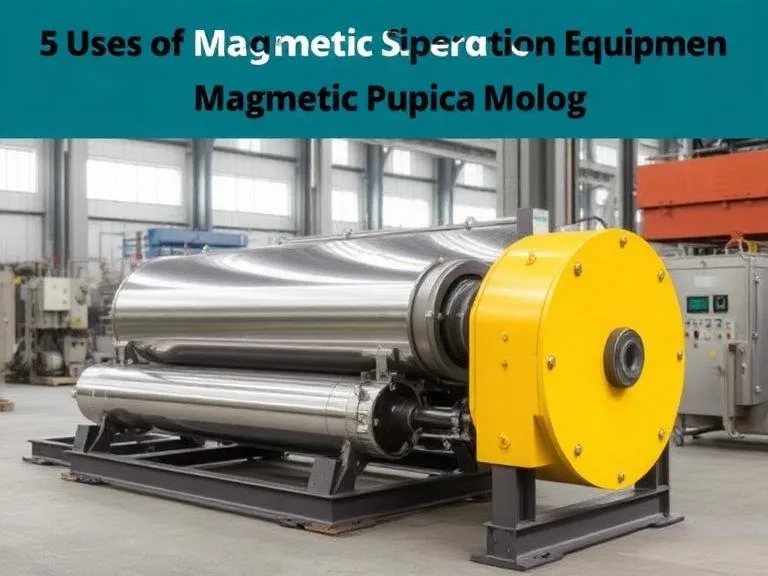
7. Wet High Intensity Magnetic Separator
Before putting your heavy concentrate on a shaking table, you must remove the magnetic iron. Black sands clog shaking tables and reduce gold recovery. By integrating a magnetic separator into your final cleaning stage, you pull the iron out magnetically, leaving clean gold and silica. For operators looking to source reliable units, evaluating magnetic separator manufacturers China provides excellent cost-to-performance ratios.

Wet High Intensity Magnetic Separator (WHIMS-002)
To maximize the efficiency of your final gold recovery, removing magnetic interference is mandatory. The Oromineral WHIMS-002 is engineered specifically for heavy mineral sands, providing a highly customizable magnetic field to strip away barren magnetite before it reaches your shaking table.
- Magnetic Field Strength: Up to 2.0 Tesla (customizable for specific ore profiles)
- Capacity & Feed: Handles 1-50 t/h with a feed particle size of ≤ 3mm.
- Construction: Built for harsh environments with Stainless Steel 304/316 and heavy-duty rubber linings.
- Compliance: ISO 9001:2015 and CE certified, with optional ATEX for hazardous zones.
Commercial Benefits of a Modular Setup
The primary benefit of utilizing this exact 7-piece small scale gold mining equipment list is modular scalability. Unlike massive, fixed-plant infrastructure, skid-mounted trommels and concentrators can be relocated as the ore body shifts. This severely reduces haulage costs. Furthermore, relying on physical gravity separation rather than chemical leaching (cyanide) vastly reduces your environmental liability and accelerates the permitting process with local governments.
Limitations and Operational Realities
We must use commercial and practical judgment: gravity separation has hard limits. If your gold is “refractory”—meaning it is chemically locked inside sulfide minerals (like pyrite or arsenopyrite)—no amount of crushing or centrifugal spinning will extract it. Refractory ores require complex roasting or pressure oxidation circuits that are far beyond the scope and budget of small scale operations. Always conduct a metallurgical assay on your core samples before buying equipment.
Who Should Deploy This Equipment
For Commercial Users and Junior Mining Syndicates: Operations aiming to process 100 to 500 tons of material per day in remote locations (Africa, South America, or rugged North American claims) are the exact target demographic. This equipment bridges the gap between artisanal manual labor and multi-million-dollar corporate infrastructure.
Who Does Not Need Commercial Gear
For Beginners and Weekend Prospectors: If your claim is a tiny creek and your budget is under $5,000, do not attempt to buy jaw crushers and centrifugal concentrators. You lack the water rights and the heavy machinery (excavators) required to feed them. Stick to a portable 2-inch dredge and a highbanker.
Common Procurement Mistakes
From our experience auditing failed mining operations, the most devastating mistake is throughput mismatch. A client will buy a trommel capable of washing 50 TPH, but funnel the output into a sluice box designed for 10 TPH. The water velocity blows the sluice out, and all the gold is washed into the tailings. When sourcing from mining equipment manufacturers global, you must demand a unified flow sheet where the capacity of stage B perfectly matches the discharge of stage A.
Expert Buying Considerations
When executing your capital expenditure, prioritize parts availability over initial unit cost. A cheap Chinese jaw crusher is useless if you have to wait six weeks for a replacement toggle plate while your crew sits idle. Partner with gold mining equipment manufacturers like Oromineral that provide extensive spare parts kits, polyurethane screen meshes, and direct technical support for the lifespan of the machinery.
Summary and Comparison Tables
Comparison Table: Placer vs. Hard Rock Processing Lists
| Processing Stage | Placer Mining (Alluvial Gravels) | Hard Rock Mining (Quartz Veins) |
|---|---|---|
| Liberation / Sizing | Trommel Screen (Washing & Classifying) | Jaw Crusher & Hammer Mill / Wet Pan Mill |
| Primary Roughing | Sluice Box with aggressive matting | Centrifugal Concentrator (Batch discharge) |
| Secondary Catch | Centrifugal Concentrator (for fine sands) | Secondary Sluice |
| Final Cleanup | Magnetic Separator & Shaking Table | Magnetic Separator & Shaking Table |
Pros and Cons of Small Scale Gravity Processing
| Pros (Why it is highly profitable) | Cons (The operational reality) |
|---|---|
| Low capital expenditure compared to CIL/CIP chemical plants. | Cannot recover ultra-fine gold locked in complex sulfides. |
| Rapid deployment and high mobility across the claim site. | Requires a massive, continuous supply of clean water to operate. |
| Environmentally safe; no toxic cyanide or mercury required. | Requires highly skilled operators to tune water flow and table vibration. |
Expert Recommendation
Is it actually worth investing heavily in this complete 7-item small scale gold mining equipment list? Emphatically, yes. Attempting to cut corners by skipping the magnetic separator or the centrifugal concentrator guarantees you will leave 20% to 40% of your gold in the dirt. We recommend that serious commercial operators treat mineral processing as a mathematical equation. To learn more about optimizing your entire circuit, from crushing to final recovery, explore our deep dive into the mineral processing techniques and equipment that drive modern profitability.
Frequently Asked Questions
How much does it cost to set up a small scale gold mining operation?
From our experience, a commercial-grade small scale setup handling 10 to 30 tons per hour requires an initial capital expenditure of $50,000 to $150,000, depending on whether you are processing alluvial (placer) deposits or hard rock ores that require extensive primary and secondary crushing infrastructure.
Which is better: a centrifugal concentrator or a traditional sluice box?
For fine gold recovery, a centrifugal concentrator is infinitely superior, capturing microscopic particles down to 300 mesh. A sluice box is a bulk roughing tool; it is excellent for capturing heavy nuggets and coarse gold but will lose up to 40% of fine gold to the tailings. In most professional situations, both are used in tandem.
Do I need a magnetic separator for gold mining?
Yes, if you are processing placer deposits rich in black sands (magnetite). A magnetic separator pulls the magnetic iron out of your heavy mineral concentrate, drastically reducing the volume of material you must process on your shaking table to recover the final pure gold.
What is the best equipment for processing hard rock gold?
Unlike placer mining, hard rock requires comminution. The mandatory equipment list includes a primary Jaw Crusher, a secondary Wet Pan Mill or Hammer Mill to grind the rock into powder, followed by a Centrifugal Concentrator and Shaking Table for gravity recovery.
Industry References & Authoritative Guidelines
To ensure our equipment specifications and metallurgical advice meet rigorous global standards, Oromineral aligns its manufacturing data with the following authoritative institutions:
- U.S. Geological Survey (USGS): Annual Mineral Commodity Summaries providing comprehensive data on global gold production, reserves, and the economic impact of artisanal and small-scale mining. Review USGS Gold Commodity Data
- Society for Mining, Metallurgy & Exploration (SME): The premier international organization representing mining professionals, publishing peer-reviewed standards on gravity gold recovery and mineral processing optimization. Review SME Metallurgical Standards
- CDC – NIOSH Mining: The National Institute for Occupational Safety and Health provides critical guidelines on hazard mitigation, machinery safeguarding, and safe operational practices for small-scale and commercial mining environments. Review NIOSH Mining Safety Guidelines