Top 5 Mining Separation Equipment Suppliers in the USA
Choosing among mining separation equipment suppliers in the USA is not simply a matter of comparing machine prices. The right supplier must match the separation technology to your ore characteristics, throughput, recovery target, water conditions, plant layout, and maintenance capabilities. A machine that performs well on one mineral deposit can deliver disappointing results on another.
For mine operators, mineral processors, aggregate producers, and engineering contractors, our recommendation is to shortlist suppliers by equipment specialization and technical support—not by marketing claims alone. This guide examines five established suppliers serving the US market, explains where each may fit, and shows how to evaluate alternatives, including equipment manufacturers such as ORO Mineral.
Direct Answer: Which Mining Separation Equipment Suppliers Should You Evaluate?
For buyers researching mining separation equipment suppliers in the USA, five companies worth evaluating are Eriez, Metso, FLS, Multotec, and TOMRA Mining. They represent different strengths across magnetic separation, flotation, mineral processing systems, gravity separation, and sensor-based sorting. This is a practical shortlist, not a verified ranking of the five largest suppliers or a claim that every company manufactures every separation technology in the United States.
- For magnetic separation: Evaluate Eriez and Metso for relevant magnetic technologies and application support.
- For integrated mineral processing: Consider Metso and FLS when separation equipment must fit into a broader process flowsheet.
- For gravity separation and mineral-specific equipment: Compare Multotec’s relevant product lines and testwork capabilities.
- For sensor-based ore sorting: Evaluate TOMRA Mining when the feed material and sorting objective are suitable for sensor-based technology.
- For direct equipment sourcing and configuration options: Include ORO Mineral in the comparison, especially for magnetic separation, gravity concentration, screening, and sand washing applications.
- Before placing an order: Request a test plan, documented performance assumptions, utility requirements, wear-part estimates, installation scope, and a clear warranty.
| Supplier | Primary evaluation area | Potentially suitable projects | What to verify |
|---|---|---|---|
| Eriez | Magnetic separation, flotation, and related process technologies | Mineral processing plants requiring specialized separation equipment | Applicable model, feed limits, recovery data, and US service coverage |
| Metso | Mineral processing equipment and integrated process solutions | New plants, plant upgrades, and projects needing coordinated equipment | Scope boundaries, commissioning, spare parts, and total installed cost |
| FLS | Mineral processing systems and separation-related technologies | Large or complex beneficiation projects | Technology fit, project delivery scope, and lifecycle service terms |
| Multotec | Mineral processing equipment, including gravity and classification-related applications | Ore-specific separation circuits and plant optimization | Local support, testwork, model availability, and replacement-part lead times |
| TOMRA Mining | Sensor-based ore sorting | Preconcentration and waste rejection before downstream processing | Ore test results, detection limits, throughput, and sorting economics |
These suppliers do not offer interchangeable solutions. A sensor sorter is not a substitute for a magnetic separator, and a gravity concentrator cannot automatically replace flotation. Start with the separation mechanism required by the ore, then compare suppliers that can demonstrate an appropriate technical fit.
Table of Contents
1. What Is Mining Separation Equipment?
Mining separation equipment separates valuable minerals from gangue, contaminants, or unwanted material by exploiting differences in physical or chemical properties. Depending on the ore and processing objective, these properties may include magnetic susceptibility, density, particle size, surface chemistry, electrical conductivity, or response to optical and other sensor signals.
In practice, separation rarely depends on a single machine. A processing plant may combine crushing, screening, classification, washing, gravity concentration, magnetic separation, flotation, and dewatering. The equipment sequence determines whether the plant can consistently produce a saleable concentrate at an acceptable operating cost.
Main types of mining separation equipment
- Magnetic separators: Remove magnetic contaminants or recover magnetic minerals. Applications depend on mineral susceptibility, particle size, moisture, and the required magnetic field.
- Gravity separators: Separate particles according to differences in density and their behavior in a fluid or flowing film. Spiral chutes and gravity concentrators may suit particular particle sizes and liberation conditions.
- Eddy current separators: Separate electrically conductive nonferrous metals from other materials. They are especially relevant to scrap and solid-waste recovery; they should not be treated as a universal solution for run-of-mine ore.
- Flotation equipment: Separates selected minerals using differences in surface properties, reagents, and aeration. Metallurgical testing is essential to determine the appropriate circuit.
- Sensor-based ore sorters: Identify and separate individual particles using suitable sensor signals. Their economics depend on detectable differences between valuable and waste material.
- Screening, washing, and classification equipment: Prepare feed material and control particle size or surface cleanliness. These operations can materially affect downstream separation performance.
For buyers, the most important distinction is between a machine that physically separates material and the complete process required to achieve the target recovery and product quality. A supplier’s equipment specification is only one part of that decision.
2. How We Evaluated the Five Mining Separation Equipment Suppliers
A useful supplier shortlist should reflect application fit rather than unsupported rankings. Company size, brand recognition, or a broad product catalog cannot establish whether a particular separator will work on a specific ore body.
For this comparison, we focus on five practical criteria:
- Technology specialization: Does the supplier offer a technology relevant to the target mineral and separation challenge?
- Process integration: Can its equipment fit the upstream and downstream stages without creating unnecessary bottlenecks?
- Testwork and engineering: Can the supplier help establish performance assumptions using representative feed material?
- Lifecycle support: Are installation, commissioning, operator training, replacement parts, and troubleshooting available for the project location?
- Commercial transparency: Does the quotation clearly state capacity assumptions, included components, exclusions, warranty conditions, and delivery responsibilities?
3. Top 5 Mining Separation Equipment Suppliers in the USA
1. Eriez — A Candidate for Specialized Magnetic Separation and Flotation Applications
Best fit: Projects that need a dedicated magnetic separation or flotation solution and value application-specific equipment selection.
Eriez is an established separation technology supplier with equipment used in mineral processing and other industrial applications. Its relevant product families may include magnetic separation and flotation technologies, depending on the feed and process objective.
We recommend putting Eriez on the shortlist when magnetic contaminants, magnetic mineral recovery, or a defined flotation duty is central to the project. This is particularly important when a separator must meet a specific product-purity target rather than simply remove visible contamination.
What to ask: Request confirmation of the recommended separator configuration, feed-size range, expected throughput, test conditions, and performance assumptions. For magnetic separation, ask how moisture, particle size, magnetic susceptibility, and the required separation intensity affect the result.
Potential limitation: A strong match for one separation process does not automatically make a supplier the best choice for an entire plant. If your project includes washing, classification, gravity concentration, and dewatering, compare the cost and integration effort of assembling a multi-vendor line.
Our view: Eriez is worth evaluating when a specialized separation duty is the core problem. The final decision should depend on model-level performance and service coverage, not brand recognition alone.
2. Metso — A Candidate for Integrated Mineral Processing Projects
Best fit: New mineral processing plants, major upgrades, and projects where separation equipment must be coordinated with other process stages.
Metso supplies equipment, technologies, and services for mining and aggregates. Its broader mineral processing portfolio makes it relevant when a buyer needs to consider how separation interacts with comminution, classification, dewatering, and plant operations.
For a project with multiple process interfaces, integrated engineering can reduce the burden of coordinating equipment specifications across suppliers. A process line is only as effective as its weakest interface: poor feed preparation, unstable slurry conditions, or inadequate downstream capacity can limit the performance of an otherwise capable separator.
What to ask: Request a clearly defined process and equipment scope. Confirm whether testwork, engineering, controls, installation supervision, commissioning, and operator training are included or separately priced. Ask for a responsibility matrix if other vendors will supply connected equipment.
Potential limitation: A broad integrated package may not be the lowest initial-cost option for a small replacement project. If only one separator needs replacing, compare the cost of a complete supplier package with a focused equipment purchase.
Our view: Metso deserves consideration when process coordination and lifecycle support matter as much as the separator itself. For smaller operations, insist on a scope that matches the project’s actual complexity.
3. FLS — A Candidate for Complex Beneficiation and Plant-Level Requirements
Best fit: Mining projects where separation is part of a larger beneficiation flowsheet and process engineering is a major purchasing consideration.
FLS serves the mining industry with mineral processing technologies, equipment, and services. Its suitability for a separation project depends on the required technology, current product offering, and the scope of engineering and support available for the target site.
For a complex plant, buying decisions should start with the metallurgical objective: concentrate grade, recovery, throughput, water consumption, and the operating envelope. Only after those requirements are defined should the buyer compare equipment packages and commercial terms.
What to ask: Identify which separation technologies are appropriate for your specific mineral. Request the basis of design, feed assumptions, process guarantees if offered, and the limits of any performance commitment. Ask how the supplier handles variability in ore hardness, mineralogy, and feed composition.
Potential limitation: Large-project capabilities are not proof that a particular product is the right match for a small or straightforward duty. Confirm the availability of the exact equipment and whether the project qualifies for the support level you need.
Our view: FLS is worth evaluating for projects where separation performance must be engineered alongside the rest of the processing circuit. Buyers should compare total project scope rather than relying on equipment descriptions alone.
4. Multotec — A Candidate for Mineral-Specific Separation and Process Equipment
Best fit: Operations evaluating mineral processing equipment for gravity separation, classification, screening, and related process duties.
Multotec offers mineral processing solutions across several equipment categories. Its relevance depends on whether the specific product line matches the mineral, particle-size distribution, feed characteristics, and operating conditions of the project.
Gravity separation deserves particular attention when valuable minerals have a useful density contrast and occur in a suitable particle-size range. A spiral concentrator or similar gravity device can be attractive where the feed is appropriately prepared and the process avoids the cost or complexity of a less suitable technology.
What to ask: Request testwork or comparable application data using representative material. Clarify how changes in feed size, solids concentration, slurry flow, and mineral liberation affect the operating window. Confirm local parts availability and the process for replacing wear components.
Potential limitation: Gravity separation is not universally effective. If mineral particles are too fine, insufficiently liberated, or too similar in density, a gravity-based solution may fail to meet the required recovery or concentrate grade.
Our view: Multotec is a reasonable candidate when its relevant mineral-processing product families match the process duty. Do not select gravity equipment solely because it appears mechanically simple or uses little energy; validate separation performance first.
5. TOMRA Mining — A Candidate for Sensor-Based Ore Sorting
Best fit: Mines investigating preconcentration, early waste rejection, or sorting individual particles before material enters a more energy-intensive processing stage.
TOMRA Mining specializes in sensor-based sorting technologies. Depending on the ore and the sensor method, sorting may help distinguish valuable material from waste before downstream processing.
The commercial attraction is straightforward: if a sorter rejects a meaningful proportion of waste while retaining enough valuable mineral, the plant may process less material in later stages. That can change the economics of crushing, grinding, transport, water use, and downstream treatment.
However, sorting is not automatically profitable. The technology needs a detectable difference between particles, appropriate feed preparation, and an operating window that delivers acceptable recovery at the target throughput. Material with weak sensor contrast or unsuitable particle sizes may produce poor results.
What to ask: Provide representative ore samples and request a structured sorting evaluation. Ask for mass rejection, valuable-mineral recovery, grade improvement, throughput, and the conditions under which the results were obtained. Include the cost of crushing, screening, conveying, and handling rejected material in the business case.
Potential limitation: Sensor-based sorting may be a poor fit where the ore does not present reliable detectable differences or where particle preparation is too costly. It should be evaluated against the complete processing flowsheet, not against a standalone equipment price.
Our view: TOMRA Mining is worth investigating when preconcentration could materially reduce downstream processing costs. Treat ore test results and a site-specific economic model as prerequisites to a capital decision.
4. Where ORO Mineral Fits Into the Supplier Comparison
Buyers searching for mining separation equipment suppliers in the USA may also compare international manufacturers, especially when they want to source a defined machine or assemble a line around a particular processing requirement. ORO Mineral is one option to evaluate in that category.
ORO Mineral Co., Ltd.
ORO Mineral describes itself as a manufacturer integrating research and development, production, and sales of mineral processing, screening, and sand washing equipment. The company states that it has operated since 2014 and serves applications involving mineral screening, solid-waste resource recovery, beneficiation, washing, and separation.
Explore ORO Mineral equipment to review the available product categories and identify models relevant to your project.
Best approach: Use ORO Mineral as a candidate for a model-specific quotation and technical comparison. Confirm the exact equipment configuration, manufacturing origin, export documentation, installation support, warranty, and spare-parts arrangements for your location.
Relevant ORO Mineral equipment categories
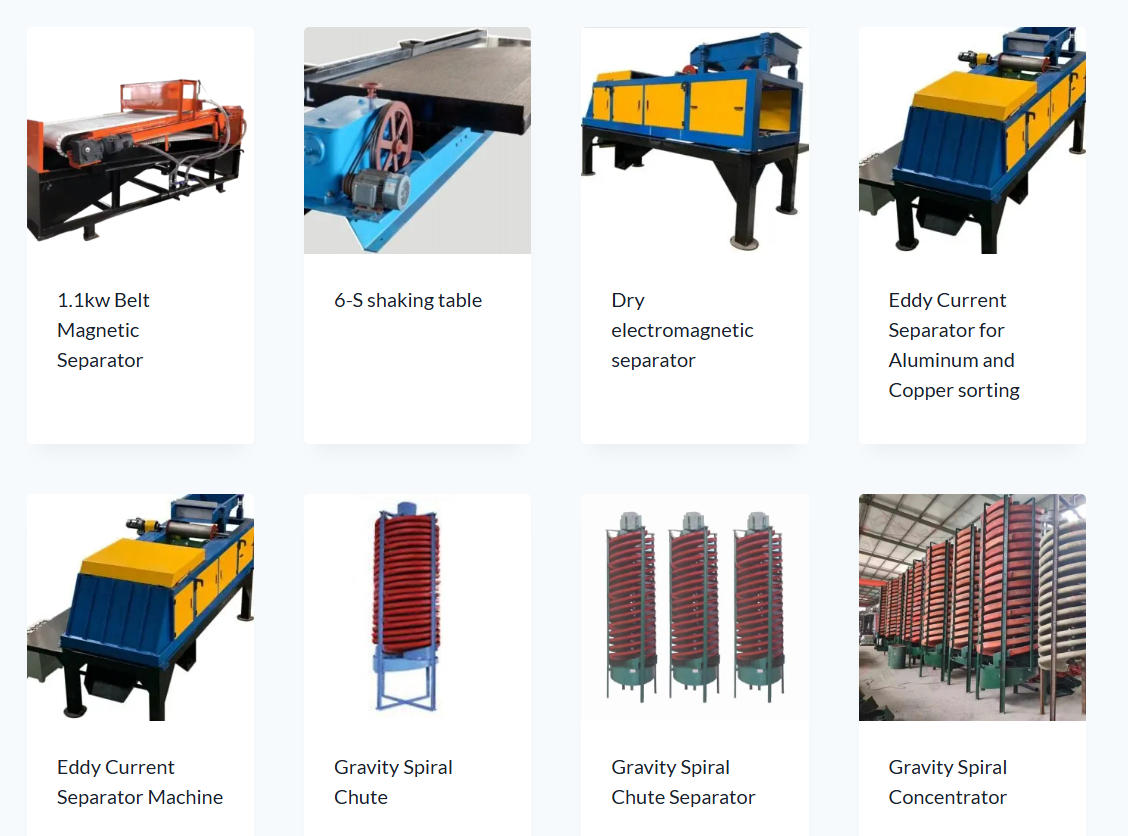
- Magnetic separation: Review magnetic separation equipment, the magnetic separator machine, and the permanent magnetic separator for duties involving magnetic material recovery or contaminant removal.
- Gravity concentration: Compare the gravity spiral chute, gravity spiral concentrator, and spiral chute where particle density and size characteristics make gravity separation a credible option.
- Nonferrous metal recovery: The eddy current separator for aluminum and copper sorting and eddy current separator machine are relevant to suitable conductive-metal sorting applications, particularly in material recovery. Confirm suitability before applying them to mineral ore.
- Specialized magnetic applications: The JF Series low-temperature superconducting magnetic separator is listed for kaolin and bauxite applications. Buyers should request application data and operating requirements for the exact mineral and feed conditions.
- Washing and feed preparation: The 100 TPH sand washing machine may be relevant to appropriate aggregate or sand-processing duties. Verify the rated capacity basis, feed properties, water circuit, and product specification.
For buyers who need more context before requesting quotations, ORO Mineral also provides an overview of magnetic separator manufacturers in China. Use manufacturer lists as a starting point for due diligence rather than as independent proof of performance.
When should you consider ORO Mineral?
ORO Mineral may be worth including when your project requires one of its listed equipment categories and you are prepared to evaluate an international supplier. The key commercial question is not whether an overseas machine has a lower purchase price. It is whether the savings remain after freight, import duties, electrical adaptation, installation, commissioning, operator training, spare parts, and potential downtime are included.
For a US operation, confirm whether the supplier can provide the required electrical configuration, documentation, safety features, technical drawings, and support arrangements. If the equipment is essential to continuous production, establish a realistic service and spare-parts plan before issuing a purchase order.
5. Mining Separation Equipment Suppliers USA: Comparison Table
The following table summarizes how the five companies and ORO Mineral may fit different purchasing scenarios. It is a qualitative screening tool, not a verified comparison of prices, capacity, delivery times, or guaranteed performance.
| Supplier | Potential strength | Best use case to investigate | Key purchasing risk | Recommended next step |
|---|---|---|---|---|
| Eriez | Specialized separation technologies | Magnetic or flotation duty with a clearly defined objective | Choosing a model without validating feed conditions | Request application-specific selection and performance assumptions |
| Metso | Broader process equipment and integration | Plant project or coordinated process upgrade | Paying for scope that is unnecessary for a small replacement | Compare a complete scope with a machine-only alternative |
| FLS | Mining process engineering and equipment | Complex beneficiation circuit | Unclear performance guarantees or project interfaces | Request the basis of design and scope responsibility matrix |
| Multotec | Mineral processing equipment across relevant applications | Gravity, classification, screening, or related duties | Assuming a technology fits without ore-specific testing | Request testwork and verify service availability at the site |
| TOMRA Mining | Sensor-based sorting | Preconcentration and early waste rejection | Insufficient sensor contrast or poor sorting economics | Run representative sample testing and a site-specific business case |
| ORO Mineral | Listed magnetic, gravity, screening, and washing equipment | Projects sourcing defined equipment categories from an international manufacturer | Underestimating logistics, commissioning, or local support requirements | Obtain a detailed quotation and verify export and after-sales terms |
How to use this table: Eliminate suppliers that cannot meet your essential technical requirements. Then compare the remaining proposals using the same feed specification, throughput target, product-quality target, operating hours, utility assumptions, and scope boundaries. A standardized request for quotation makes the comparison much more reliable.
6. How to Select the Right Mining Separation Technology
Before choosing a supplier, establish what the separation process must achieve. The wrong technology can remain uneconomical even when the machine is well engineered.
Magnetic separation: when magnetic properties create a useful difference
Magnetic separators are appropriate when the target mineral or unwanted material responds sufficiently to a magnetic field. Buyers must distinguish between removing ferrous contamination, recovering strongly magnetic minerals, and separating weakly magnetic particles. These are different duties and may require different equipment configurations.
Ask for the expected separation result at your actual feed size and moisture conditions. For applications involving fine or weakly magnetic minerals, determine whether higher-intensity or specialized magnetic technology is necessary and what operating costs it introduces.
Gravity separation: when density contrast and particle size support recovery
Gravity separation can be attractive when valuable minerals have a meaningful density difference from the surrounding material and the particles are sufficiently liberated. Spiral chutes and spiral concentrators are examples of equipment that may suit appropriate feeds.
Do not assume that a gravity separator will deliver high recovery simply because the target mineral is dense. Fine particles, slimes, variable feed rates, and poor classification can reduce separation efficiency. A representative sample test is often more useful than a general claim about the machine’s capacity.
Eddy current separation: when conductive-metal recovery is the real objective
Eddy current separators exploit the response of conductive nonferrous metals to a changing magnetic field. They are commonly relevant to aluminum and copper recovery from suitable mixed materials. They are not a universal replacement for mineral beneficiation equipment.
If the feed is run-of-mine ore rather than a prepared metal-bearing waste stream, confirm that the process objective and particle characteristics match the technology before requesting a quotation.
Sensor-based sorting: when valuable and waste particles can be distinguished
Sensor sorting can reject waste before more expensive downstream processing, but only when the sensor can identify a reliable difference between particles. Sample representativeness is critical. A test based on unusually clean or high-grade material may not reflect the full variability of the deposit.
We recommend testing several representative ore types and evaluating recovery, mass rejection, and downstream cost savings together. The right question is not simply whether a sorter can detect ore; it is whether the resulting material balance improves project economics.
Washing, screening, and classification: do not overlook feed preparation
Separation equipment cannot compensate for every problem created upstream. Incorrect screen sizing, unstable slurry density, excess fines, or inadequate washing can undermine performance. In sand and aggregate operations, the sand washing process steps provide useful context for understanding how feed preparation and washing fit into the overall workflow.
For professional operators, feed consistency is an operating requirement—not a minor detail. Evaluate the entire circuit before upgrading only the final separator.
7. Cost-Benefit Analysis: What Mining Separation Equipment Really Costs
Supplier quotations are rarely comparable unless they cover the same scope. One price may include controls, installation supervision, commissioning, and initial spares; another may cover only the machine. Comparing the totals without reconciling these differences can lead to an expensive purchasing mistake.
Evaluate total cost of ownership
Calculate the expected cost over the equipment’s useful operating life, not just the initial purchase price. At a minimum, include:
- Equipment purchase price and optional components.
- Freight, insurance, import duties, taxes, and customs clearance where applicable.
- Foundations, structural work, electrical supply, controls, and process connections.
- Installation, commissioning, training, and production ramp-up.
- Power, water, consumables, reagents where relevant, and labor.
- Wear parts, scheduled maintenance, unplanned repairs, and spare-parts inventory.
- Downtime costs, production losses, and the cost of handling rejected or tailings material.
A lower-priced machine may be the better choice when its performance, reliability, and support are demonstrably adequate. Conversely, a more expensive package can be justified when it reduces operating costs, improves recovery, lowers maintenance requirements, or reduces integration risk.
Use a simple payback model
For a first-pass evaluation, estimate annual net benefit as the additional value of recovered product plus verified operating-cost savings, minus additional annual operating and maintenance costs. Divide the initial installed investment by that annual net benefit to estimate simple payback.
For example, a separator that increases recovery may create value through additional saleable concentrate, but the result depends on concentrate quality, commodity price, processing costs, and whether the recovered material can actually be sold. Do not calculate payback from theoretical recovery gains without validating the mass balance and product specification.
For larger projects, use discounted cash flow and sensitivity analysis rather than simple payback alone. Model changes in ore grade, throughput, recovery, power prices, water availability, and commodity prices. The equipment with the lowest quoted price is not necessarily the equipment with the lowest cost per tonne of saleable product.
8. Pros and Cons: Specialist Suppliers vs. Integrated Suppliers
| Supplier approach | Pros | Cons | When we recommend it |
|---|---|---|---|
| Specialist equipment supplier | Focused expertise, potentially targeted equipment selection, and a practical option for replacement projects | May require more coordination between vendors; process integration can fall to the buyer or engineer | One defined separation duty, an existing plant, or a limited upgrade |
| Integrated process supplier | Can coordinate multiple equipment stages, interfaces, and project responsibilities | May involve a larger package, more complex commercial scope, or higher initial investment | New plants, major expansions, or projects with significant process interactions |
| International equipment manufacturer | May offer competitive equipment sourcing and access to specialized product configurations | Freight, customs, technical adaptation, time-zone differences, and service logistics need careful planning | Buyers with strong engineering oversight and a verified after-sales plan |
| Local or regional supplier | Potentially easier site access, communication, and service coordination | Available technologies and manufacturing options may be narrower for a specific duty | Operations where rapid support and minimizing downtime are priorities |
The best approach depends on project risk. For a critical production bottleneck, local service access and clear escalation procedures may be worth paying for. For a noncritical machine in a well-supported plant, direct international sourcing may be reasonable if technical verification and logistics are handled properly.
9. Common Mistakes When Buying Mining Separation Equipment
Mistake 1: Selecting by nominal capacity alone
A quoted tonnes-per-hour figure is meaningful only when its basis is clear. Capacity can vary with feed size, moisture, mineralogy, slurry density, separation target, and operating conditions. Ask whether the quoted figure refers to dry solids, wet feed, a specific particle-size distribution, or an ideal test condition.
Mistake 2: Accepting recovery claims without a test basis
Recovery and concentrate grade are not interchangeable. A process can recover more valuable material while producing a lower-grade concentrate, or improve grade while losing too much valuable mineral to tailings. Ask for the complete material balance, test conditions, and the method used to calculate results.
Mistake 3: Ignoring downstream bottlenecks
Installing a faster separator does not necessarily increase plant production. If the crusher, screen, pump, thickener, or dewatering system cannot handle the output, the added capacity may create more instability rather than more saleable product.
Mistake 4: Treating overseas delivery as the only import cost
International procurement can introduce customs, electrical compliance, documentation, installation, commissioning, and spare-parts challenges. Ask for a complete delivered-cost estimate and identify who is responsible for every stage between shipment and stable production.
Mistake 5: Skipping maintenance planning
A separator that is difficult to maintain can become a production liability. Confirm the expected inspection schedule, wear-part life assumptions, recommended spare inventory, service tools, and realistic delivery times for critical parts. Ask how the equipment behaves when feed conditions move outside the normal operating range.
10. Mining Separation Equipment Buying Checklist
Use this checklist before sending a request for quotation or approving a purchase order.
- Feed characterization: Document mineralogy, particle-size distribution, moisture, density, liberation, and relevant magnetic, gravity, or sensor properties.
- Performance targets: Define throughput, recovery, concentrate grade or product purity, mass rejection, and allowable losses.
- Testwork: Request representative testing where performance depends on ore-specific characteristics.
- Operating envelope: Specify normal and peak feed conditions, operating hours, temperature, water availability, and site constraints.
- Utilities: Confirm electrical voltage and frequency, power demand, water requirements, compressed air where applicable, and control interfaces.
- Installation: Define dimensions, equipment weight, foundation loads, access clearances, lifting requirements, and connections to adjacent equipment.
- Compliance: Identify applicable US federal, state, local, electrical, workplace-safety, and site-specific requirements. Confirm which party supplies documentation and certifications.
- Maintenance: Obtain the recommended maintenance plan, wear-part list, spare-parts pricing, and expected replenishment times.
- Warranty: Read exclusions, start dates, remedies, operating conditions, and any performance-guarantee conditions.
- Support: Confirm commissioning arrangements, training, remote troubleshooting, onsite service availability, and escalation contacts.
- Commercial terms: Compare delivery terms, payment milestones, currency, taxes, freight, insurance, and cancellation or delay provisions.
- Acceptance criteria: Define the test procedure and measurable conditions for final acceptance before the order is placed.
For technical specifications and electrical or machinery safety requirements, use the standards and regulatory obligations applicable to the specific equipment and installation. Do not assume that a supplier’s general statement of compliance replaces verification against the requirements of the actual US site.
11. Expert Recommendation: How We Would Build the Shortlist
From our experience evaluating industrial equipment purchasing decisions, the strongest shortlist begins with the process requirement, not the brand name. We recommend selecting two or three technically credible candidates and sending each the same feed data, performance targets, operating conditions, and scope requirements.
For magnetic separation: Start by evaluating suppliers with relevant magnetic technology, such as Eriez or Metso, and compare any ORO Mineral model that matches the application. Do not compare magnetic separators without confirming whether the duty involves strongly magnetic minerals, weakly magnetic particles, or contamination removal.
For gravity concentration: Evaluate the mineral’s density contrast, liberation, and particle-size distribution first. A suitable spiral concentrator can be practical, but a representative test is essential when fine particles or complex mineralogy are involved. Compare technical results before purchase price.
For integrated plant upgrades: Consider Metso or FLS when coordination across several process stages is a major concern. Require a clear statement of what is included, what other vendors must supply, and who is responsible for performance across process interfaces.
For preconcentration: Evaluate TOMRA Mining if sensor-based sorting is technically plausible. Make the decision from ore test results and the expected impact on downstream processing cost, not from a headline sorting-performance figure.
For buyers comparing international manufacturers: ORO Mineral may be a candidate for the equipment categories it lists. We recommend requesting model-specific drawings, a complete bill of supply, performance assumptions, a delivery plan, warranty terms, and a written after-sales support arrangement. Compare the full landed and installed cost with US-based alternatives.
In most professional situations, the right supplier is the one that can demonstrate a credible match between feed material, separation mechanism, operating conditions, and measurable performance requirements. A strong proposal should explain not only what the machine can do, but also where its limits begin.
12. Frequently Asked Questions
What are the best mining separation equipment suppliers in the USA?
Eriez, Metso, FLS, Multotec, and TOMRA Mining are five suppliers worth evaluating for different mineral processing and separation requirements. The best choice depends on whether the project needs magnetic separation, gravity concentration, flotation, integrated process equipment, or sensor-based sorting. Verify current product availability and US service coverage directly with each supplier.
Which company is best for magnetic separation equipment?
Eriez and Metso are reasonable starting points for evaluating relevant magnetic separation technologies. ORO Mineral can also be included if its listed magnetic separator models match the duty. The final selection should be based on magnetic properties, particle size, throughput, target purity or recovery, test data, and service requirements.
How much does mining separation equipment cost?
There is no reliable single price for mining separation equipment because costs vary with technology, capacity, materials, automation, engineering, installation, and operating conditions. Request quotations using the same technical specification and compare purchase price, freight, installation, power, water, wear parts, maintenance, and downtime exposure.
Is gravity separation better than magnetic separation?
Neither technology is universally better. Gravity separation depends on useful density differences and suitable particle characteristics, while magnetic separation depends on differences in magnetic response. Some flowsheets use both technologies in sequence. Select the method that produces the required grade and recovery on representative material.
Can ORO Mineral supply mining separation equipment to US buyers?
ORO Mineral presents itself as a mineral processing equipment manufacturer and lists magnetic separation, gravity concentration, screening, and washing equipment. US buyers should confirm that the required model can be exported and supplied for their project, including electrical configuration, shipping, documentation, installation support, warranty, and spare-parts arrangements.
What should I send a supplier before requesting a quotation?
Provide the mineral or material type, feed-size distribution, moisture, target throughput, separation objective, required product grade or purity, operating hours, utilities, site location, and relevant sample-test results. Drawings, photos, and process-flow diagrams can also help the supplier identify constraints and specify a suitable machine.
Should I buy a complete processing line or individual machines?
A complete line may simplify coordination and process responsibility on a new plant or major expansion. Individual machines can be more economical for a limited replacement or upgrade, provided the buyer has the engineering capacity to manage interfaces. Compare the total scope and accountability, not just the number of suppliers.
What is the most important factor when comparing mining separation equipment suppliers?
The most important factor is demonstrated suitability for the feed material and required process outcome. Compare testwork, performance assumptions, lifecycle cost, support coverage, and acceptance criteria. A lower price or larger catalog does not establish that a separator will meet the project’s recovery, grade, or throughput targets.
13. References
The following primary sources can be used to verify supplier portfolios and identify the appropriate technical contacts. Individual product availability, support coverage, and performance must still be confirmed for the project.
- Eriez official website — Company information and relevant separation technology categories.
- Metso official website — Mining and mineral processing equipment, technologies, and services.
- TOMRA Mining official website — Sensor-based sorting technology and mining applications.
Final Takeaway
Finding the right mining separation equipment suppliers in the USA requires more than compiling a list of well-known companies. Match the technology to the ore, validate performance using representative material, compare the full installed cost, and verify the service arrangement before committing capital.
Eriez, Metso, FLS, Multotec, and TOMRA Mining offer different starting points depending on the separation challenge. ORO Mineral is another candidate to investigate for its listed magnetic separation, gravity concentration, screening, and washing equipment. Whichever supplier you choose, make the purchase decision around documented requirements, transparent scope, and measurable acceptance criteria—not broad marketing claims.