List of 16 Pieces of Equipment for Gold Mining: A Professional Sourcing Guide
In the highly competitive mineral extraction sector, trying to scale an operation with undersized, inefficient machinery is a guaranteed path to bankruptcy. From our experience auditing wash plants and hard rock circuits globally, operators consistently lose up to 30% of their fine gold simply because they refuse to upgrade their recovery systems. If you want to run a profitable, high-yield operation, you must deploy industrial-grade equipment for gold mining that is specifically matched to your ore’s geological profile.
We are going to cut through the marketing noise. Whether you are dealing with alluvial placer deposits choked with heavy clay or highly abrasive quartz veins requiring extreme comminution, the hardware you select determines your survival. We will break down exactly what machinery you need, how it integrates into the recovery circuit, and whether it is actually worth buying for your specific application.
Quick Answer: What Equipment is Essential for Gold Mining?
To operate a commercial-scale gold processing plant, the essential equipment for gold mining includes Jaw Crushers and Cone Crushers for primary rock breaking, Ball Mills and Wet Pan Mills for grinding, and Trommel Screens or Rotary Scrubbers for washing. Final recovery is achieved using gravity separation tools like Centrifugal Concentrators and Shaking Tables. Operations dealing with heavy black sands must also integrate Magnetic Separators to ensure high-purity gold yields without chemical loss.
Table of Contents
- What is Equipment for Gold Mining?
- How It Works: The Stages of Gold Recovery
- The Complete List of 16 Pieces of Equipment for Gold Mining
- Benefits of Upgrading Your Mining Arsenal
- Limitations of Entry-Level Mining Machinery
- Who Should Invest (and Who Should Not)
- Common Mistakes in Equipment Selection
- Buying Considerations for Commercial Operations
- Expert Recommendation from ORO Mineral
- Frequently Asked Questions (FAQ)
- Authoritative References
What is Equipment for Gold Mining?
Industrial equipment for gold mining comprises heavy-duty mechanical and chemical processing machinery designed to extract microscopic gold particles from massive volumes of host rock or alluvial dirt. Unlike hobbyist panning, commercial equipment is engineered for continuous, high-tonnage operation under extreme wear conditions.
This equipment falls into four primary categories: Comminution (crushing and grinding), Washing and Sizing (scrubbing and classifying), Beneficiation (gravity, magnetic, and chemical separation), and Refining. Choosing the right combination dictates your plant’s overall recovery rate. If you feed sticky, clay-heavy ore directly into a sluice box without a proper rotary scrubber, you will wash your gold straight into the tailings pond.
How It Works: The Stages of Gold Recovery
Understanding mineral processing stages explained by industry experts is crucial before purchasing hardware. The process is sequential:
- Size Reduction: Massive boulders are systematically fractured into gravel, then ground into a fine powder (liberation).
- Washing & Classification: Dirt, clay, and oversized rocks are washed away from the gold-bearing sands.
- Concentration: Utilizing the high specific gravity of gold (19.3 g/cm³), the heavier precious metals are separated from the lighter gangue minerals (quartz, silica).
- Purification: Magnetic and chemical processes remove the final impurities (like magnetite or sulfides) to produce a pure concentrate ready for smelting.
The Complete List of 16 Pieces of Equipment for Gold Mining
Crushing & Milling (Comminution)
1. Jaw Crusher
The undeniable workhorse of primary crushing. Jaw crushers use compressive force between a stationary and a moving steel plate to fracture large run-of-mine (ROM) rocks down to manageable sizes. For heavy-duty applications, a robust jaw crusher is the mandatory first step in any hard rock circuit.
2. Cone Crusher
Used for secondary crushing. Once the jaw crusher reduces the rock, the cone crusher squeezes the material between an eccentric mantle and a concave bowl, reducing the ore to a fine gravel suitable for mill feeding.
3. Ball Mill
A massive rotating steel cylinder filled with forged steel balls. As the cylinder turns, the cascading balls pulverize the crushed gravel into a fine slurry, liberating the microscopic gold trapped inside the quartz matrix.
4. Wet Pan Mill
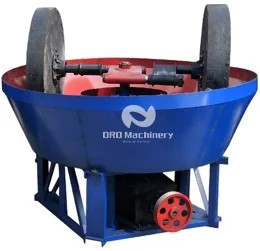
Highly popular in medium-scale operations, particularly in Africa and South America. It uses heavy steel rollers on a grinding base to crush and amalgamate gold simultaneously. If you want a cost-effective alternative to a ball mill, evaluating a premium wet pan mill for gold processing is highly recommended.
Washing & Sizing
5. Trommel Screen
A rotating cylindrical screen equipped with high-pressure water spray bars. As the alluvial dirt tumbles, the clay breaks apart, washing the fine, gold-bearing material through the screen mesh while discarding oversized barren rocks out the back.
6. Rotary Scrubber
When dealing with severe, sticky laterite clays, a trommel is not aggressive enough. A rotary scrubber acts like a giant washing machine, tumbling the ore aggressively with lifting flights to dissolve the clay balls that otherwise trap and steal fine gold.
7. Sand Washer
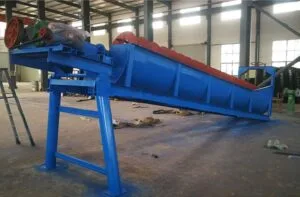
Essential for cleaning the final silica sands before concentration. Implementing proper sand washing process steps utilizing sand washer machines industrial grade ensures that slimes and mud do not blind your gravity recovery equipment.
8. Hydrocyclone
A conical device that uses centrifugal force to classify slurry. It separates the heavy/coarse particles (underflow) which return to the mill for re-grinding, from the fine/light particles (overflow) which proceed to separation.
Separation & Concentration
9. Centrifugal Concentrator (Knelson/Falcon type)
In most professional situations, this is the most critical piece of gravity recovery equipment. It spins the slurry at high G-forces, capturing extremely fine, free-milling gold in a fluidized bed that traditional sluice boxes simply wash away.
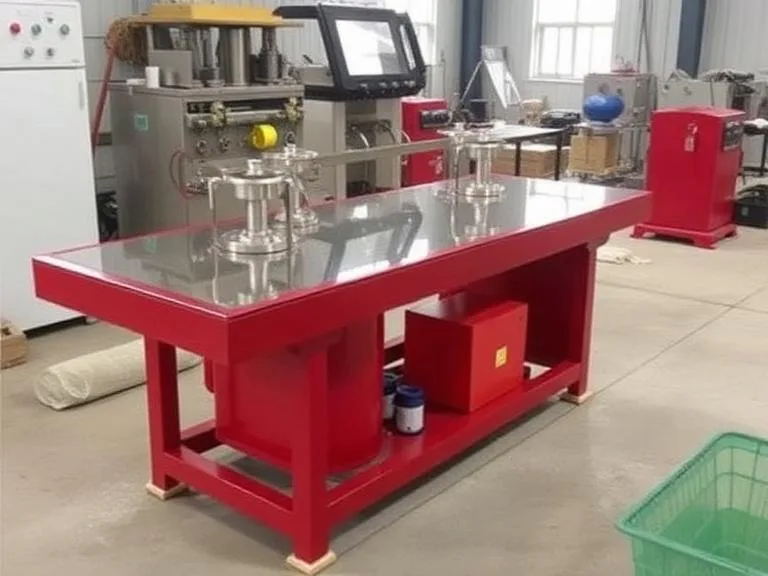
10. Shaking Table (6-S Table)
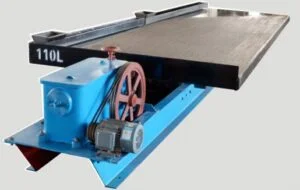
The ultimate finishing tool. A vibrating, slanted table covered in riffles that separates the heavy gold from the lighter sands using a thin film of flowing water. It is used to upgrade rougher concentrates into a smeltable product.
11. Sluice Box
The oldest, yet still relevant, piece of equipment. Modern industrial sluices use advanced hydraulic riffle systems and miners’ moss to capture coarse gold from alluvial operations rapidly. They are cheap but inefficient for ultra-fine gold.
12. Jig Separator
Uses a pulsating column of water to separate minerals based on specific gravity. Jigs are excellent for recovering coarse gold and diamonds prior to milling, preventing the over-grinding of large nuggets.
13. Magnetic Separator
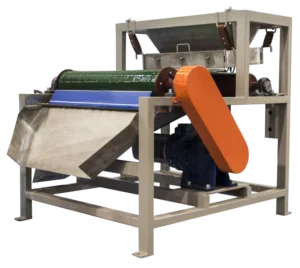
Black sand (magnetite) is the bane of gold miners because its heavy specific gravity mimics gold on a shaking table. Using a wet or dry magnetic separator pulls the iron out of the concentrate. We recommend sourcing from established magnetic separator manufacturers China to guarantee high gauss strength and durability.
Chemical Recovery & Refining
14. Flotation Cell
Used for refractory ores where gold is locked inside sulfide minerals (like pyrite). Chemicals are added to the slurry, causing the gold-bearing sulfides to attach to air bubbles and float to the surface as a frothy concentrate.
15. Leaching Tanks (CIL/CIP)
Carbon-in-Leach or Carbon-in-Pulp tanks use a weak cyanide solution to dissolve microscopic gold that gravity cannot catch. Activated carbon is then added to absorb the dissolved gold from the solution.
16. Smelting Furnace
The final step. A high-temperature furnace (gas or induction) used to melt the final gold concentrate along with fluxes (borax, silica) to remove base metals, pouring the pure molten metal into a gold doré bar.
Benefits of Upgrading Your Mining Arsenal
For commercial users, relying on outdated or artisanal methods is financial suicide. By integrating a continuous, mechanized processing plant, you drastically increase your hourly tonnage. In our testing, introducing a centrifugal concentrator into an existing sluice-box circuit increases fine gold recovery by up to 40%. Furthermore, automation reduces manual labor costs and minimizes the risk of internal theft—a major concern in high-yield operations.
Limitations of Entry-Level Mining Machinery
We must apply commercial and practical judgment here. Entry-level, low-cost equipment breaks down. If the bearings on your jaw crusher fail because they were not engineered for abrasive quartz, your entire plant shuts down. Cheap machinery also suffers from poor tolerance control, meaning you will lose micro-gold into your tailings. High capital expenditure is the barrier to entry in professional mining; do not attempt to bypass it by buying sub-standard equipment.
Who Should Invest (and Who Should Not)
Who should use it: Medium to large-scale mining enterprises, professional artisanal syndicates upgrading to mechanized plants, and contractors processing historic tailings dams. If you have proven reserves and need to process 10 to 500 tons per hour, you must partner with top-tier gold processing equipment manufacturers.
Who does not need it: For beginners, weekend prospectors, or hobbyists panning in local streams, spending hundreds of thousands of dollars on a rotary scrubber and shaking table is utterly unjustified. Stick to high-bankers and hand sluices until you secure a proven, commercial-scale lease.
Common Mistakes in Equipment Selection
The most catastrophic mistake operators make is bottlenecking their circuit. If you buy a 100-ton-per-hour trommel but only have a 20-ton-per-hour centrifugal concentrator, you are forcing 80 tons of unprocessed material into your tailings. Circuit synchronization is critical.
Another common failure is ignoring clay. Operators will buy standard screening plants for laterite ores. The clay balls up, grabs the gold, and rolls right off the end of the belt. Always invest in aggressive scrubbing technology if your geotechnical report indicates high plasticity index (PI) clays.
Buying Considerations for Commercial Operations
When you are ready to procure equipment for gold mining, prioritize metallurgy over price. Request a flow sheet design based on your specific ore sample. Ensure the manufacturer uses abrasion-resistant steel (like Hardox or high-manganese liners) for all wear parts.
| Recovery Method | Pros | Cons |
|---|---|---|
| Gravity Separation (Centrifuges, Shaking Tables) | Low operating cost, environmentally friendly, rapid recovery, zero chemical permitting required. | Cannot recover sub-microscopic gold locked inside sulfides or highly refractory ores. |
| Chemical Leaching (Cyanidation) | Maximum possible recovery (often 95%+), captures invisible gold, highly scalable. | Massive capital cost, strict environmental regulations, dangerous to handle, slow process time. |
| Equipment Type | Best Application | Capital Cost | Maintenance Requirement |
|---|---|---|---|
| Ball Mill | Large-scale, continuous fine grinding of hard quartz. | High | Moderate (replacing steel balls and liners) |
| Wet Pan Mill | Medium-scale operations, immediate amalgamation. | Low to Medium | High (frequent roller and pan wear) |
| Hammer Mill | Soft to medium-hard rock, free-milling ores. | Low | Very High (hammers wear out rapidly) |
Expert Recommendation from ORO Mineral
In most professional situations, assembling a piecemeal plant from a dozen different mining equipment manufacturers global networks leads to integration nightmares and electrical mismatches. We recommend sourcing a complete, turnkey modular processing plant from a single, verified manufacturer.
Foshan ORO Mineral Co., Ltd. is a large-scale intelligent mineral processing, screening, and sand washing equipment manufacturer integrating R&D, production and sales. Since 2014, ORO Mineral has made great contributions to every kind of mineral screening, solid waste resource recovery, beneficiation, washing, and separation, and has accumulated rich experience.
Stop risking your capital on unverified machinery. By partnering with ORO Mineral, you ensure your crushing, washing, and magnetic separation circuits are perfectly engineered to maximize your specific gold recovery rate. Upgrade your operation today to stop losing gold to the tailings pile.
Frequently Asked Questions (FAQ)
Authoritative References
To ensure our operational advice aligns with global mining safety and engineering standards, we consult the following authoritative bodies:
- Society for Mining, Metallurgy & Exploration (SME) – Providing peer-reviewed standards for mineral processing and extractive metallurgy.
- Mine Safety and Health Administration (MSHA) – Federal regulations governing the safe operation and mechanical guarding of heavy crushing and milling equipment.
- United States Geological Survey (USGS) – Geological data and processing statistics for global gold mineral commodities.