6 Key Components of a Magnetic Separation System
A magnetic separation system is only as effective as the equipment working together around its magnetic field. In mineral processing plants, choosing a powerful magnetic separator without considering feeding, material conditioning, discharge, and control systems often leads to disappointing recovery rates, inconsistent concentrate quality, and unnecessary operating costs.
From our experience in mineral processing equipment, the best results come from treating magnetic separation as a complete process rather than purchasing an individual machine. Whether you are recovering magnetite, removing iron impurities from quartz, upgrading feldspar, or processing fine mineral slurries, understanding the six key components of a magnetic separation system will help you select equipment that performs reliably under actual production conditions.
Quick Answer: What Are the 6 Components of a Magnetic Separation System?
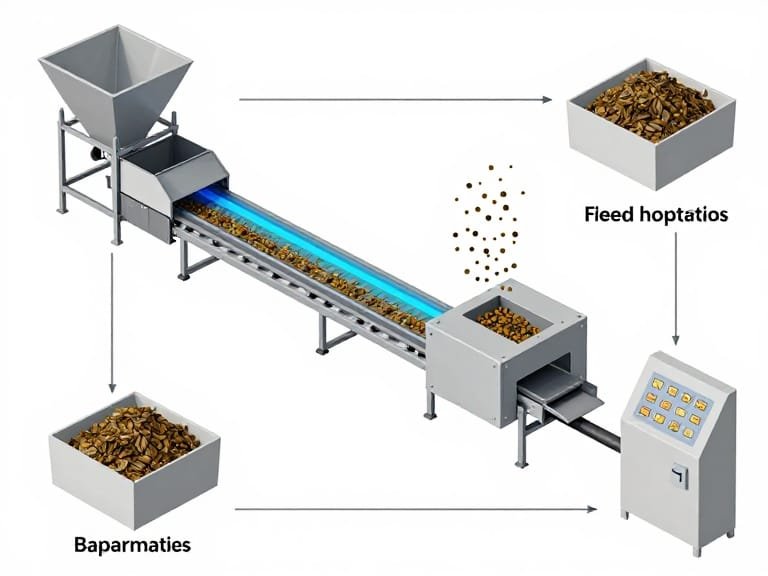
The six main components of a magnetic separation system are:
- Feeding system: Delivers material into the separator at a controlled and consistent rate.
- Material conditioning system: Prepares particles through screening, sizing, mixing, and slurry adjustment.
- Magnetic field generation system: Produces the magnetic force required to attract and separate target minerals.
- Separation chamber and conveying mechanism: Controls particle movement through the magnetic field.
- Discharge and collection system: Collects magnetic concentrate and non-magnetic tailings separately.
- Drive, control, and supporting system: Maintains operating speed, electrical conditions, cooling, and process stability.
Our recommendation: Select all six components according to mineral properties, particle size, moisture content, processing capacity, and the required concentrate grade. A high-intensity separator alone cannot compensate for poor feeding or unsuitable material preparation.
Table of Contents
- What Is a Magnetic Separation System?
- Quick Summary of the Six Components
- 1. Feeding System
- 2. Material Conditioning System
- 3. Magnetic Field Generation System
- 4. Separation Chamber and Conveying Mechanism
- 5. Discharge and Collection System
- 6. Drive, Control, and Supporting System
- Magnetic Separation System Comparison
- How to Choose the Right System
- Common Magnetic Separation Mistakes
- Cost-Benefit and Upgrade Recommendations
- Why Consider ORO Mineral?
- Frequently Asked Questions
- References
What Is a Magnetic Separation System?
A magnetic separation system is a combination of mechanical, electrical, and material-handling equipment designed to separate magnetic particles from non-magnetic or less-magnetic materials. It works by exploiting differences in the magnetic susceptibility of individual minerals.
In mineral processing, magnetic separation is commonly used to recover iron-bearing minerals, remove unwanted iron contamination, and upgrade industrial minerals such as quartz, feldspar, and kaolin.
The principle is straightforward: when a mixture passes through a magnetic field, particles with sufficient magnetic susceptibility experience a magnetic force. Depending on the equipment design, they are attracted toward a magnetic surface, retained within a matrix, or diverted along a different discharge trajectory. Non-magnetic particles generally follow a separate material path.
However, the actual separation result depends on more than magnetic attraction. Particle size distribution, liberation, slurry concentration, feed rate, magnetic field gradient, and residence time all influence performance.
How Does the Complete System Work?
A typical mineral processing magnetic separation system follows this sequence:
- Raw material enters the feeding system.
- Screening, crushing, classification, or slurry conditioning prepares the feed where necessary.
- The material enters the magnetic separation zone.
- The magnetic circuit attracts or retains the target magnetic particles.
- Magnetic and non-magnetic fractions follow different discharge routes.
- Concentrate and tailings are collected for further processing, recycling, or disposal.
For example, in a magnetite beneficiation plant, a wet magnetic drum separator can recover strongly magnetic magnetite from a water-based mineral slurry. In contrast, removing weakly magnetic iron impurities from fine quartz may require a wet high-intensity magnetic separator with a specialized matrix.
These are different processing challenges. We do not recommend treating them as interchangeable applications simply because both use magnetic separation.
Quick Summary Table: Six Components of a Magnetic Separation System
| Component | Main Function | Important Selection Factor | Operational Benefit |
|---|---|---|---|
| Feeding system | Controls material delivery | Feed rate and uniformity | Stable separation performance |
| Material conditioning | Prepares the feed | Particle size and moisture | Improved liberation and separation |
| Magnetic field generation | Creates magnetic attraction | Field intensity and gradient | Target mineral recovery |
| Separation chamber and conveying | Exposes particles to the field | Residence time and flow path | Controlled particle separation |
| Discharge and collection | Separates product streams | Discharge design and capacity | Reduced cross-contamination |
| Drive, control, and supporting system | Maintains equipment operation | Power, cooling, and automation | Reliable continuous production |
1. Feeding System: Maintaining a Consistent Material Flow
The feeding system is the first critical component of a magnetic separation system. Its job is to deliver raw material into the separation zone at a controlled and consistent rate.
Common feeding equipment includes hoppers, vibrating feeders, belt conveyors, screw feeders, slurry pumps, and feed distribution channels. The appropriate arrangement depends on whether the process handles dry ore, granular material, or mineral slurry.
Why Feeding Uniformity Matters
In most professional situations, feed consistency is one of the first things we investigate when separation performance becomes unstable.
If too much material enters the magnetic zone simultaneously, particles can form multiple layers. Some magnetic particles may remain buried beneath non-magnetic particles and fail to contact the effective separation zone. This can reduce recovery and increase contamination.
Conversely, insufficient feeding may leave expensive equipment underutilized and reduce plant throughput.
Recommended Feeding Equipment
| Feed Type | Recommended Equipment | Selection Consideration |
|---|---|---|
| Dry granular ore | Vibrating feeder | Uniform material distribution |
| Coarse mineral material | Belt conveyor and hopper | Stable transportation capacity |
| Fine mineral powder | Controlled screw or vibrating feeder | Feed consistency and dust control |
| Mineral slurry | Slurry pump and feed distributor | Flow rate and solids concentration |
Expert recommendation: For commercial users, install adjustable feeding equipment rather than relying on manual material delivery. This makes it easier to test different operating conditions and maintain consistent production.
2. Material Conditioning System: Preparing Minerals for Separation
Material conditioning is frequently overlooked when buyers evaluate the components of a magnetic separation system. Yet poor feed preparation can undermine even a well-designed magnetic separator.
This component includes screening, crushing, grinding, classification, washing, mixing, and slurry preparation equipment. Not every plant needs every process. The correct configuration depends on the mineral’s liberation characteristics and particle size distribution.
Particle Size and Mineral Liberation
Magnetic separation works most effectively when the target mineral particles are sufficiently liberated from surrounding gangue minerals.
Consider a quartz processing plant containing iron-bearing impurities. If the impurities remain attached to larger quartz particles, simply increasing magnetic field intensity may not achieve the required product purity. Additional grinding or classification may be necessary, provided the resulting particle size remains suitable for the selected separator.
For this reason, we recommend conducting mineralogical analysis and particle size testing before finalizing equipment specifications.
Wet and Dry Material Conditioning
- Dry processing: Requires suitable moisture control, screening, and consistent particle distribution. Excessive moisture can cause fine particles to stick together.
- Wet processing: Requires appropriate slurry concentration, mixing, pumping, and flow control. Excessive solids concentration can increase viscosity and interfere with particle movement.
For plants requiring preliminary screening, a YA Series Circular Vibrating Screen can be considered as part of the feed preparation arrangement.
Where washing and classification are necessary, a 100 TPH sand washing machine may be incorporated into the broader mineral processing workflow.
3. Magnetic Field Generation System: The Core of Magnetic Separation
The magnetic field generation system is the central functional component of a magnetic separation machine. It creates the magnetic force needed to attract, retain, or redirect magnetic minerals.
Depending on the application, this system may use permanent magnets, electromagnets, or specialized high-gradient magnetic circuits.
Permanent Magnet Systems
Permanent magnetic separators generate magnetic fields using permanent magnet materials. They generally do not require continuous electrical excitation to maintain the magnetic field.
They are commonly used for magnetite recovery, tramp iron removal, and applications involving strongly magnetic materials.
For straightforward magnetic recovery applications, a permanent magnetic separator may provide a practical solution with relatively simple operation and supporting infrastructure.
Electromagnetic Systems
Electromagnetic separators generate magnetic fields through electrical current flowing through coils. Operators can adjust the magnetic field by changing the excitation current within the equipment’s design limits.
This flexibility is valuable when processing weakly magnetic minerals or when different feed characteristics require different operating conditions.
For applications involving kaolin, feldspar, and quartz, a water-cooling electromagnetic separator may be appropriate, subject to feed testing and process requirements.
Low-Intensity vs High-Intensity Magnetic Systems
Magnetic field intensity is not the only factor determining separation efficiency. Field gradient, magnetic susceptibility, particle size, and particle movement are equally important considerations.
| Magnetic System | Typical Target | Common Applications | Selection Advice |
|---|---|---|---|
| Low-intensity magnetic system | Strongly magnetic minerals | Magnetite recovery | Choose when the target responds strongly to conventional magnetic fields. |
| High-intensity magnetic system | Weakly magnetic minerals | Hematite, ilmenite, iron impurity removal | Evaluate mineral susceptibility and required field gradient. |
| High-gradient magnetic system | Fine, weakly magnetic particles | Kaolin, feldspar, quartz purification | Check matrix design, particle size, and slurry conditions. |
For fine weakly magnetic mineral applications, a wet high-intensity magnetic separator may be worth evaluating.
4. Separation Chamber and Conveying Mechanism: Controlling Particle Movement
The separation chamber is where magnetic separation actually takes place. Its design determines how particles interact with the magnetic field and how efficiently magnetic and non-magnetic fractions are separated.
The mechanical arrangement varies according to separator type. Common configurations include rotating drums, magnetic rolls, conveyor belts, plate assemblies, and matrix-based separation chambers.
How a Wet Drum Separation Chamber Works
In a typical wet drum separator, mineral slurry enters a tank or feed zone. A magnetic assembly inside the drum attracts magnetic particles toward the drum surface. As the drum rotates, the captured material is transported out of the slurry stream and released at the appropriate discharge location.
Non-magnetic particles generally remain in the slurry and leave through a separate tailings outlet.
The internal magnetic assembly, drum speed, tank geometry, feed direction, and operating gap all influence separation performance.
How High-Gradient Separation Chambers Work
High-gradient magnetic separators use a ferromagnetic matrix inside an applied magnetic field. The matrix creates localized high-gradient magnetic regions that attract weakly magnetic particles from the flowing slurry.
Once the matrix accumulates captured material, the equipment follows its designed cleaning or flushing cycle to remove the collected magnetic fraction.
Matrix opening size is especially important. If particles are too large, they may obstruct the matrix. If the design is unsuitable for the target particle distribution, separation performance and operating reliability may suffer.
From our experience, buyers should evaluate the separation chamber as carefully as the magnetic circuit. A powerful magnet cannot compensate for poor material distribution or insufficient particle exposure.
5. Discharge and Collection System: Separating Concentrate from Tailings
The discharge and collection system directs the separated material into different product streams. Its purpose is to maintain the separation achieved inside the magnetic zone and prevent unnecessary mixing between concentrate and tailings.
Typical components include concentrate collection hoppers, tailings outlets, discharge chutes, slurry launders, flushing pipes, collection tanks, and downstream conveyors.
Magnetic Concentrate Discharge
The magnetic concentrate discharge system collects particles attracted or retained by the magnetic field.
Depending on the separator configuration, concentrate may be released through gravity discharge, scraper mechanisms, drum rotation, or water flushing.
In wet high-gradient magnetic separation, flushing is particularly important because accumulated particles must be removed from the matrix before they interfere with subsequent separation cycles.
Non-Magnetic Tailings Discharge
Non-magnetic particles leave through a separate discharge channel. In some mineral processing applications, this stream is not waste in the traditional sense. It may contain recoverable minerals that require additional gravity separation, flotation, or other processing methods.
For example, a plant may combine magnetic separation with a spiral chute for mineral concentration when processing suitable heavy mineral mixtures.
The correct process arrangement depends on the density, magnetic susceptibility, particle size, and economic value of the remaining minerals.
Why Discharge Design Matters
- Prevents concentrate and tailings from mixing again.
- Supports stable material throughput.
- Reduces material accumulation and blockages.
- Improves downstream processing consistency.
- Makes product sampling and process monitoring easier.
Our recommendation: When evaluating a separator, ask to see the complete concentrate and tailings discharge arrangement. Do not assess the machine only by its magnetic drum or magnet assembly.
6. Drive, Control, and Supporting System: Ensuring Stable Operation
The sixth component includes the mechanical drive, electrical control, power supply, cooling arrangements, monitoring instruments, and safety-related supporting equipment.
These systems do not directly create the separation result, but they determine whether the equipment can maintain its designed operating conditions over extended production periods.
Drive System
Motors, gearboxes, bearings, shafts, and transmission assemblies control the movement of rotating drums, conveyors, and other mechanical components.
Incorrect drum speed can influence particle retention, transport, and discharge. Excessive mechanical loading can increase wear and maintenance requirements.
For commercial users, we recommend checking the drive system’s rated capacity, operating speed range, bearing arrangement, and maintenance accessibility.
Electrical Control System
Electromagnetic separators require an appropriate electrical supply and control arrangement. Depending on the design, operators may adjust excitation current, monitor operating conditions, and control automatic cleaning cycles.
Permanent magnetic systems generally have different electrical requirements because the magnetic field does not depend on continuous coil excitation.
Cooling System
Electromagnetic separators may require air or water cooling to manage heat generated by electrical coils. The appropriate arrangement depends on coil design, electrical loading, ambient conditions, and operating duration.
For water-cooled systems, water circulation, cooling capacity, temperature monitoring, and maintenance of the cooling circuit should be included in the equipment evaluation.
Monitoring and Safety
Depending on the installation, useful monitoring and protection features include:
- Motor current and overload protection.
- Temperature monitoring for electromagnetic coils.
- Cooling water flow and temperature monitoring.
- Emergency stop and equipment interlocks.
- Drum speed and operating status monitoring.
- Access guards and appropriate electrical protection.
We recommend evaluating the supporting system as part of the complete equipment package. A low purchase price becomes less attractive when the machine requires frequent manual intervention or has limited maintenance accessibility.
Magnetic Separation System Comparison: Which Configuration Should You Choose?
The six components remain relevant across different magnetic separation technologies, but their designs change significantly depending on the material being processed.
| System Type | Magnetic Technology | Feed Condition | Best Applications | Main Consideration |
|---|---|---|---|---|
| Permanent magnetic drum separator | Permanent magnets | Usually wet slurry | Magnetite recovery and strongly magnetic minerals | Magnetic recovery and drum configuration |
| Plate-type magnetic separator | Permanent magnetic assembly or designed magnetic plates | Dry or suitable process streams | Iron removal and material purification | Material contact and installation arrangement |
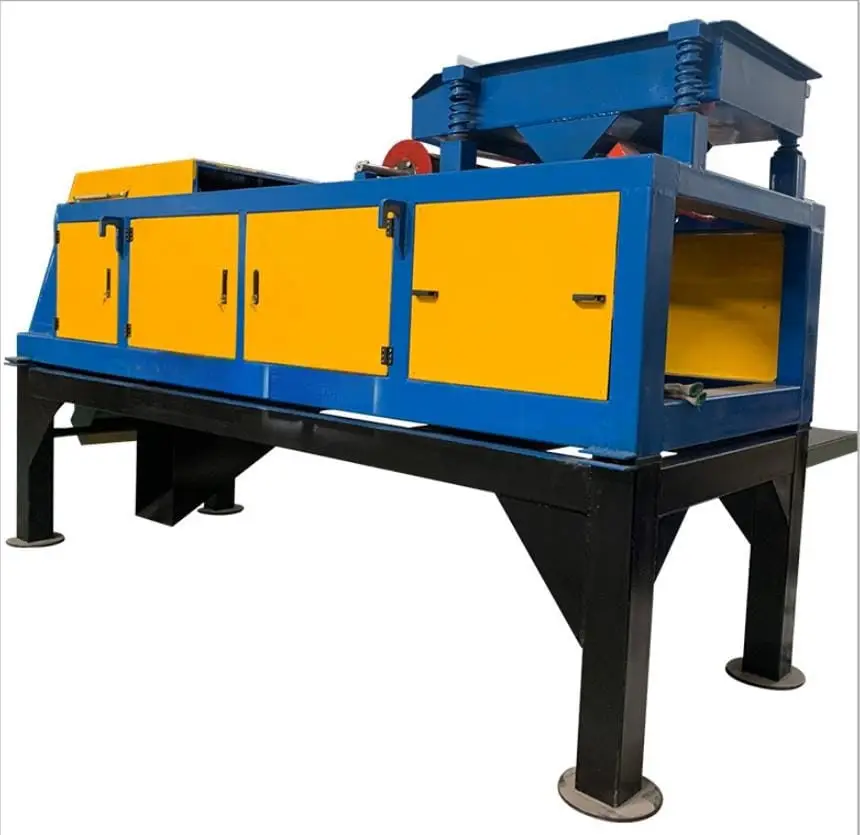
| Electromagnetic separator | Electromagnets | Application-dependent | Industrial mineral purification | Power supply and cooling requirements |
| Wet high-intensity separator | High-intensity electromagnetic field and matrix | Fine mineral slurry | Weakly magnetic impurity removal | Matrix design and slurry conditions |
| Dry high-intensity separator | High-intensity magnetic rolls or circuits | Dry, suitably sized particles | Heavy mineral and industrial mineral separation | Moisture control and feed uniformity |
Permanent Magnetic Separator vs. Electromagnetic Separator
For strongly magnetic minerals, a permanent magnetic separator is often a sensible starting point. It offers a relatively straightforward magnetic arrangement and avoids the need for continuous electrical excitation of the magnet.
Electromagnetic equipment becomes more attractive when the processing target requires an adjustable magnetic field or higher field intensity. However, the additional electrical and cooling infrastructure should be included in the total ownership cost.
For applications involving fine, weakly magnetic iron impurities, a standard permanent magnetic drum may not provide the separation performance required. In those cases, we recommend testing a high-intensity or high-gradient configuration before committing to a production installation.
Wet vs. Dry Magnetic Separation
Wet magnetic separation is generally suitable for fine mineral particles that can be processed in slurry form. Water helps transport particles through the separation zone and can support matrix cleaning and material handling.
Dry magnetic separation avoids the need for process water and can be appropriate for suitably sized, free-flowing materials. However, moisture, dust, particle agglomeration, and feed distribution require careful management.
Our advice is simple: choose wet or dry processing based on mineral behavior and plant infrastructure, not on the assumption that one technology is universally more efficient.
How to Choose the Right Components of a Magnetic Separation System
Before requesting a quotation, buyers should establish the actual separation objective. The following evaluation process can prevent expensive equipment mismatches.
1. Identify the Target Mineral
Determine whether the target is strongly magnetic, weakly magnetic, or non-magnetic material that needs to be purified by removing magnetic contaminants.
Magnetite recovery and iron impurity removal from quartz are different tasks. They should not automatically use the same separator configuration.
2. Test Particle Size Distribution
Provide the manufacturer with the full particle size distribution rather than only an average particle size. Oversized particles, ultrafine particles, and wide size distributions can all affect separation behavior.
3. Confirm Processing Capacity
Specify the required throughput in tonnes per hour and clarify whether the figure refers to dry solids or total slurry flow. This distinction is essential when calculating equipment capacity.
4. Define the Required Product Quality
Explain the target concentrate grade, maximum allowable iron content, recovery expectations, or other product specifications. A separator designed for rough recovery may not achieve the purity needed for premium industrial minerals.
5. Evaluate Water and Power Availability
Wet electromagnetic systems may require substantial supporting infrastructure, including slurry pumps and cooling water. Dry systems may require dust collection and moisture management.
6. Request Actual Mineral Testing
For commercial applications, we strongly recommend laboratory or pilot-scale testing using representative samples from the customer’s mine or processing plant.
A reliable test should record feed characteristics, operating parameters, concentrate grade, recovery, tailings composition, and water or energy requirements where relevant.
Manufacturer Selection Checklist
- Does the manufacturer understand your specific mineral application?
- Can it explain why a particular magnetic technology is suitable?
- Does it offer equipment configuration based on particle size and throughput?
- Can it provide a complete process flow arrangement?
- Are cooling, electrical, feeding, and discharge systems included in the proposal?
- Are wear parts and maintenance procedures clearly documented?
- Can the manufacturer provide technical support and spare parts?
- Are performance guarantees and acceptance criteria clearly defined?
We recommend comparing manufacturers based on process engineering capability, application experience, equipment reliability, and after-sales support rather than purchase price alone. Buyers researching suppliers can also review our guide to magnetic separator manufacturers in China.
Common Mistakes When Designing a Magnetic Separation System
Mistake 1: Selecting Equipment Based Only on Magnetic Strength
A higher magnetic field rating does not guarantee better separation. Field gradient, mineral susceptibility, particle size, and feed conditions all influence the result.
Mistake 2: Ignoring Feed Preparation
Uncontrolled particle size and poor liberation can prevent the separator from achieving its intended performance. Invest in appropriate screening and classification before increasing magnetic intensity.
Mistake 3: Oversizing or Undersizing the Separator
Undersized equipment may experience excessive loading and unstable separation. Oversized equipment can increase capital expenditure and supporting infrastructure costs without delivering proportional benefits.
Mistake 4: Ignoring Discharge Design
Even effective magnetic capture can produce poor final concentrate if discharge streams mix or retained particles are not properly released.
Mistake 5: Comparing Manufacturers Using Different Test Conditions
A machine processing a different particle size or feed concentration cannot be fairly compared with another machine using different operating conditions. Ask for standardized test data and clearly documented feed specifications.
Mistake 6: Overlooking Maintenance and Cooling
For electromagnetic systems, cooling and electrical maintenance are essential. For mechanical systems, bearings, drives, drum surfaces, and wear components require regular inspection.
Magnetic Separation System Cost-Benefit Analysis and Upgrade Recommendations
The purchase price is only one part of the cost of a magnetic separation system. Buyers should compare capital investment with operating expenses, recovery improvements, product quality, maintenance requirements, and downstream processing savings.
Where Should You Invest First?
| Investment Area | Potential Benefit | Our Recommendation |
|---|---|---|
| Feed control | More stable material loading | Prioritize when feed fluctuations are significant. |
| Screening and classification | More suitable particle size distribution | Prioritize when oversized or ultrafine material affects separation. |
| Magnetic circuit upgrade | Improved capture of target magnetic particles | Consider when mineral testing confirms insufficient magnetic response under the existing configuration. |
| Discharge improvement | Reduced product mixing and material losses | Prioritize when concentrate contamination is linked to discharge design. |
| Automation and monitoring | More consistent operation and easier fault detection | Consider for continuous commercial production. |
| Cooling system improvement | Better thermal management | Prioritize when electromagnetic equipment experiences cooling limitations. |
Is Upgrading to High-Intensity Magnetic Separation Worth It?
It can be worthwhile when the target minerals are weakly magnetic and the existing low-intensity equipment cannot achieve the required concentrate quality or recovery.
However, upgrading is not automatically justified. Higher-intensity systems may involve higher capital costs, additional electrical consumption, cooling infrastructure, and more complex maintenance.
We recommend calculating the potential financial benefit using measurable plant data:
- Additional saleable concentrate recovered per operating hour.
- Improvement in concentrate quality and achievable selling price.
- Reduction in valuable mineral losses to tailings.
- Changes in electricity, water, and maintenance costs.
- Additional capital expenditure and installation costs.
For example, a quartz processing plant may justify a high-intensity separator if reducing iron contamination allows the final product to meet a higher-value specification. If the existing product already meets customer requirements, an expensive upgrade may offer little commercial benefit.
Our position: Upgrade the component responsible for the actual bottleneck. Do not replace an entire magnetic separation system when a feeding, screening, or discharge improvement can solve the problem.
Why Consider ORO Mineral for Mineral Processing Equipment?
ORO Mineral Co., Ltd.
ORO Mineral is a mineral processing, screening, and sand washing equipment manufacturer integrating research and development, production, and sales.
Since 2014, the company has worked on equipment and solutions for mineral screening, solid waste resource recovery, beneficiation, washing, and separation.
Equipment Selection Based on Processing Requirements
We believe that selecting mineral processing equipment should begin with the customer’s material and production objectives, not with a predetermined machine model.
Different projects may require different combinations of magnetic separation, screening, washing, and gravity concentration. For example, magnetite recovery, quartz purification, and heavy mineral concentration have different process requirements.
ORO Mineral provides equipment options for different mineral processing applications, including:
- Permanent magnetic separators for suitable strongly magnetic material recovery applications.
- Plate-type permanent magnetic separation equipment for appropriate material separation and iron removal applications.
- Water-cooling electromagnetic separators for selected industrial mineral purification applications.
- Wet high-intensity magnetic separators for fine, weakly magnetic mineral separation.
For projects requiring a complete mineral processing arrangement, equipment selection should also consider screening, washing, gravity concentration, material transportation, and downstream processing.
We recommend discussing the following information with the equipment supplier before requesting a final configuration:
- Mineral type and representative sample information.
- Feed particle size distribution and mineral composition.
- Required processing capacity in tonnes per hour.
- Dry or wet processing preference.
- Target concentrate grade and recovery requirements.
- Available water, electricity, and installation space.
This information provides a much stronger basis for equipment selection than a general request for the highest-capacity or strongest-magnet machine.
Frequently Asked Questions About the Components of a Magnetic Separation System
1. What are the six main components of a magnetic separation system?
The six main components are the feeding system, material conditioning system, magnetic field generation system, separation chamber and conveying mechanism, discharge and collection system, and drive, control, and supporting system. Together, they control material preparation, magnetic attraction, particle separation, product collection, and equipment operation.
2. What is the most important component of a magnetic separation system?
The magnetic field generation system is central to the separation process because it creates the magnetic force used to attract target minerals. However, it cannot work effectively without consistent feeding, appropriate particle preparation, and a suitable separation chamber. Overall system performance depends on all components working together.
3. What is the difference between permanent and electromagnetic separators?
Permanent magnetic separators use permanent magnet materials to generate a magnetic field without continuous electrical excitation. Electromagnetic separators use electrical current through coils to generate the magnetic field, which can generally be adjusted within the equipment’s design limits. Permanent systems are often suitable for strongly magnetic minerals, while electromagnetic systems can be advantageous for applications requiring adjustable or high-intensity magnetic fields.
4. Is wet or dry magnetic separation better?
Neither method is universally better. Wet magnetic separation is often appropriate for fine mineral particles and slurry-based processing. Dry magnetic separation is suitable for free-flowing materials where water availability, moisture control, and particle handling conditions favor dry operation. The decision should be based on mineral properties and process testing.
5. Can magnetic separation remove iron impurities from quartz?
Yes. Magnetic separation is widely used to remove suitable iron-bearing magnetic impurities from quartz. The appropriate separator depends on the type of iron contamination, particle size, liberation, and required final purity. Fine or weakly magnetic impurities may require high-intensity or high-gradient magnetic separation rather than a conventional low-intensity drum separator.
6. What factors affect magnetic separation efficiency?
Important factors include magnetic field intensity, field gradient, mineral magnetic susceptibility, particle size, mineral liberation, feed rate, slurry concentration, moisture content, residence time, and discharge design. The interaction of these factors determines recovery, concentrate grade, and operating stability.
7. How do I select a magnetic separator manufacturer?
Evaluate the manufacturer’s mineral processing experience, equipment configuration capability, material testing services, technical documentation, quality control, spare parts availability, and after-sales support. Request test results using representative mineral samples and confirm that quoted capacity and performance conditions match your production requirements.
8. Is a high-intensity magnetic separator worth the additional investment?
It is worth considering when weakly magnetic minerals or fine iron-bearing impurities cannot be adequately separated by existing low-intensity equipment. However, the additional investment should be justified through mineral testing, expected concentrate improvement, recovery gains, operating costs, and the commercial value of the final product.
9. How often should a magnetic separation system be maintained?
Maintenance frequency depends on operating hours, feed abrasiveness, equipment design, and manufacturer recommendations. Operators should regularly inspect bearings, drives, electrical connections, cooling systems, separation surfaces, matrix components, and discharge channels. Follow the manufacturer’s maintenance schedule and operating manual rather than applying one universal inspection interval.
Final Recommendation: Design the Complete System, Not Just the Magnetic Separator
Understanding the six components of a magnetic separation system is essential for selecting equipment that can deliver consistent results in real mineral processing operations.
The feeding system determines how material enters the machine. Material conditioning prepares particles for separation. The magnetic circuit generates the required magnetic force. The separation chamber controls particle movement. The discharge system collects the separated products, while the drive and control system maintains stable operation.
From our experience, the most effective purchasing decision is based on mineral characteristics, particle size, required throughput, concentrate specifications, and total operating cost.
For beginners, start with mineral testing and a clear understanding of the separation objective. For commercial users, evaluate the complete process configuration, including feeding, screening, magnetic separation, discharge, and downstream equipment.
If you are planning a new mineral processing line or upgrading an existing magnetic separation system, contact ORO Mineral to discuss your material characteristics and equipment requirements.
References and Technical Resources
The following technical publications provide additional information about magnetic separation principles, mineral processing configurations, and equipment selection.
- Metso / AusIMM: Basics in Minerals Processing. Technical reference covering mineral processing equipment and magnetic separation systems.
- Helmholtz Institute Freiberg: Methods Handbook for Mining, Processing and Smelter Dumps. Technical information on wet high-intensity magnetic separation and mineral recovery.
- Academic Press / ScienceDirect: Magnetic Techniques for Mineral Processing. Research chapter discussing magnetic separation principles, low- and high-intensity technologies, and mineral processing applications.