6 Essential Pieces of Equipment for Magnetic Separation: How to Choose the Right Machine
Choosing equipment for magnetic separation is not simply a matter of buying the strongest magnet. The right machine depends on the magnetic properties of the material, particle size, feed rate, moisture, contamination level, and the separation result your plant needs to achieve. A permanent magnetic separator may be sufficient for removing tramp iron from a conveyor, while fine mineral beneficiation can require a high-intensity electromagnetic system with carefully controlled feed conditions.
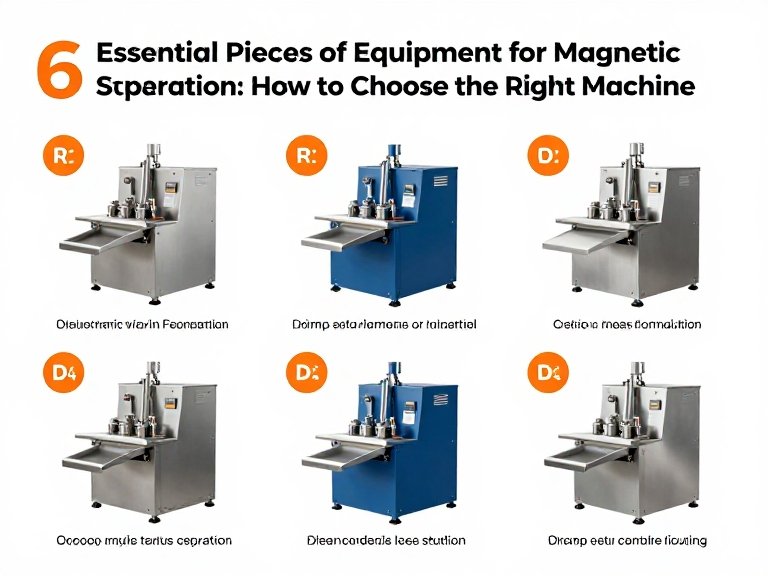
Quick Answer: Select magnetic separation equipment according to the material and separation objective, not magnet strength alone. Permanent magnetic systems are generally simpler to operate and do not require continuous coil power. Electromagnetic systems offer controllable magnetic fields and can handle demanding mineral-processing duties. Drum and pulley designs suit continuous material handling, while high-gradient equipment is used when fine or weakly magnetic particles must be captured from a flowing feed.
What Is Equipment for Magnetic Separation?
Equipment for magnetic separation is designed to separate magnetic or magnetically susceptible materials from non-magnetic materials by applying a magnetic field. In mineral processing, recycling, aggregate production, and industrial material preparation, these machines help recover valuable magnetic minerals, remove unwanted ferrous contaminants, or improve the quality of a processed product.
The equipment can be installed at different stages of a production line. Some machines remove large pieces of tramp iron before crushing. Others recover magnetic minerals after grinding, classification, or slurry preparation. The correct installation point is important: a separator placed too late may allow metal contaminants to damage downstream equipment, while a poorly positioned unit may receive an unsuitable feed and deliver inconsistent separation.
What materials can magnetic separators process?
Magnetic separation is commonly used for:
- Strongly magnetic minerals, including magnetite and other iron-rich minerals.
- Weakly magnetic minerals and impurities that require higher field intensity or gradient.
- Ferrous contaminants in sand, aggregates, coal, and industrial raw materials.
- Metal fragments in solid waste and recycling streams.
- Iron-bearing impurities in selected industrial minerals such as feldspar, quartz, and kaolin.
One important limitation: magnetic separation does not separate every mineral in an ore. A mineral must have sufficient magnetic susceptibility under the operating conditions. If two materials respond similarly to the magnetic field, magnetic separation alone may not achieve the required purity or recovery. In that situation, gravity separation, flotation, screening, or another process may be needed.
How Does Magnetic Separation Equipment Work?
Magnetic separation works by exposing a feed material to a magnetic field. Magnetic particles experience a force that changes their movement relative to non-magnetic particles. The machine then uses a suitable mechanical arrangement, such as a moving belt, rotating drum, plate, or matrix, to collect or discharge the separated material.
The actual separation result depends on more than the nominal magnetic field strength. Particle size, mineral liberation, feed concentration, moisture, material velocity, magnetic susceptibility, and the distance between the material and the magnetic source all influence performance.
Three factors that determine separation efficiency
- Magnetic susceptibility: Strongly magnetic particles are generally easier to capture. Weakly magnetic particles require a more carefully designed field and may need a high-gradient arrangement.
- Particle size and liberation: A particle containing both magnetic and non-magnetic minerals may not separate cleanly. Grinding and classification may be necessary to liberate the target mineral, but excessive grinding can increase operating costs and create fine particles that are more difficult to handle.
- Feed presentation: A consistent feed layer and controlled flow help expose particles to the magnetic field. Excessive feed depth or uneven distribution can allow magnetic particles to pass through without being captured.
6 Types of Equipment for Magnetic Separation
1. Permanent Magnetic Separator

A permanent magnetic separator uses permanent magnet materials to create a magnetic field without requiring continuous electrical power for magnetization. Depending on its design, it can remove ferrous contaminants from a material stream or recover magnetic particles during mineral processing.
Permanent magnetic separators are widely used where the feed contains strongly magnetic particles and the separation duty is relatively stable. They are attractive to plants that want a straightforward machine with fewer electrical components and predictable operating requirements.
Best use cases:
- Removing iron pieces from aggregates, sand, and bulk materials.
- Recovering strongly magnetic minerals in suitable processing circuits.
- Protecting crushers, conveyors, screens, and other downstream equipment from tramp iron.
- Production lines where continuous operation and simple maintenance are priorities.
Limitations: The magnetic field is not normally adjusted in the same way as an electromagnetic unit. A permanent magnetic separator may also be unsuitable for very fine, weakly magnetic impurities if the design does not provide adequate field intensity and gradient.
For plants handling strongly magnetic materials, a permanent magnetic separator is a sensible starting point. Compare the feed size, required capacity, installation arrangement, and discharge method before selecting a model.
2. Electromagnetic Separator

An electromagnetic separator creates a magnetic field using an energized coil. This design can provide a controllable magnetic field, making it useful for demanding separation duties where field intensity and operating conditions need to be adjusted.
Electromagnetic systems are used in mineral processing and industrial mineral purification, particularly when the target material is weakly magnetic or when a stronger, more controlled field is needed than a conventional permanent magnet can provide.
Best use cases:
- Removing weakly magnetic iron-bearing impurities from selected mineral feeds.
- Processing quartz, feldspar, kaolin, and other industrial minerals where iron contamination affects product quality.
- Separation circuits that need adjustable magnetic intensity.
- Applications where the material characteristics vary and the process requires operating flexibility.
Limitations: Coil-based equipment requires electrical power and may involve additional cooling, control, and maintenance requirements. The total operating cost should include power consumption, cooling arrangements, and maintenance access.
For mineral feeds such as kaolin, feldspar, and quartz, ORO Mineral lists a water-cooling electromagnetic separator. This type of system is worth evaluating when weakly magnetic impurities are a major product-quality concern. Confirm the actual feed characteristics and required separation performance with a material test before specifying capacity.
3. Magnetic Drum Separator
A magnetic drum separator uses a rotating drum containing a magnetic assembly. As material passes over or around the drum, magnetic particles are attracted and retained on the magnetic surface while non-magnetic material follows a different discharge path.
Drum separators are common in continuous processing lines because they can handle steady material flows. Depending on the configuration, they can be used for wet or dry separation and for different particle-size ranges.
Best use cases:
- Recovering magnetic minerals from suitable ore streams.
- Removing ferrous contaminants from bulk solids.
- Continuous separation in mineral-processing plants.
- Processing circuits where a rotating separation surface supports steady feed handling.
Limitations: Drum speed, feed distribution, magnetic arc, and material loading all influence performance. A drum separator should not be selected by diameter alone. The magnetic system, working gap, feed properties, and discharge arrangement are equally important.
For operators who need a continuous-duty solution, review the available magnetic separator machine configurations and compare their operating principles with the material flow in your plant.
4. Overband Magnetic Separator
An overband magnetic separator is installed above a conveyor belt. It attracts ferrous metal from the moving material and removes it from the main stream, usually through a self-cleaning belt or another discharge arrangement. It is commonly used for tramp iron removal rather than fine mineral beneficiation.
In many production plants, the main value of an overband separator is equipment protection. Metal fragments can damage crushers, conveyors, screens, and other machinery. Removing them before they reach sensitive equipment can reduce unplanned downtime and repair costs.
Best use cases:
- Aggregate and quarry conveyor systems.
- Coal handling and bulk material processing.
- Recycling plants handling mixed waste streams.
- Conveyor lines where ferrous contamination must be removed continuously.
Limitations: Installation height, belt width, material depth, conveyor speed, and the size of tramp metal affect capture performance. An overband unit is not a universal replacement for a mineral beneficiation separator. It is primarily a protection and ferrous-removal device.
For conveyor installations, calculate the required suspension height and consider the maximum tramp iron size. A separator mounted too high above a deep material bed may fail to capture metal that a correctly positioned unit could remove.
5. Magnetic Pulley Separator
A magnetic pulley replaces or integrates with the head pulley of a conveyor. As material reaches the end of the belt, magnetic particles are retained along the belt path and discharged separately from non-magnetic material, which follows its natural trajectory.
This arrangement is useful when a plant wants magnetic separation integrated into an existing conveyor rather than installing a separate overhead unit. It can be a practical choice for continuous dry processing and ferrous removal.
Best use cases:
- Removing ferrous material from dry bulk products.
- Integrating magnetic separation into conveyor discharge points.
- Protecting downstream processing equipment.
- Retrofitting certain existing conveyor lines where space above the belt is limited.
Limitations: A magnetic pulley is constrained by conveyor geometry, belt configuration, and the material trajectory. It is not always suitable for deep feed beds or applications requiring high recovery of fine weakly magnetic minerals.
We recommend evaluating the existing conveyor layout before considering a magnetic pulley. If the plant needs to remove large tramp iron pieces from a thick material layer, an overband separator may provide a more appropriate arrangement.
6. High-Gradient Magnetic Separator (HGMS)
A high-gradient magnetic separator uses a magnetic field together with a matrix or other specially designed structure that creates localized regions of high magnetic field gradient. This arrangement helps capture fine, weakly magnetic particles that may not be effectively separated by conventional low-gradient equipment.
HGMS systems are used in selected mineral beneficiation and industrial mineral purification applications. They can be particularly valuable when small quantities of weakly magnetic impurities have a significant effect on final product quality.
Best use cases:
- Removing fine weakly magnetic impurities from selected mineral slurries.
- Purifying industrial minerals where iron-bearing contaminants must be reduced.
- Processing fine particle streams that are difficult to treat with conventional magnetic equipment.
- Specialized mineral separation circuits where product specifications justify a more complex system.
Limitations: High-gradient systems can involve more complex feed preparation, matrix cleaning, slurry handling, and operating controls. They are not automatically the best choice for coarse ferrous metal removal or simple conveyor protection. Their value must be assessed against the required product grade, recovery, water use, and maintenance requirements.
For a fine mineral stream, we recommend pilot testing or representative sample testing before purchasing an HGMS system. A laboratory result should be used to establish realistic expectations for the full-scale process.
Magnetic Separation Equipment Comparison Table
The following comparison is a practical screening guide. Actual performance depends on equipment design, magnetic circuit, feed characteristics, and operating conditions. Use it to shortlist machine types, not as a substitute for engineering specifications or material testing.
| Equipment type | Magnetic source | Typical duty | Suitable material | Key advantage | Main limitation |
|---|---|---|---|---|---|
| Permanent magnetic separator | Permanent magnets | Ferrous removal and magnetic mineral recovery | Strongly magnetic particles and tramp iron | Simple operation and no continuous coil power | Limited field adjustment |
| Electromagnetic separator | Energized coil | Controlled or high-intensity separation | Selected weakly magnetic mineral feeds | Controllable magnetic field | Power and cooling requirements |
| Magnetic drum separator | Internal magnetic assembly | Continuous wet or dry separation | Suitable granular or slurry feeds | Continuous material handling | Performance depends on feed loading and drum design |
| Overband magnetic separator | Permanent magnet or electromagnet | Tramp iron removal above conveyors | Bulk solids on conveyor belts | Protects downstream equipment | Not designed for all fine mineral separation duties |
| Magnetic pulley | Magnetic head pulley | Ferrous removal at conveyor discharge | Dry bulk material | Integrated conveyor arrangement | Constrained by belt and discharge geometry |
| High-gradient magnetic separator | High-intensity field and matrix | Fine weakly magnetic particle capture | Fine mineral particles, often in slurry | Can capture particles missed by conventional systems | More demanding process and maintenance requirements |
Which type should you shortlist first?
- For conveyor protection: Start with an overband separator or magnetic pulley.
- For strongly magnetic mineral recovery: Evaluate permanent magnetic drums or other permanent magnetic configurations.
- For weakly magnetic mineral impurities: Investigate electromagnetic or high-gradient equipment.
- For fine industrial mineral purification: Compare high-intensity electromagnetic and high-gradient options using representative samples.
Pros and Cons of Magnetic Separation Equipment
Magnetic separation is an established process because it can separate selected materials without relying on chemical reagents. However, it is not a universal beneficiation method. Its effectiveness depends on the magnetic properties of the target and the quality of feed preparation.
| Advantages | Limitations |
|---|---|
| Can recover or remove magnetic materials continuously in suitable process designs. | Cannot reliably separate materials that have insufficiently different magnetic properties. |
| Can reduce ferrous contamination and protect downstream equipment. | Fine or weakly magnetic particles may require higher-intensity systems. |
| Permanent magnetic designs can operate without continuous coil power. | Permanent magnetic field strength is not normally adjusted during operation. |
| Can be integrated into conveyors, mineral-processing circuits, and recycling lines. | Installation geometry and feed presentation can restrict separation performance. |
| Can reduce reliance on some chemical separation steps in appropriate applications. | May require complementary processes such as grinding, classification, flotation, or gravity separation. |
| Can support product quality improvement and recovery of valuable magnetic fractions. | Incorrect sizing or overloaded equipment can reduce recovery and increase operating costs. |
Our view: Magnetic separation is worth investing in when the target material has a meaningful magnetic response and the separation objective is clearly defined. It is not worth buying a high-intensity system simply because it sounds more powerful. A properly selected conventional separator can outperform an oversized or poorly matched advanced machine in the application it was designed for.
How to Choose the Right Equipment for Magnetic Separation
For plant managers, process engineers, and procurement teams, the best purchase decision starts with the material rather than the equipment catalogue. Before requesting quotations, prepare a feed specification and define what a successful separation result means for your operation.
1. Identify the magnetic properties of the target
Determine whether the material to be removed or recovered is strongly magnetic, weakly magnetic, or only slightly susceptible to a magnetic field. This distinction narrows the equipment choices quickly. Strongly magnetic particles can often be handled by permanent magnetic systems, while weakly magnetic impurities may require higher field intensity or a high-gradient design.
2. Confirm particle size and distribution
Particle size influences magnetic force, movement, and capture. A separator designed for coarse fragments may not perform well with fine particles. Conversely, equipment intended for fine slurry separation may be unnecessarily complex for large ferrous pieces. Provide the supplier with the full particle-size distribution rather than a single average size.
3. Define capacity and feed conditions
Specify throughput in tonnes per hour, feed concentration, moisture, temperature where relevant, and whether the process is wet or dry. Capacity should be considered together with the material bed depth and feed consistency. A nominal capacity figure without feed characteristics is not enough to determine real separation performance.
4. Set measurable product and recovery targets
Decide whether your priority is removing contaminants, increasing concentrate grade, recovering magnetic minerals, or protecting machinery. These are different duties. A tramp iron separator should be judged on contaminant removal and equipment protection; a beneficiation separator should be evaluated using grade, recovery, throughput, and process stability.
5. Evaluate maintenance and operating cost
Consider power consumption, cooling requirements, belt and bearing maintenance, matrix cleaning, wear parts, access for servicing, and operator training. For commercial users, downtime can be more expensive than the initial price difference between two machines. A design that is easier to inspect and maintain may deliver better long-term value than a lower-priced machine with difficult service access.
6. Request material testing and technical confirmation
For mineral beneficiation, representative sample testing is one of the most valuable steps before equipment selection. Ask the manufacturer what test conditions were used, whether the feed resembles your material, and which performance indicators were measured. If the supplier cannot explain the proposed process flow or the basis for its capacity recommendation, treat the quotation cautiously.
- Feed material composition and magnetic characteristics.
- Particle-size distribution and maximum particle size.
- Dry or wet processing conditions.
- Required throughput and operating hours.
- Target concentrate grade, recovery, or contamination limit.
- Available installation space and conveyor dimensions.
- Power supply, cooling water, and utility requirements.
- Wear parts, maintenance schedule, and technical support.
- Test data or references for comparable feed materials.
Common Mistakes When Buying or Operating Magnetic Separators
Mistake 1: Selecting by magnetic field strength alone
Field strength matters, but so do field gradient, working distance, matrix design, particle size, and feed presentation. Ask the manufacturer how the magnetic circuit performs at the actual working gap and under your material conditions.
Mistake 2: Ignoring mineral liberation
If magnetic minerals are locked together with non-magnetic gangue, separation may be limited even when the magnetic field is adequate. Review the mineralogy and liberation characteristics. Additional crushing, grinding, or classification may be necessary, but these steps should be justified by testing because they add energy and operating costs.
Mistake 3: Overloading the separator
Excessive feed rate or material depth can prevent particles from reaching the effective magnetic zone. The result may be lower recovery or more contamination in the non-magnetic product. Keep the feed distribution within the machine’s design limits.
Mistake 4: Treating tramp iron removal as mineral beneficiation
An overband separator is useful for removing ferrous objects from a conveyor, but it is not a substitute for a high-intensity mineral separator when the objective is to remove fine weakly magnetic impurities. Define the process duty before choosing the equipment category.
Mistake 5: Ignoring wet-process requirements
Wet magnetic separation involves slurry concentration, flow distribution, water management, and cleaning requirements. A dry separator cannot simply be installed in a slurry circuit without considering its design and operating limits.
Mistake 6: Buying without checking service support
For heavy-duty applications, confirm access to spare parts, technical documentation, commissioning support, and troubleshooting assistance. A machine’s purchase price is only one component of its lifecycle cost.
Industrial Applications of Magnetic Separation Equipment
Magnetic separation is used across different industries, but the machine configuration changes according to the material and process objective.
Mining and mineral beneficiation
Mining operations use magnetic separators to recover magnetic minerals and remove unwanted magnetic components from ore. The process may be integrated after crushing, grinding, classification, or other beneficiation stages. The correct separator depends on ore mineralogy, liberation, particle size, and the required concentrate specification.
For a wider view of process selection, read our guide to magnetic separation applications in industry. It helps put individual machines into the context of real industrial separation duties.
Quartz, feldspar, and kaolin processing
Industrial minerals often require impurity reduction to meet downstream quality requirements. Iron-bearing contaminants can affect product appearance or processing suitability. Depending on their magnetic response and particle size, electromagnetic or high-gradient systems may be appropriate. A representative sample test should establish whether the proposed machine can achieve the required product quality.
Sand and aggregate production
Sand and aggregate plants may use magnetic separation to remove ferrous contaminants and protect downstream machinery. Magnetic equipment can be integrated with screening, washing, and conveying systems. Where the main problem is contamination rather than mineral recovery, the separator should be selected around the conveyor arrangement and tramp metal characteristics.
Where washing and classification are also needed, compare the magnetic separation stage with the wider process line. ORO Mineral’s 100 TPH sand washing machine is an example of equipment that may form part of a broader sand-processing setup, depending on the project requirements.
Solid waste and metal recycling
Recycling plants use magnetic separators to recover ferrous metals from mixed material streams. Overband separators and magnetic drums are common choices because they can operate continuously with conveyor-fed materials. The feed’s composition, moisture, material depth, and desired recovery level should guide the machine configuration.
Iron and steel processing
Magnetic separation can support ferrous material recovery and contaminant removal in metal processing. However, different separation objectives may require different methods. If the task involves separating iron from steel or distinguishing different metal fractions, review the process-specific options in our guide to methods to separate iron and steel.
ORO Mineral: Mineral Processing and Magnetic Separation Equipment
ORO Mineral Co., Ltd. is a mineral processing, screening, and sand washing equipment manufacturer integrating research and development, production, and sales. Since 2014, the company has worked across mineral screening, solid waste resource recovery, beneficiation, washing, and separation equipment. Its equipment portfolio is intended to support processing plants with different material-handling and separation requirements.
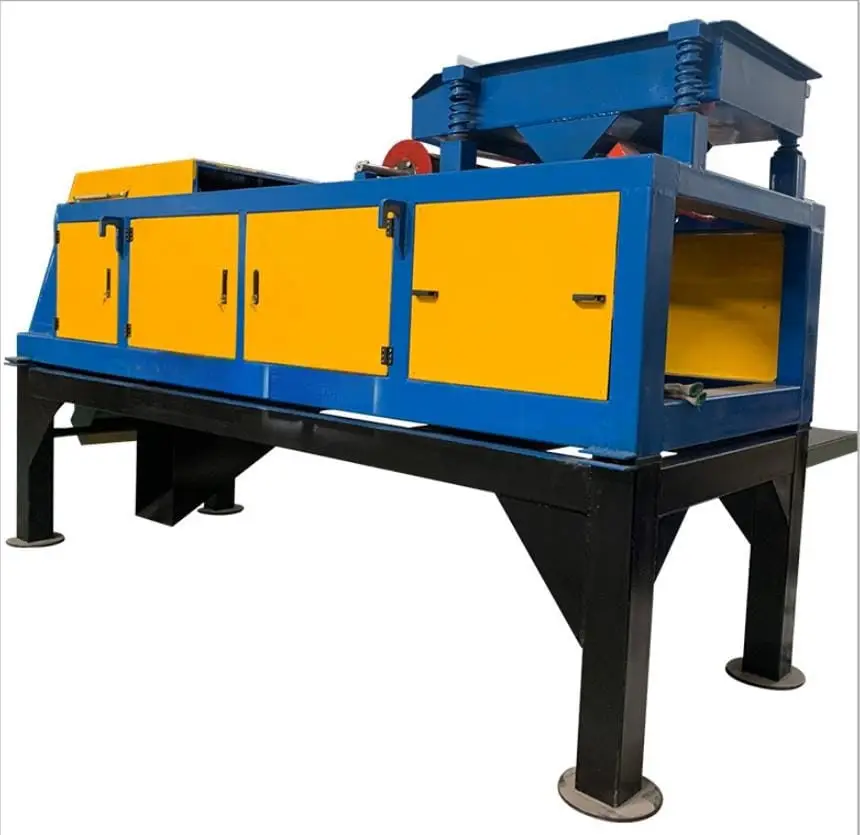
ORO Mineral Processing Equipment
ORO Mineral integrates equipment research and development, manufacturing, and sales. Its product range covers mineral screening, washing, beneficiation, and separation applications.
For buyers evaluating a magnetic separation project, the key is to match the equipment configuration to the feed material, processing capacity, and separation target. A product category should be treated as the starting point for technical discussion rather than a complete engineering specification.
When should you contact a manufacturer?
Contact the manufacturer when the feed is variable, the target mineral is weakly magnetic, the required product specification is strict, or the proposed machine needs integration with existing conveyors and processing equipment. Provide representative material information and ask for a clear explanation of the proposed separation principle.
For a project involving multiple beneficiation stages, it is also worth reviewing the role of gravity separation. A spiral chute or spiral gravity chute system may complement magnetic separation where mineral density differences can be used to improve recovery. These processes should be selected based on mineral properties and test results, not combined simply because both are common in mineral-processing plants.
Magnetic Separation Equipment Cost: What Should Buyers Compare?
There is no reliable universal price for magnetic separation equipment. Costs vary with machine type, magnetic circuit design, processing capacity, construction materials, cooling arrangements, automation, and project-specific engineering. A basic permanent magnetic unit and a high-gradient electromagnetic system serve different duties and should not be compared as if they were interchangeable products.
Purchase price versus total cost of ownership
For commercial users, the better comparison is total cost over the expected operating life. Include:
- Initial equipment price and installation work.
- Electrical power and cooling requirements.
- Conveyor, pump, slurry, and material-handling integration.
- Routine maintenance and replacement components.
- Cleaning time and process downtime.
- Operator training and technical support.
- Potential savings from reduced contamination, improved recovery, or fewer equipment failures.
A permanent magnetic separator may be the more economical option for a stable tramp iron removal duty. An electromagnetic or high-gradient system may justify a higher initial investment if it produces a measurable improvement in mineral grade or recovery. The business case should be based on the value of the recovered product, avoided contamination, and actual operating costs.
When is an upgrade worth it?
Upgrade when the current separator consistently fails to meet a defined process target and testing shows that a different magnetic configuration can improve the result. Examples include persistent weakly magnetic impurities, insufficient recovery of fine magnetic particles, or a conveyor protection system that cannot handle the actual tramp metal load.
Do not upgrade solely because a newer machine advertises a higher field strength or throughput. If the bottleneck is poor liberation, unstable feed, or inadequate screening, the more effective investment may be upstream process improvement.
Quick Summary: Which Magnetic Separation Equipment Should You Choose?
| Plant requirement | Recommended equipment to evaluate | Why it fits | What to confirm |
|---|---|---|---|
| Remove large ferrous objects from a conveyor | Overband magnetic separator | Designed for continuous tramp iron removal above a belt | Belt width, suspension height, feed depth, metal size |
| Remove ferrous material at conveyor discharge | Magnetic pulley | Integrates magnetic separation with the conveyor head pulley | Belt layout, material trajectory, feed loading |
| Recover strongly magnetic minerals | Permanent magnetic separator or drum | Suitable for many strongly magnetic separation duties | Particle size, feed rate, magnetic circuit, recovery target |
| Separate weakly magnetic impurities | Electromagnetic separator | Offers a controllable magnetic field for demanding applications | Field requirements, power, cooling, sample test results |
| Process continuous granular or slurry feed | Magnetic drum separator | Supports continuous material handling | Wet or dry design, drum speed, feed distribution |
| Capture fine weakly magnetic particles | High-gradient magnetic separator | Uses a high-gradient matrix to capture fine susceptible particles | Slurry conditions, matrix cleaning, grade and recovery targets |
Frequently Asked Questions About Equipment for Magnetic Separation
1. What are the six main types of equipment for magnetic separation?
The six common types are permanent magnetic separators, electromagnetic separators, magnetic drum separators, overband magnetic separators, magnetic pulleys, and high-gradient magnetic separators. Each is designed for different material properties and separation objectives.
2. Which magnetic separator is best for mineral processing?
There is no single best separator for every mineral. Permanent magnetic equipment is often suitable for strongly magnetic minerals, while electromagnetic and high-gradient systems are used for selected weakly magnetic materials. The right choice depends on mineralogy, particle size, feed conditions, and the required concentrate grade and recovery.
3. What is the difference between a permanent magnetic separator and an electromagnetic separator?
A permanent magnetic separator uses permanent magnets to generate a magnetic field without continuous coil power. An electromagnetic separator uses an energized coil and can provide a controllable magnetic field. Permanent systems are often simpler for stable duties, while electromagnetic systems can be more suitable for applications requiring higher or adjustable field intensity.
4. Can magnetic separation remove iron from quartz or feldspar?
Magnetic separation can reduce certain iron-bearing impurities in quartz and feldspar when those impurities have sufficient magnetic susceptibility. The required equipment depends on impurity mineralogy, particle size, liberation, and product specifications. High-intensity electromagnetic or high-gradient equipment may be considered, but representative sample testing is essential.
5. Is magnetic separation suitable for wet processing?
Yes. Magnetic separation can be performed in wet or dry conditions, depending on the equipment design. Wet systems process material in a slurry and require suitable flow distribution, concentration control, and cleaning arrangements. Always confirm that the selected machine is designed for the intended feed condition.
6. What factors affect magnetic separation efficiency?
Magnetic susceptibility, field intensity and gradient, particle size, mineral liberation, feed rate, material depth, moisture, and separator geometry all influence efficiency. Stable feed presentation and correct equipment sizing are as important as the magnetic field itself.
7. How do I choose the right capacity for a magnetic separator?
Start with the required throughput and provide the manufacturer with particle-size distribution, material composition, moisture, feed concentration, and operating conditions. Capacity should be confirmed for the actual material and separation target rather than selected from a generic tonnes-per-hour figure.
8. Does a stronger magnetic field always produce better separation?
No. A stronger field may improve capture for certain weakly magnetic particles, but separation also depends on field gradient, particle liberation, feed presentation, and equipment design. Excessive feed loading or poor material preparation can limit performance even with a high-intensity magnetic system.
9. What should I ask a magnetic separation equipment manufacturer?
Ask about the separation principle, suitable feed characteristics, capacity basis, magnetic field specifications, expected grade and recovery, power and cooling needs, maintenance requirements, test data, installation conditions, and after-sales support. For mineral processing, request a material test or a technical explanation based on representative samples.
References
- U.S. Geological Survey (USGS) – National Minerals Information Center. Mineral information and technical context for understanding mineral resources and processing requirements.
- Society for Mining, Metallurgy & Exploration (SME). Professional mining and mineral-processing resources covering beneficiation and separation practices.
- Australasian Institute of Mining and Metallurgy (AusIMM). Technical resources and professional knowledge covering mineral processing, plant operation, and extractive metallurgy.
Equipment selection should be confirmed through current manufacturer specifications, engineering review, and representative material testing. General industry references do not establish the performance of a particular separator on a specific ore or feed stream.
Final Recommendation: Match the Separator to the Material
The most effective equipment for magnetic separation is the machine that meets the actual separation target with reliable throughput, manageable operating costs, and practical maintenance requirements. Permanent magnetic separators and overband systems are often the sensible choices for routine ferrous removal. Electromagnetic and high-gradient systems deserve consideration when fine or weakly magnetic impurities affect product quality. Drum separators and magnetic pulleys can provide continuous separation where the material flow and conveyor arrangement suit their design.
Before purchasing, define the material properties, particle-size distribution, feed rate, moisture, and required product quality. Ask the manufacturer to explain the proposed separation process and provide evidence relevant to your feed. ORO Mineral’s mineral processing and separation equipment portfolio can be a starting point for evaluating equipment configurations, but the final specification should always be based on the actual process requirement.
Explore ORO Mineral magnetic separation equipment or view the complete mineral processing equipment range.