The 6 Best Gravity Concentration Equipment for Optimal Mineral Recovery in 2026
Expert Insight from ORO Mineral: As a leading authority in the global mining sector, ORO Mineral has engineered, deployed, and optimized mineral processing solutions across six continents. We understand that maximizing your ore recovery requires uncompromising precision. When processing heavy minerals, deploying the Best gravity concentration equipment is not just an operational upgrade—it is a strategic necessity that drastically lowers chemical reagent costs and slashes your environmental footprint.
In modern mineral processing, the fundamental principles of physics remain your most profitable asset. Gravity separation relies entirely on the specific gravity differences between valuable heavy minerals (like gold, tin, tungsten, and chromite) and lighter gangue (waste rock). From our experience, the mining industry’s aggressive shift toward sustainable, eco-friendly extraction methods has triggered a massive resurgence in gravity-based classification systems. Because these systems require minimal to no chemical reagents, identifying the Best gravity concentration equipment for your specific ore body is the single most effective way to secure a rapid return on investment (ROI).
However, the global market is saturated with machinery claiming to offer optimal recovery rates. You must understand that large particles of a light mineral can easily behave exactly like small particles of a heavy mineral in a fluid stream. This is why pairing accurate size classification with the Best gravity concentration equipment is critical. We recommend a meticulous approach to circuit design. In this comprehensive, opinionated guide, we will analyze the top six gravity separation technologies dominating the industry in 2026, dissecting their working principles, processing capacities, and ideal applications.
Summary: Top 6 Best Gravity Concentration Equipment
Before diving into the complex mechanics of each machine, review our quick-reference summary table to identify which machinery aligns with your targeted particle size and throughput requirements.
| Equipment Type | Ideal Particle Size | Primary Advantage | Common Applications |
|---|---|---|---|
| Centrifugal Concentrators | 3 – 1000 Microns | Extreme recovery of ultra-fine precious metals via high G-forces. | Gold, Platinum Group Metals (PGMs), fine Tin. |
| Spiral Concentrators | 0.02 – 4.0 mm | Zero moving parts, high continuous throughput, low OPEX. | Coal, Iron Ore, Chrome, Mineral Sands. |
| Shaking Tables | 0.1 – 2.0 mm | Produces incredibly high-grade final concentrates. | Gold upgrading, Tungsten, Tantalum, Niobium. |
| Mineral Jigs | 5.0 – 25.0 mm | Exceptional for bulk sorting of very coarse materials. | Alluvial Gold, Diamonds, Coarse Chromite, Barite. |
| Multi-Gravity Separators | 5 – 75 Microns | Recovers ultra-fine particles lost by traditional spirals or tables. | Tailings reprocessing, complex sulfide ores. |
| Sluice Boxes | > 1.0 mm | Incredibly low capital cost, entirely robust for remote sites. | Artisanal alluvial gold mining, initial roughing. |
Table of Contents
1. Centrifugal Gravity Concentrators
If you are operating a hard-rock gold recovery circuit, you cannot afford to ignore centrifugal technology. From our experience, high G-force centrifugal concentrators stand unequivocally as the Best gravity concentration equipment for recovering ultra-fine precious metals. While traditional gravity relies on a singular 1G force, a centrifugal concentrator spins a ribbed bowl at extreme speeds, generating enhanced gravitational fields ranging from 60G to over 200G.
As the mineral slurry is fed into the spinning bowl, the immense centrifugal force drives the heavy gold particles into the capture rings. Fluidization water is injected from behind the rings to keep the mineral bed loose, ensuring that lighter gangue particles are continuously flushed out and over the top lip. We firmly believe that integrating these units directly into the grinding circuit (often receiving the underflow from a hydrocyclone) is the most efficient way to prevent fine gold from overgrinding and ending up in the tailings pond. If you are comparing gold processing equipment manufacturers, their expertise in fluidized centrifugal technology should be your primary metric.
2. Spiral Concentrators (Featuring ORO Mineral 5LL Series)
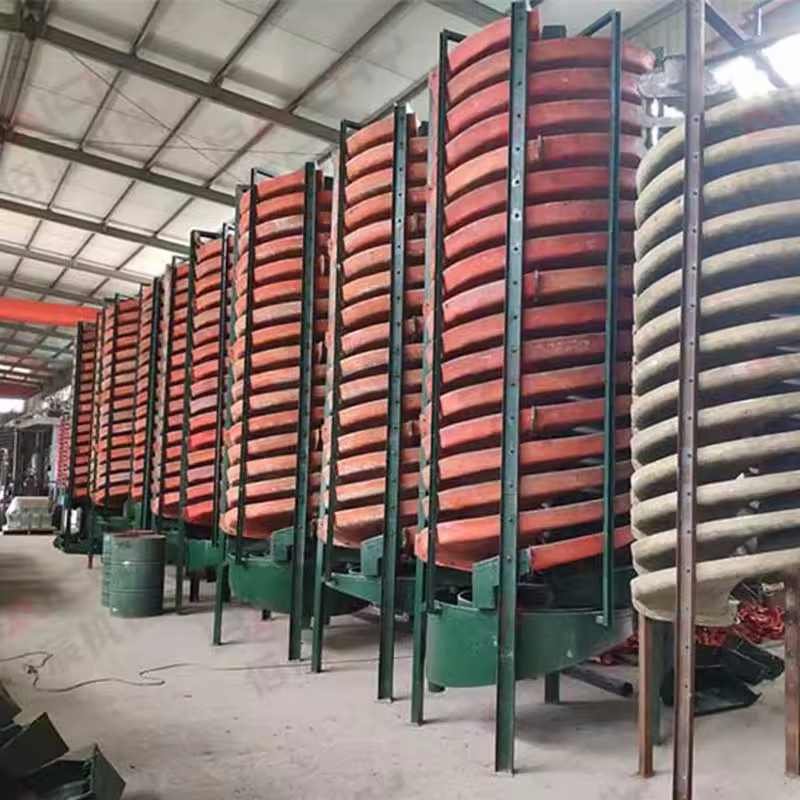
For sheer volume, durability, and operational simplicity, spiral concentrators are an undisputed champion. Spiral separators exploit both gravity and centrifugal force. As the slurry descends the helical chute, heavier particles hug the inner radius due to friction and specific gravity, while lighter particles are accelerated toward the outer rim by the centrifugal sweep of the water.
We recommend spirals as the Best gravity concentration equipment for massive, continuous bulk processing applications such as mineral sands, iron ore, and coal desliming. Because they possess absolutely zero moving parts, the maintenance requirements are virtually nonexistent. You truly have a “set-it-and-forget-it” system, provided your feed density and water wash ratios remain consistent.
To demonstrate the precision engineering involved in modern spirals, below are the technical specifications for our highly acclaimed Oromineral Gravity Spiral Concentrator line. Notice how the pitch and lateral slope are rigorously calibrated across varying diameters to optimize the separation of specific particle sizes.
Model | 5LL-2000 | 5LL-1500 | 5LL-1200 | 5LL-900 | 5LL-600 | 5LL-400 | |
Outside Dia. (mm) | 2000 | 1500 | 1200 | 900 | 600 | 400 | |
Pitch (mm) | 1200 | 800,680,540 | 720,540,360 | 660,540,400 | 450,360,270 | 240,180 | |
Lateral slope | 9° | 9° | 9° | 9° | 9° | 9° | |
External size | Length (mm) | 2300 | 1560 | 1360 | 1060 | 700 | 460 |
Width (mm) | 2300 | 1560 | 1360 | 1060 | 700 | 460 | |
Height (mm) | 6500 | 5230 | 5230 | 4000 | 2600 | 1500 | |
Starts/Turns per column | 4-2 | 4-2 | 4-2 | 4-2 | 2 | 2 | |
Feeding size (mm) | 4-0.04 | 0.8-0.037 | 0.3-0.03 | 0.3-0.03 | 0.2-0.02 | 0.2-0.02 | |
Feeding density (%) | 20-45 | 30-60 | 25-55 | 25-55 | 25-55 | 25-55 | |
Capacity (t/h) | 12-10 | 8-6 | 4-6 | 2-3 | 0.8-1.2 | 0.15-0.2 | |
Weight (KG) | 1100 | 800 | 600 | 400 | 150 | 50 | |
Properly configuring these spirals within your circuit often requires classifying the feed prior to entry. Understanding the sand washing plant working principle is essential for ensuring your spiral concentrators receive a properly deslimed and uniform feed.
3. Shaking Tables
When you need to achieve the absolute highest concentrate grade possible without utilizing toxic chemical leaching, the shaking table is unparalleled. Shaking tables operate by spreading a fan of slurry across an inclined deck equipped with parallel riffles. A motorized head motion drives the deck in a rapid, asymmetric reciprocating movement. Heavy particles settle behind the riffles and are “walked” longitudinally toward the concentrate discharge end, while the lighter gangue is washed laterally over the riffles by the cross-flowing wash water.
We view shaking tables as the definitive Best gravity concentration equipment for final cleaning stages. If your rougher spirals or centrifugal concentrators have produced a low-grade bulk concentrate, passing that material over a shaking table will easily upgrade it to a direct-smeltable product. They are notoriously slow, processing only 0.5 to 2 tons per hour per deck, but the visual separation accuracy is unmatched.
4. Mineral Jigs (Jigging Separators)
Mineral jigs handle what spirals and centrifuges cannot: coarse, bulky material. A jig operates by pulsing a bed of water up and down through a screen containing a layer of “ragging” (artificial heavy media like steel shot or dense rocks). As the water pulses upward, the mineral bed expands and fluidizes. As the water strokes downward, the particles settle based strictly on density. Heavy minerals plummet through the ragging and screen into the hutch below, while light waste rock is swept away over the tailboard.
From our experience, jigs represent the Best gravity concentration equipment for alluvial diamond mining and coarse placer gold operations. They excel at processing feed sizes from 5mm all the way up to 25mm. Their ability to handle high throughputs with massive, unliberated rocks makes them an indispensable roughing tool for primary aggregate sorting.
5. Multi-Gravity Separators (MGS)
As ore grades decline globally, the mining sector has been forced to process heavily disseminated ores that require ultra-fine grinding. Traditional gravity methods fail completely below 50 microns because the water’s viscosity overpowers the gravitational pull on the microscopic particles. Enter the Multi-Gravity Separator (MGS).
The MGS essentially wraps the flat surface of a shaking table into a rapidly rotating cylindrical drum. By spinning the drum, it creates an enhanced gravitational field that pins ultra-fine particles against the drum wall, while scrapers and wash water mimic the cross-flow action of a shaking table. We consider the MGS to be the ultimate, bleeding-edge tier of the Best gravity concentration equipment for recovering ultra-fine tin, chromite, and refractory gold lost in tailings ponds. When researching mining equipment manufacturers global, the presence of MGS technology in their catalog indicates a highly advanced, forward-thinking engineering firm.
6. Sluice Boxes
It would be a disservice to the history of mineral extraction to ignore the sluice box. While technologically primitive compared to a PLC-controlled continuous centrifugal concentrator, sluice boxes remain highly relevant. A sluice is an inclined trough lined with trapping mechanisms—such as riffles, expanded metal, and miner’s moss.
As slurry flows rapidly down the sluice, turbulent eddies form behind the riffles, creating low-pressure drop zones where coarse, heavy gold nuggets immediately settle and become trapped. We recommend sluices strictly for artisanal operations or as a secondary scavenging tool in remote, low-capital alluvial wash plants where access to electricity is completely nonexistent.
Expert Guide: Choosing the Right Equipment
Selecting the Best gravity concentration equipment is an exercise in rigorous metallurgical testing. You must never purchase machinery based on assumptions. We mandate that our clients perform extensive laboratory analysis to determine the specific gravity differential between the target mineral and the gangue, as well as the optimal liberation size.
If the density difference is less than 1.0 SG unit, gravity concentration alone will struggle. In these complex scenarios, hybridizing your circuit is essential. For instance, combining gravity separation with a robust magnetic circuit can drastically improve recovery of paramagnetic ores. We highly suggest reading our magnetic separation process guide and thoroughly understanding the magnetic separator machine working principle to see how these two environmentally friendly forces complement each other beautifully.
Finally, always size your equipment for surges. Bottlenecking a high-capacity grinding circuit with an undersized gravity classifier will permanently cripple your plant’s profitability.
Frequently Asked Questions (FAQs)
The Best gravity concentration equipment operates using only water, physical motion, and gravitational/centrifugal forces. It requires absolutely zero toxic reagents like sodium cyanide or sulfuric acid, eliminating the risk of catastrophic chemical spills and drastically simplifying tailings management.
Yes, but only if you use the correct machinery. Traditional sluice boxes and standard shaking tables will lose gold particles below 75 microns to the tailings. To capture ultra-fine “flour” gold (down to 5 microns), you must utilize enhanced gravity devices like high G-force centrifugal concentrators or Multi-Gravity Separators.
A spiral concentrator is a high-volume, low-cost roughing device with no moving parts, designed to process massive tonnages of ore efficiently. A shaking table is a low-volume, highly precise finishing device that uses mechanical vibration to clean rough concentrates up to a final, direct-smeltable grade.
Authoritative References
To ensure our clients have access to the highest level of peer-reviewed engineering data, we recommend consulting the following specialized resources:
- Sepro Mineral Systems: Choosing The Correct Gravity Separation Machine – An authoritative breakdown of high G-force centrifugal dynamics vs. standard gravity devices.
- FLSmidth (Knelson): Gravity Concentration Equipment – Extensive documentation on the engineering behind fluidized bed enhanced gravity concentrators.
- Multotec: How Does Gravity Concentration Equipment Work? – A comprehensive industry overview of spiral separator deployment across coal, iron ore, and mineral sand processing plants.