6 Best Non Ferrous Metal Separator Machines for Advanced Mineral Processing
By ORO Mineral
In the highly demanding sectors of mineral processing, metallurgy, and industrial recycling, achieving absolute material purity is the ultimate objective. The presence of unwanted non-ferrous and ferrous contaminants not only degrades the value of the final mineral concentrate but also causes catastrophic damage to downstream processing equipment. To mitigate these risks and maximize resource recovery, operators rely on advanced non ferrous metal separator machines. These specialized industrial systems utilize magnetic, electromagnetic, and physical properties to isolate valuable minerals from waste streams with unprecedented precision.
From our experience engineering solutions for the global mining industry, we understand that selecting the appropriate separation technology dictates the economic viability of an entire plant. As ores become more complex and particle sizes decrease, traditional separation methods fall short. Today, the best non ferrous metal separator machines integrate superconducting technology, high-intensity magnetic fields, and automated control systems to recover micron-sized particles that were previously lost to tailings. In this authoritative guide, we will analyze the technical specifications, operational advantages, and applications of the top 6 non ferrous metal separator machines currently leading the market.
Table of Contents
- 1. Understanding the Physics of Non Ferrous Metal Separation
- 2. Core Criteria for Evaluating Separation Equipment
- 3. The 6 Best Non Ferrous Metal Separator Machines
- 4. Integrating Separators into Mineral Processing Circuits
- 5. Summary Table: Non Ferrous Metal Separator Machines Comparison
- 6. Frequently Asked Questions (FAQs)
- 7. Industry References
1. Understanding the Physics of Non Ferrous Metal Separation
The term non ferrous metal separator machines encompasses a broad category of equipment designed to extract metals that do not contain significant amounts of iron. These include valuable elements such as copper, aluminum, zinc, gold, titanium, and rare earth elements. Because these metals do not respond strongly to standard permanent magnets, isolating them requires exploiting other physical properties, such as electrical conductivity, specific gravity, or paramagnetic susceptibility.
We recommend approaching mineral separation through a multi-stage methodology. Primary stages remove strongly magnetic tramp iron, while secondary and tertiary stages deploy highly sensitive non ferrous metal separator machines to separate weakly magnetic or non-magnetic valuable ores from gangue. Understanding these dynamics is critical for anyone looking to optimize their plant layout and improve recovery rates. For a broader perspective on the global supply chain of these technologies, you can review our insights on magnetic separator manufacturers worldwide.
2. Core Criteria for Evaluating Separation Equipment
From our experience, plant managers frequently make the error of purchasing non ferrous metal separator machines based solely on capital expenditure rather than technical suitability. When evaluating these complex systems, we recommend focusing on the following critical parameters:
- Magnetic Field Intensity: Measured in Gauss or Tesla, this determines the machine’s ability to capture weakly magnetic particles. High-intensity applications require at least 1.0 to 2.0 Tesla.
- Particle Size Limitations: Certain non ferrous metal separator machines excel at processing coarse aggregates (greater than 3mm), while others are engineered specifically for ultra-fine slurries (5-100μm).
- Throughput Capacity: The machine must align with your plant’s hourly tonnage requirements without causing bottlenecks.
- Energy Consumption: Advanced systems, such as superconducting magnets, offer immense field strengths with minimal electrical resistance, drastically lowering operational costs.
3. The 6 Best Non Ferrous Metal Separator Machines
Based on metallurgical recovery rates, energy efficiency, and industrial reliability, we have compiled the definitive list of the best non ferrous metal separator machines for modern processing facilities.
3.1 JF Series Low-temperature Super-conducting Magnetic Separator
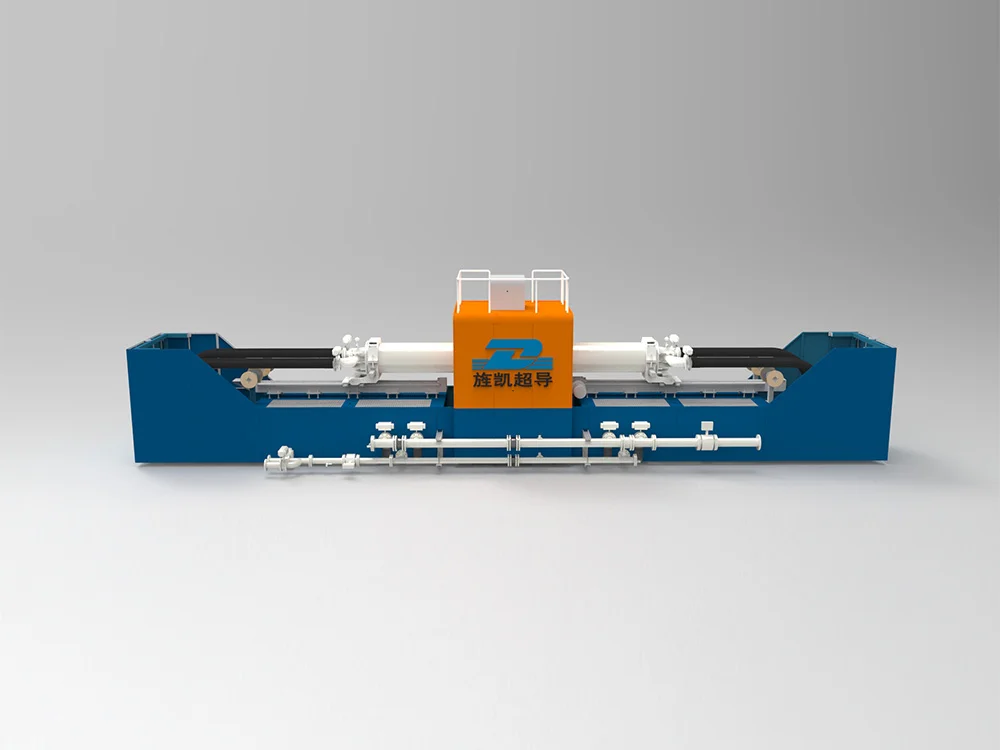
When dealing with highly refined industrial minerals like kaolin and bauxite, the removal of microscopic paramagnetic impurities (such as iron and titanium oxides) is essential for achieving high brightness and purity. The JF Series Low-temperature Super-conducting Magnetic Separator with Liquid Helium for Kaolin & Bauxite represents the absolute pinnacle of non ferrous metal separator machines.
This equipment features unparalleled technical advantages. By utilizing advanced liquid helium circulation, the cooling system maintains the internal coils in a superconducting state, resulting in near-zero electrical resistance. This allows the machine to generate an adjustable background field of 0 to 50,000 Gauss while keeping the total installed power under 20kW, an exceptionally energy-efficient design. The horizontal slurry flow pattern maximizes particle contact with a specialized steel wool matrix, making it specifically engineered for micron-sized mineral particles in the 5-100μm range. The continuous reciprocating design supports scalable processing capacities from 2.5 to 16 T/h, ensuring consistent, uniform magnetic field distribution and uninterrupted operation.
3.2 Wet High Intensity Magnetic Separator (WHIMS)

For operations processing wet slurries containing weakly magnetic minerals such as hematite, ilmenite, or wolframite, the WHIMS technology is indispensable. As one of the most reliable non ferrous metal separator machines on the market, our Wet High Intensity Magnetic Separator (Model WHIMS-002) is engineered for robust industrial performance.
This machine generates a magnetic field strength up to 2.0 Tesla (customizable based on ore characteristics) and efficiently handles feed particle sizes of ≤ 3mm. Depending on the specific configuration, it delivers a processing capacity of 1 to 50 t/h while maintaining a power consumption footprint between 5 and 50 kW. Constructed from Stainless Steel 304/316 with high-grade magnets and durable rubber linings, the WHIMS-002 is designed to withstand harsh, corrosive environments at operating temperatures up to 60 degrees Celsius. We recommend integrating this machine with PLC-based automation to precisely control separation parameters in real-time.
3.3 Advanced Eddy Current Separators (ECS)
Eddy Current Separators are the backbone of the recycling industry and are widely considered essential non ferrous metal separator machines for recovering aluminum, copper, and brass from shredded municipal solid waste or auto shredder residue (ASR). An ECS utilizes a high-speed alternating magnetic rotor housed within a non-metallic drum. As non-ferrous metals pass over the rotor, the alternating magnetic field induces electrical currents (eddy currents) within the metals. These currents create their own magnetic field, which violently repels the non-ferrous metals away from the inert materials (like plastic and glass) into a separate collection chute.
From our experience, the effectiveness of an ECS relies entirely on the rotational speed of the rotor and the pole configuration. Operators looking to integrate this technology must carefully calculate their return on investment. For detailed economic considerations, we suggest reviewing the factors that influence eddy current separator cost.
3.4 High-Tension Electrostatic Separators
In dry mineral sands processing (such as separating rutile from zircon), high-tension electrostatic separators are highly effective non ferrous metal separator machines. These systems exploit the difference in electrical conductivity between various minerals. The dry mineral feed is passed over a grounded rotating roll and subjected to a high-voltage corona discharge. Conductive particles (like rutile) rapidly dissipate their charge to the grounded roll and are thrown off by centrifugal force, while non-conductive particles (like zircon) retain their charge and remain pinned to the roll until physically brushed off.
We recommend electrostatic separation exclusively for perfectly dry environments, as any moisture on the particle surface alters its electrical conductivity and ruins the separation efficiency.
3.5 Dense Media Separation (DMS) Systems
While not relying on magnetism or electricity, Dense Media Separation relies on specific gravity, making it a crucial category within non ferrous metal separator machines. DMS involves suspending crushed ore in a heavy liquid medium (usually a mixture of water and ultra-fine ferrosilicon). Lighter gangue minerals float to the surface, while heavier valuable non-ferrous metalliferous minerals sink.
This technique is a staple in the pre-concentration phase, drastically reducing the volume of material that must be processed downstream. To understand how DMS fits into a broader operational context, we recommend exploring our comprehensive overview of mineral processing techniques and equipment.
3.6 Sensor-Based X-Ray Transmission Sorters
The future of non ferrous metal separator machines lies in sensor-based sorting. X-Ray Transmission (XRT) sorters blast raw crushed rock with X-rays. Dual-energy sensors detect the atomic density of each individual rock in milliseconds. If the sensor identifies a rock containing valuable non-ferrous metal, highly precise pneumatic air jets blast that specific rock off the conveyor belt into a recovery bin.
This technology is revolutionary for sorting complex scrap metal alloys and upgrading low-grade run-of-mine ores before they enter the energy-intensive milling and grinding circuits. It represents a massive leap forward in precision and resource conservation.
4. Integrating Separators into Mineral Processing Circuits
Procuring top-tier non ferrous metal separator machines is only half the battle; integrating them into a cohesive circuit is where true efficiency is realized. From our experience, the feed material must be properly prepared before it reaches the separation stage. If the ore is coated in clay or mud, it will severely hinder the performance of magnetic and electrostatic sensors.
We strongly recommend employing rigorous washing and scrubbing protocols prior to separation. To ensure your feed material is pristine, consult our sand washing methods guide and review the specifications of the latest sand washer machines industrial models. Proper desliming and classification will exponentially improve the recovery rates of your non ferrous metal separator machines.
5. Summary Table: Non Ferrous Metal Separator Machines Comparison
| Equipment Type | Primary Separation Mechanism | Target Materials | Optimal Particle Size | Key Advantage |
|---|---|---|---|---|
| JF Series Super-conducting Separator | Ultra-High Magnetic Field (Liquid Helium) | Paramagnetic impurities in Kaolin & Bauxite | 5 – 100 μm | Massive field strength with near-zero power loss (< 20kW). |
| WHIMS-002 | Wet High Intensity Magnetism | Hematite, Ilmenite, Wolframite | ≤ 3 mm | Robust wet processing up to 2.0 Tesla capability. |
| Eddy Current Separator | Induced Alternating Magnetic Fields | Aluminum, Copper, Brass from Scrap | 5 mm – 150 mm | Physical repulsion of non-ferrous metals from inert waste. |
| Electrostatic Separator | High-Tension Electrical Conductivity | Rutile, Zircon, Mineral Sands | 0.1 mm – 2 mm | Dry separation based on electrical conductivity differences. |
| Dense Media Separation | Specific Gravity / Density | Heavy Metalliferous Ores | 1 mm – 50 mm | Excellent pre-concentration bulk sorting method. |
| X-Ray Transmission Sorter | Atomic Density Detection via X-Ray | Complex Alloy Scrap, Low-Grade Ore | 10 mm – 120 mm | Individual particle precision using pneumatic ejection. |
6. Frequently Asked Questions (FAQs)
Why are superconducting magnets used in non ferrous metal separator machines?
From our experience, standard electromagnets consume massive amounts of electricity and generate excessive heat when attempting to reach high background fields. By using liquid helium to cool the coils to a superconducting state, machines like the JF Series can generate up to 50,000 Gauss with near-zero electrical resistance, making the operation incredibly powerful and energy-efficient.
Can an Eddy Current Separator remove stainless steel?
Generally, no. Most grades of stainless steel have very low electrical conductivity and are poorly magnetic, meaning they do not react strongly to the alternating magnetic fields generated by the rotor. Extracting stainless steel typically requires sensor-based sorting technologies or highly specialized, ultra-strong magnetic drum separators.
What is the maintenance requirement for a Wet High Intensity Magnetic Separator?
We recommend implementing a strict preventive maintenance schedule for WHIMS equipment. Because the slurry is highly abrasive, regular inspection of the stainless steel matrix, rubber linings, and flush valves is critical. Flushing the high-gradient matrix with high-pressure water during the backwash cycle is necessary to prevent permanent clogging by magnetic particles.
How does feed preparation affect the efficiency of these machines?
Separation efficiency is directly tied to a narrow particle size distribution. If the feed material contains a mix of large rocks and ultra-fine dust, the physical forces applied by the non ferrous metal separator machines will affect the particles inconsistently. Proper screening, grinding, and washing are non-negotiable prerequisites for high recovery rates.
7. Industry References
To ensure our clients have access to the most rigorous, scientifically validated data regarding mineral processing and environmental standards, we encourage reviewing the following authoritative sources:
- United States Geological Survey (USGS) – National Minerals Information Center: Provides comprehensive data on global mineral recovery rates and processing technologies.
- Environmental Protection Agency (EPA) – Sustainable Materials Management: Guidelines on industrial recycling efficiency, secondary material recovery, and electronic waste separation protocols.